Abstract
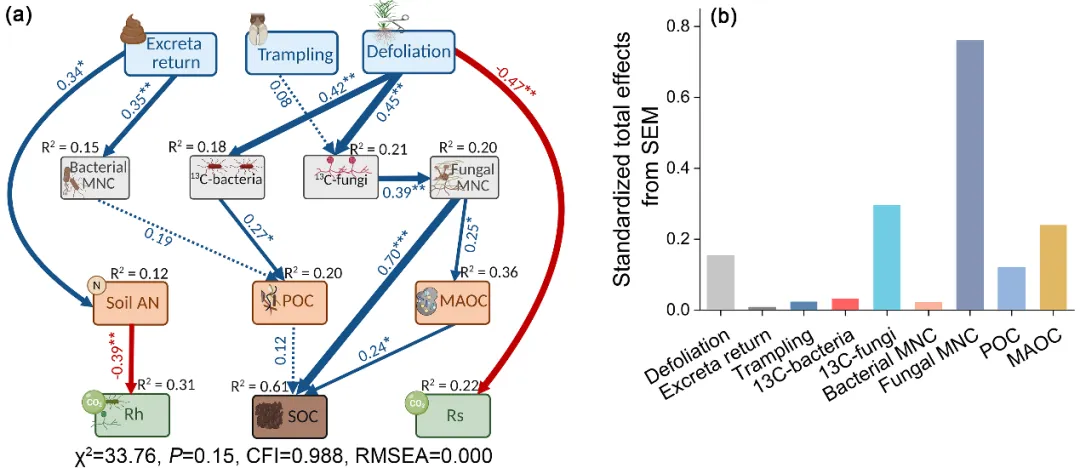
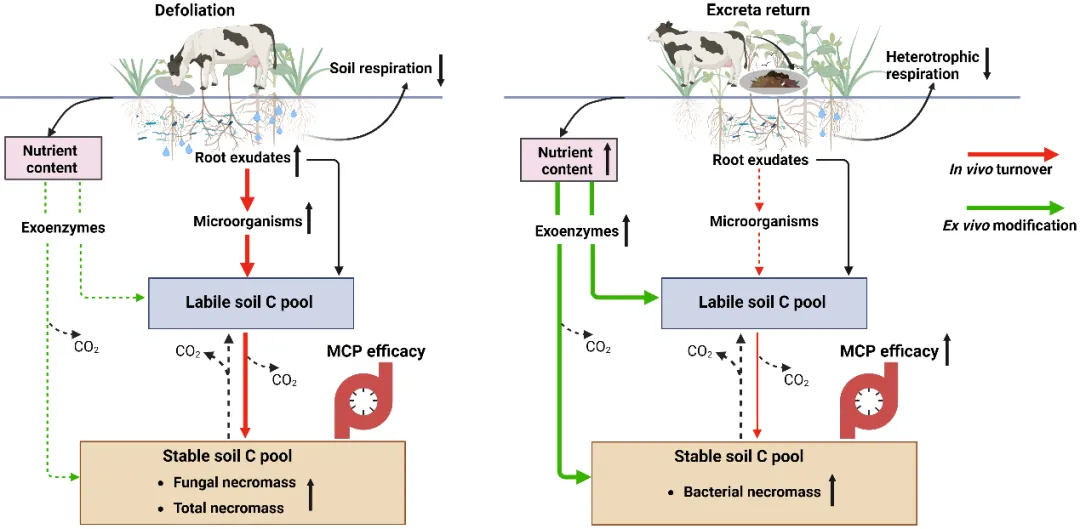
Ungulate grazing encompasses multiple components, including defoliation, trampling, and excreta return, all of which affect soil organic carbon (SOC) dynamics by influencing the balance between rhizodeposition and the subsequent C input and release. However, it remains unclear how ungulate grazing regulates SOC through living roots, especially as evidence from the field is lacking. A 13CO2 pulse labeling experiment was conducted on an 8-year simulated grazing field experiment, involving separate or combined treatments of defoliation, excreta return, and trampling from grazing animals. We investigated the fate of newly assimilated C in different soil C pools and quantified CO2 release under grazing treatments. Defoliation enhanced C assimilation in soil microorganisms and promoted fungal necromass formation, thereby increasing the microbial carbon pump (MCP) “capacity” (i.e., the net microbial necromass accumulation), contributing more C to SOC (+32%) and mineral-associated organic C (+34%) while reducing soil respiration (−19%). Excreta return stimulated C incorporation into bacterial necromass, enhanced MCP “efficacy” (i.e., the contribution of microbial necromass to SOC) and “capacity”, and reduced heterotrophic respiration (−19%). Significant interactions existed between defoliation and excreta return on 13C recovery of SOC and CO2: excreta return reduced the positive effect of defoliation on 13C recovery of SOC, while defoliation mitigated the inhibitory effect of excreta return on 13C recovery of CO2. Trampling increased the contribution of plant-derived C to particulate organic C (POC, +26%) and significantly interacted with defoliation by weakening its positive effect on 13C recovery of POC. This study advances our understanding of root-derived C formation and stabilization in grazing grassland by disentangling the effects of defoliation, excreta return, and trampling from ungulates. Our work offers new insights for optimizing management practices to effectively utilize the soil MCP for C sequestration in grasslands in response to global climate change. 1 Introduction Grasslands cover approximately 40% of the world's land surface and store 34% of the terrestrial carbon (C) stocks, playing a crucial role in soil C sequestration and in mitigating anthropogenic climate change by offsetting greenhouse gas emissions (Bai and Cotrufo 2022). Grassland soil C balance is determined by C inputs, primarily from living root-derived sources (Dijkstra et al. 2021), and C release through soil respiration, which includes autotrophic respiration from plant roots and heterotrophic respiration driven by soil microorganisms. Stable soil organic carbon (SOC) is formed by two main pathways: (1) Microorganisms assimilate root-derived C and produce microbe-derived organic compounds (in vivo turnover and entombing effect); (2) Transformation of macromolecular plant substrates with the modification of extracellular enzymes (ex vivo modification) (Huang et al. 2021; Liang et al. 2017). Soil microbial carbon pump (MCP), which governs the conversion of plant-derived C into stable SOC through microbial necromass accumulation (MCP “capacity”) and its proportional contribution to SOC (MCP “efficacy”), acts as a critical regulator of these pathways (Zhu et al. 2020; Chen et al. 2023). Nearly 50% of the world's grasslands are subject to grazing—a multifaceted disturbance encompassing defoliation, excreta return, and trampling, either individually or in combination—that can substantially alter SOC formation and turnover by modifying plant-derived C inputs and subsequent microbial processing via both in vivo and ex vivo pathways (Liu et al. 2015; Liang et al. 2017). However, long-term field experimental evidence is still lacking on how these complex grazing disturbances jointly mediate SOC dynamics by influencing both C formation and release processes. Defoliation by herbivores reduces aboveground biomass by removing plant tissue but can preferentially allocate resources belowground, promoting root growth, increasing root length or surface area, and further stimulating rhizodeposition (Huang et al. 2021; Zhang et al. 2023). The resulting high-quality root exudates, such as dissolved sugars, amino acids, and organic acids, are readily utilized by soil microorganisms (Stanley et al. 2024). Herbivore-induced defoliation may lead to disproportionate assimilation of rhizodeposition-derived C by soil microorganisms into organic C. For example, defoliation enhanced fungal assimilation (13C incorporation into the fungal community) (Wei et al. 2023), as fungi exhibit a greater capacity to acquire rhizodeposition C through mycelium action, resulting in more efficient biomass synthesis and residue production (Strickland and Rousk 2010). Stimulating microbial growth promotes greater microbial necromass accumulation in soil, thereby enhancing the “capacity” of the soil MCP (Liang et al. 2017). Rhizodeposits are continuously transformed into microbial residues via microbial turnover and are thought to primarily contribute to the slow-cycling mineral-associated organic C (MAOC) pool, ultimately stabilized in the soil (Huang et al. 2021). Rhizodeposition after defoliation may promote soil microbial activity, leading to higher heterotrophic respiration, consequently partially offsetting SOC sequestration (Wang, Bicharanloo, et al. 2021). Meanwhile, the reduction in root biomass due to defoliation may decrease soil respiration, but the resulting increase in surface soil temperature caused by the lowered canopy height may counteract this effect by enhancing soil respiration (Li et al. 2024). The net balance between rhizodeposition-driven C stabilization and CO2 efflux resulting from herbivore defoliation remains poorly quantified, and long-term field experimental evidence is lacking. In comparison, the return of dung and urine from ungulate herbivores, compared to ungrazed conditions—particularly the increase in soil available nitrogen (N)—may decrease rhizodeposition because it is no longer necessary to stimulate microbial mining for N from SOC decomposition, potentially leading to a reduction in heterotrophic respiration (Bicharanloo et al. 2022; Craine et al. 2007). Yet, other research also reported that rhizodeposition either increased or remained unchanged with higher N availability, potentially due to a simultaneous increase in root biomass (Bicharanloo et al. 2022; Bowsher et al. 2018). In addition, excreta return by grazing animals may enhance extracellular enzyme activity due to the input of exogenous nutrients (Wang et al. 2024). Soil microorganisms break down or convert macromolecular plant substrates into smaller components by secreting extracellular enzymes through ex vivo modification, thereby facilitating the accumulation of plant-derived C in the soil (Liang et al. 2017). Moreover, enhanced nutrient availability from excreta return may improve microbial carbon use efficiency (CUE), optimizing the conversion of plant-derived C into microbial necromass and thus increasing MCP “efficacy” (Stanley et al. 2024; Yang et al. 2024). Despite these contrasting findings, the overall influence of ungulate excreta on rhizodeposition and associated microbial processes remains unresolved, revealing a critical knowledge gap in our understanding of how herbivore-mediated excreta return regulates belowground C cycling.

 10个月宝宝每天需要喝多少奶粉?

