顶刊写作解构 | Ecological Indicators 如何用“多维度分解+空间轨迹追踪+PLS-R网络建模”讲透农业碳排放效率的“黑箱”解构与“掩盖效应”
栏目导语:本期拆解一篇2026年4月发表于 Ecological Indicators 的论文。作者以长江经济带为案例,构建了方向性距离函数(DDF)+标准差椭圆(SDE)+偏最小二乘回归(PLS-R)的集成框架,对农业碳排放效率进行多维度分解,揭示了单因子效率的结构性分化与系统驱动机制。关键发现:总要素效率呈非线性演变,中游资源效率下降产生“空间拖拽效应”;结构分解暴露严重生态不对称——劳动和机械效率因技术替代快速提升,而化肥和灌溉效率陷入“低值锁定”,形成资本驱动数据掩盖深层资源强度的“掩盖效应”;PLS-R识别了城镇化与城乡收入差距驱动的技术替代,以及山地地形破碎化导致的“规模悖论”。研究为全球农业流域提供了可转移的生态诊断协议。你将收获:①摘要“方法集成+掩盖效应+空间拖拽”的高效结构;②引言“从黑箱评估到因子解构、从掩盖效应到规模悖论”的递进批评逻辑;③可直接套用的顶刊级学术语料库。
论文基础信息
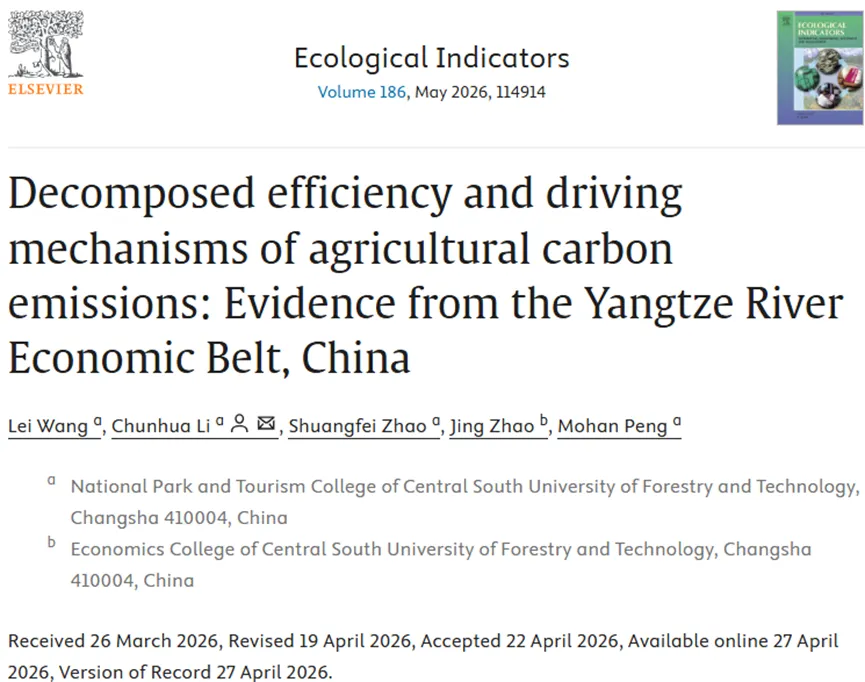
通讯作者:Chunhua Li (中南林业科技大学)
发表期刊:Ecological Indicators(SCI-Q1)
发表时间:2026年4月27日
核心关键词:agricultural carbon emission efficiency; efficiency decomposition; driving mechanisms; DDF; PLS-R; Yangtze River Economic Belt
核心概念缩写注释:
ACEE:Agricultural Carbon Emission Efficiency,农业碳排放效率;
DDF:Directional Distance Function,方向性距离函数,用于多维度因子分解;
SDE:Standard Deviational Ellipse,标准差椭圆,用于轨迹追踪;
PLS-R:Partial Least Squares Regression,偏最小二乘回归,用于复杂网络建模;
“掩盖效应(Masking Effect)”:资本驱动因子的效率提升在统计上掩盖了资源密集型因子的低效锁定
论文DOI:10.1016/j.ecolind.2026.114914
一、Abstract深度解构与写作赏析
摘要原文逐句拆解标注版
Under the context of global climate change, reconciling food security with low-carbon development poses a complex spatial data challenge for agricultural basins worldwide. Existing evaluations of Agricultural Carbon Emission Efficiency (ACEE) typically rely on aggregate indicators, treating the agricultural sector as a “black box” and lacking the computational resolution to reveal structural ecological trade-offs among internal production factors.(研究背景与行业语境+理论缺口/研究空白锚定:农业碳排放效率评估依赖聚合指标,将农业视为“黑箱”,缺乏揭示内部生产要素间结构性生态权衡的计算分辨率)
To overcome this data limitation, this study constructs a high-resolution computational decomposition framework applied to the Yangtze River Economic Belt (YEB), China (2003−2022). By integrating the Directional Distance Function (DDF) for multi-dimensional factor deconstruction, Standard Deviational Ellipse (SDE) for trajectory tracking, and Partial Least Squares Regression (PLS-R) for complex network modeling, we systematically uncover the spatiotemporal dynamics and systemic drivers of ACEE.(研究核心内容与设计:DDF+SDE+PLS-R集成框架,长江经济带2003-2022)
The results demonstrate that: (1) Total-factor efficiency evolved nonlinearly, and SDE tracking visualizes a spatial drag effect driven by the decline in resource efficiency in the mid-stream regions. (2) The structural decomposition exposes a severe ecological asymmetry: while labor and machinery efficiencies improved rapidly due to technological substitution, fertilizer and irrigation efficiencies remained in a state of low-value lock-in. This reveals a critical “Masking Effect” in current agricultural transformations, where capital-driven data statistically conceals deep-seated resource intensity. (3) PLS-R modeling identifies systemic spatial trade-offs: urbanization and the urban-rural income gap drive technological substitution, while spatial heterogeneity—manifested as land fragmentation in mountainous terrains—induces a “Scale Paradox” that hinders ecological economies of scale.(核心研究发现/结果:三点——①中游资源效率下降导致空间拖拽效应;②劳动/机械效率快速提升,化肥/灌溉效率低值锁定,揭示“掩盖效应”;③城镇化与城乡收入差距驱动技术替代,山地地形破碎化导致“规模悖论”)
This study provides a transferable data deconstruction and diagnostic protocol for evaluating multidimensional ecological performance in global agricultural basins.(研究理论贡献+实践意义:可转移的数据解构与诊断协议)
摘要核心逻辑框架与可复用模板
写作逻辑链条:
ACEE评估黑箱化、缺乏因子分解分辨率(背景+缺口)→ 方法(DDF+SDE+PLS-R集成框架)→ 发现1(非线性演化+中游空间拖拽)→ 发现2(掩盖效应:劳动/机械快增,化肥/灌溉低值锁定)→ 发现3(城镇化/收入差距驱动技术替代,地形破碎化导致规模悖论)→ 意义(可转移诊断协议)
高分亮点设计:
“掩盖效应”的概念提炼:资本驱动因子掩盖资源密集型因子低效。
“空间拖拽效应”的可视化:中游资源效率下降拖累整体。
“规模悖论”的识别:山地地形破碎化阻碍生态规模经济。
DDF+SDE+PLS-R三方法集成:方法创新。
二、Introduction深度解构与写作赏析
第一段:农业的双重使命与碳排放挑战
(段落功能:宏观背景铺垫——气候变化下农业面临粮食安全与碳减排的双重矛盾;促进碳减排和低碳经济发展是国际社会共同目标,也是联合国2030议程核心要求;农业是基础产业,既是粮食安全保障,也是重要温室气体排放源;IPCC第六次评估报告显示全球粮食系统贡献约1/3人为GHG排放;若无定向减排,仅农业排放就可能使全球变暖无法控制在1.5°C目标内;中国是农业大国,农业仍是关键碳源;提高农业碳排放效率(“脱钩”产量增长与碳强度)成为实现双碳目标的关键路径)
Global climate change presents a defining challenge for modern agriculture: the sector must fulfill the dual, often conflicting, mandates of ensuring food security for a growing population while rigorously curbing greenhouse gas (GHG) emissions. Promoting carbon abatement and low-carbon economic development is not only a shared goal of the international community but also a core requirement of the United Nations 2030 Agenda for Sustainable Development. As a foundational industry, agriculture plays a dual role: it ensures food security while simultaneously acting as a significant source of greenhouse gas (GHG) emissions. According to the Sixth Assessment Report of the IPCC, global food systems contribute approximately one-third of anthropogenic GHG emissions. Without targeted mitigation, agricultural emissions alone could prevent global warming from being limited to the 1.5 °C target, even if fossil fuel use were completely halted. For China, a major agricultural nation, agriculture remains a critical carbon source. Enhancing Agricultural Carbon Emission Efficiency (ACEE)—essentially “decoupling” yield growth from carbon intensity—has thus become the pivotal pathway for realizing the nation‘s “Dual Carbon” goals.(农业双重矛盾;IPCC数据;ACEE关键)
第二段:长江经济带作为“自然实验室”的典型性
(段落功能:区域聚焦——长江经济带是研究这些挑战的理想“自然实验室”;覆盖中国约21.4%国土面积、>40%人口和GDP;其战略意义不仅在于总体规模,更在于显著的内部异质性——从下游长三角高度城市化、资本密集型平原到上游破碎化、劳动依赖型山地,压缩了多种农业景观;这种空间梯度——现代集约农业与传统小农实践并存——意味着整体效率评估可能掩盖局部的要素分配扭曲)
The Yangtze River Economic Belt (YEB) serves as an ideal “natural laboratory” for examining these challenges. Recent evidence underscores the critical role of the YEB‘s ecological policies in balancing human development with environmental protection. Spanning China’s eastern, central, and western regions, the YEB covers approximately 21.4% of China‘s land area and contributes over 40% of its population and GDP. However, the strategic significance of the YEB extends beyond its aggregate scale to its pronounced internal heterogeneity. The region compresses China’s diverse agricultural landscapes into a single belt: from the highly urbanized, capital-intensive plains of the Yangtze River Delta downstream to the fragmented, labor-dependent mountainous terrains upstream. This distinct spatial gradient—characterized by the coexistence of modern intensive farming and traditional smallholder practices—means that holistic efficiency evaluations may obscure significant localized distortions in factor allocation.(YEB数据;内部异质性;整体评估局限)
第三段:现有研究的“黑箱”局限与“掩盖效应”的理论缺口
(段落功能:研究缺口锚定1——现有文献存在“黑箱”局限;整体评估将农业效率视为均质聚合,隐含假设所有生产要素同步优化;这种“聚合偏差”无法捕捉内部结构性分化——特别是“现代化因子”(机械、资本)的快速效率提升如何在统计上补偿并掩盖“资源基础因子”(化肥、水)的停滞或恶化)。此外,驱动机制识别存在方法论挑战,传统单变量模型孤立处理效率指标,无法捕捉农业生产网络内在的系统性权衡)
However, a critical theoretical gap remains: the “Masking Effect” in efficiency evolution has been largely overlooked. Existing literature on ACEE often suffers from a “black box” limitation. Holistic evaluations predominantly treat agricultural efficiency as a homogeneous aggregate, implicitly assuming synchronous optimization across all production factors. This “Aggregate Bias” fails to capture the internal structural divergence—specifically, how the rapid efficiency gains in “modernization factors” (e.g., machinery, capital) may statistically compensate for, and thus mask, the stagnation or deterioration of “resource-based factors” (e.g., fertilizer, water). Furthermore, identifying driving mechanisms faces methodological challenges, as traditional univariate models typically treat efficiency indicators in isolation, failing to capture the systemic trade-offs and synergies inherent in the agricultural production network.(“黑箱”批评;聚合偏差;掩盖效应;方法挑战)
第四段:本文的方法集成与三点贡献
(段落功能:本文研究目标与解决路径——从“全要素评估”转向“多维度因子分解”,整合DDF、SDE、PLS-R,系统解构2003-2022年YEB的ACEE时空格局与驱动机制。三点边际贡献:①方法集成与指标开发——开创可转移的计算框架,提取单因子效率指标(E1-E6),从单变量评估转向识别复杂农业网络中的系统性生态权衡;②揭示“掩盖效应”与“规模悖论”——实证揭示资本驱动指标(机械、劳动)的效率增长在统计上掩盖了深层资源强度(化肥、灌溉赤字);空间异质性分析揭示地形破碎化如何诱导“规模悖论”,阻碍山地生态规模经济;③可视化“空间拖拽”的全球适用性——利用空间轨迹追踪可视化中游资源低效对整体的空间拖拽效应,为其他农业流域提供可转移的诊断协议)
To bridge these gaps, this study attempts to shift the perspective from “Total-Factor Assessment” to “Multi-Dimensional Factor Deconstruction“. Integrating the Directional Distance Function (DDF), Standard Deviational Ellipse (SDE), and Partial Least Squares Regression (PLS-R), this paper systematically deconstructs the spatiotemporal patterns and driving mechanisms of ACEE in the YEB from 2003 to 2022. This study makes three marginal contributions: (1) Methodological Integration and Indicator Development: We pioneer a transferable computational framework that extracts a novel suite of high-resolution, single-factor efficiency indicators (E1–E6) using the DDF. By coupling this with SDE and PLS-R modeling, we transition from simple univariate assessments to identifying systemic ecological trade-offs within complex agricultural networks. (2) Uncovering the “Masking Effect” and “Scale Paradox”: Our indicator deconstruction reveals a critical structural asymmetry in China‘s agricultural transition. We provide empirical evidence that rapid efficiency gains in capital-driven indicators (machinery and labor) statistically mask deep-seated resource intensity (fertilizer and irrigation deficits). Furthermore, spatial heterogeneity analysis exposes how topographical fragmentation induces a “Scale Paradox” that hinders ecological economies of scale in mountainous terrains. (3) Visualizing “Spatial Drag” for Global Applicability: We utilize spatial trajectory tracking to visualize how mid-stream resource inefficiency exerts a “spatial drag” on the overall basin. This integrated framework serves as a transferable, indicator-based diagnostic protocol. It allows policymakers in other global agricultural basins (e.g., in the Global South) to precisely identify whether their agricultural performance is driven by genuine technological progress or merely high-emission factor substitution.(三点贡献;掩盖效应;规模悖论;空间拖拽)
引言核心逻辑框架与写作范式
写作逻辑闭环:
第一层:农业面临粮食安全与碳减排双重矛盾,ACEE是双碳关键(背景)
↓
第二层:YEB作为“自然实验室”,内部异质性显著,整体评估掩盖局部扭曲(区域聚焦)
↓
第三层:现有研究“黑箱”局限——聚合偏差无法捕捉因子间结构性分化,且传统单变量模型无法捕捉系统权衡(缺口)
↓
第四层:本文方法(DDF+SDE+PLS-R)+三点贡献(掩盖效应揭示、规模悖论识别、空间拖拽可视化)(方案)
研究缺口锚定技巧:作者采用 “黑箱聚合+单变量方法”的双层批评:
顶刊级亮点设计:
IPCC数据的有力引用:粮食系统贡献1/3人为GHG排放。
“即使是粮食系统单独就可能使1.5°C目标无法实现”的警示。
YEB“自然实验室”的定位:21.4%国土、>40%人口GDP。
“掩盖效应”的概念创新:资本驱动因子掩盖资源因子低效。
“规模悖论”的识别:地形破碎化阻碍生态规模经济。
三点贡献的平行结构。
三、可复用写作语料库
摘要写作专属语料
研究缺口/不足表述类
“Existing evaluations of ACEE typically rely on aggregate indicators, treating the agricultural sector as a ‘black box’ and lacking the computational resolution to reveal structural ecological trade-offs among internal production factors.”(黑箱+缺乏因子分解分辨率)
方法创新类
“We construct a high-resolution computational decomposition framework integrating DDF for multi-dimensional factor deconstruction, SDE for trajectory tracking, and PLS-R for complex network modeling.”(DDF+SDE+PLS-R集成)
核心发现类
“Mid-stream resource efficiency decline creates spatial drag effect. Labor and machinery efficiency improved rapidly while fertilizer and irrigation efficiency remained low-value locked-in, revealing a ‘Masking Effect’. Urbanization and urban-rural income gap drive technological substitution; land fragmentation induces a ‘Scale Paradox’.”(空间拖拽;掩盖效应;规模悖论)
政策意义类
“Provides a transferable data deconstruction and diagnostic protocol for evaluating multidimensional ecological performance in global agricultural basins.”(可转移诊断协议)
引言写作专属语料
农业双重矛盾类
*“Global food systems contribute approximately one-third of anthropogenic GHG emissions. Without targeted mitigation, agricultural emissions alone could prevent global warming from being limited to the 1.5 °C target.”*(IPCC数据;警示)
YEB典型性类
*“The YEB covers 21.4% of China’s land area and contributes over 40% of its population and GDP, compressing diverse agricultural landscapes from capital-intensive plains to fragmented mountainous terrains.”*(YEB数据+内部异质性)
黑箱批评类
“Holistic evaluations treat agricultural efficiency as a homogeneous aggregate, assuming synchronous optimization across all factors, failing to capture how rapid gains in modernization factors may statistically mask stagnation of resource-based factors—a ‘Masking Effect’.”(黑箱+掩盖效应)
单变量模型批评类
“Traditional univariate models treat efficiency indicators in isolation, failing to capture systemic trade-offs and synergies inherent in the agricultural production network.”(单变量模型局限)
三点贡献类
“First, methodological integration extracting single-factor efficiency indicators. Second, uncovering the ‘Masking Effect’ and ‘Scale Paradox’. Third, visualizing ‘Spatial Drag’ as a transferable diagnostic protocol.”(三点贡献)
写作核心总结:这篇Ecological Indicators论文可以借用的3个写作套路
摘要的“方法集成+掩盖效应+规模悖论”三重结构:先点明DDF+SDE+PLS-R的方法集成;再用“劳动/机械快增、化肥/灌溉低值锁定”的对比揭示“掩盖效应”;最后用“城镇化/收入差距驱动技术替代”与“地形破碎化导致规模悖论”的对比收尾。从“怎么测”到“什么被掩盖”到“为什么”,逻辑递进。
引言的“黑箱聚合+单变量方法”双层批评法:先批评整体评估的“聚合偏差”——将农业视为均质黑箱,无法捕捉现代化因子快速提升掩盖资源因子低效的“掩盖效应”;再批评传统单变量模型孤立处理效率指标,无法捕捉系统性生态权衡。两层批评分别对应本文的方法创新(DDF单因子分解)和建模创新(PLS-R网络建模)。
“掩盖效应”与“规模悖论”的概念创新:第三段明确提出“Masking Effect”——资本驱动因子的效率增长在统计上掩盖了资源密集型因子的低效锁定;第四段提出“Scale Paradox”——山地地形破碎化阻碍生态规模经济。这两个概念精准概括了研究发现,具有跨区域的可迁移性,也为政策干预提供了直接靶点,是顶刊论文中“从数据到概念”升华的典型技法。