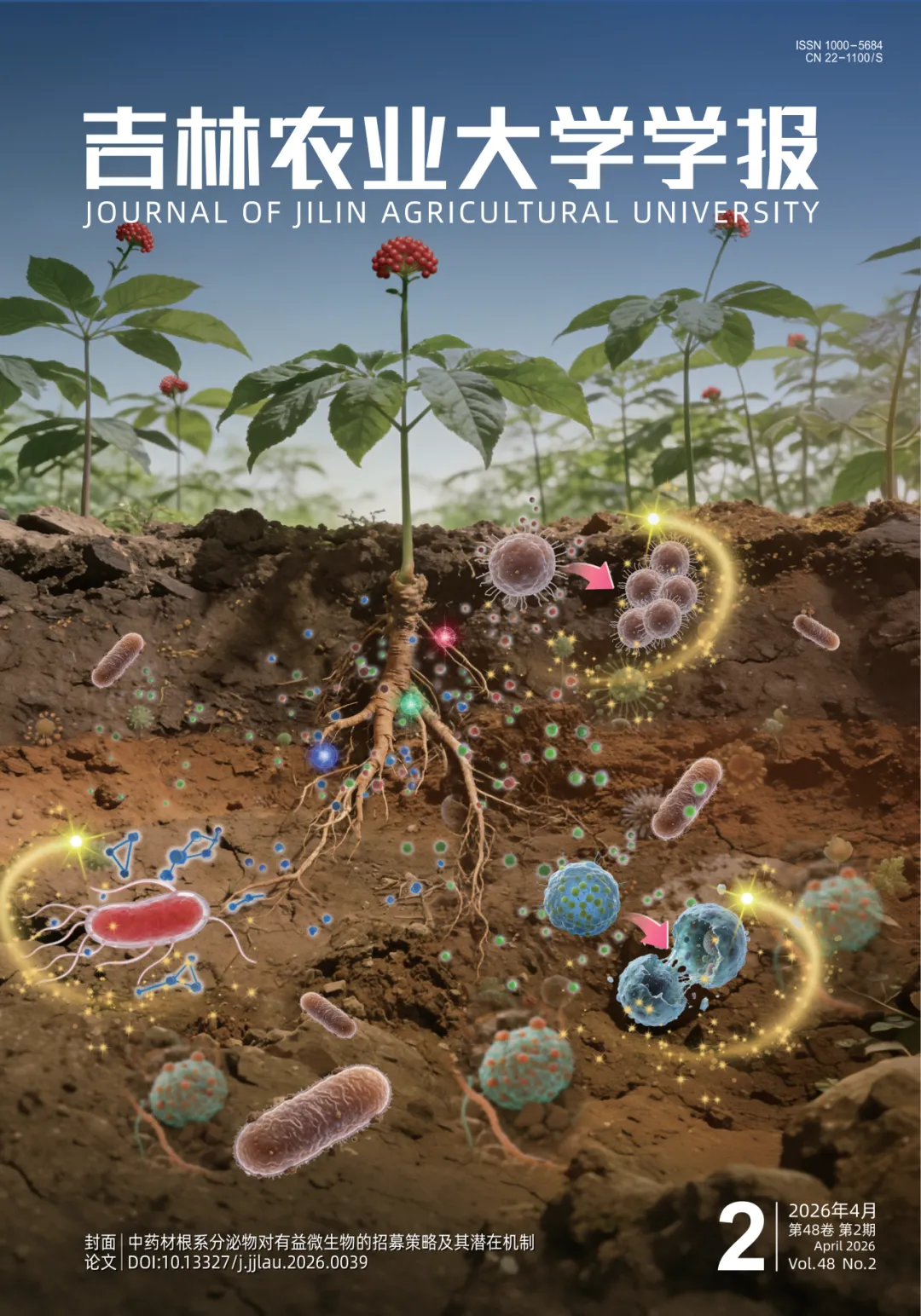
当前位置:首页>农业>封面文章 | 中国农业科学院特产研究所孙海,张亚玉等:中药材根系分泌物对有益微生物的招募策略及其潜在机制

封面文章 | 中国农业科学院特产研究所孙海,张亚玉等:中药材根系分泌物对有益微生物的招募策略及其潜在机制

  • 2026-05-17 02:06:03
封面文章 | 中国农业科学院特产研究所孙海,张亚玉等:中药材根系分泌物对有益微生物的招募策略及其潜在机制

吉林农业大学学报

第2期

第48卷

作者及单位

孙海,邵财,王秋霞,张亚玉*

中国农业科学院特产研究所,吉林省中药材种植(养殖)重点实验室,长春130112

基金信息

吉林省自然科学基金项目(YDZJ202601ZYTS317)

摘要&关键词

摘要: 根系是中药材感知和抵御逆境的重要器官,微生物为土壤中物质转化提供动力,其中根系分泌物作为二者的沟通物质,会影响中药材的生长和发育。中药材生长过程中会面临一系列的生物和非生物胁迫,逆境下中药材能通过释放根系分泌物等途径招募有益微生物,增强自身的抗病能力和对逆境的适应能力。综述了逆境条件下中药材根系对有益微生物招募的生态效益及其潜在机制,阐释“根系分泌物-土壤微生物-次生代谢产物”路径的调控途径及内在驱动力,以期为中药材的生态种植提供科学依据。

关键词: 中药材;根系分泌物;次生代谢产物;招募作用

正文

根系是中药材与土壤环境直接接触的部位,是中药材水分和养分吸收的主要器官[1-2]。中药材多数为多年生植物,其品质和产量与生长环境密切相关。当生长过程中受到生物和非生物胁迫时,中药材通过调节自身的生理代谢来对抗不利的生长环境。在整个生长过程中,中药材通过长期的共同进化,与多种微生物形成了密切的共生关系,这个过程通过动态调节自身生理代谢、能量转换、资源分配和抗逆性机制等,以应对不利的生境条件[3]。其中,根系与土壤微生物互作是中药材适应环境、提升抗逆性和形成道地性的关键[4]。近年来,随着根际微生态学的发展,根系分泌物在中药材种植中的作用日益受到重视。

根系分泌物是指在特定环境下,植物通过根系的不同部位释放到根际环境中的有机物质的总称,是一种复杂的非均一体系[5]。根系分泌物是植物在生长过程中主动释放的有机化合物,包括初级代谢产物和次级代谢产物[6]。这些化合物在植物与微生物的相互作用中起着至关重要的调节作用,通过改变根际土壤的化学环境,调控根际微生物的组成和功能,其主要招募策略:一是功能时序调控,不同年生不同生育期植物生长需求不同,通过根系分泌物信号招募或调控功能微生物[7];二是胁迫响应招募,由于无法移动躲避不利环境,中药材通过分泌核苷酸类成分,选择性地招募抗性微生物,协同抵御逆境[8];三是空间定殖策略,通过根部凯氏带泄漏谷氨酰胺等氨基酸,吸引假单胞菌等有益菌在根部定殖[9];四是“呼救”信号,当遭受病原菌侵染时,植物通过分泌特定根系分泌物吸引抗病微生物或是作为信号分子招募有益菌,进而增强抗病性[10]。中药材通过根系分泌物与微生物进行跨界交流,响应环境变化。

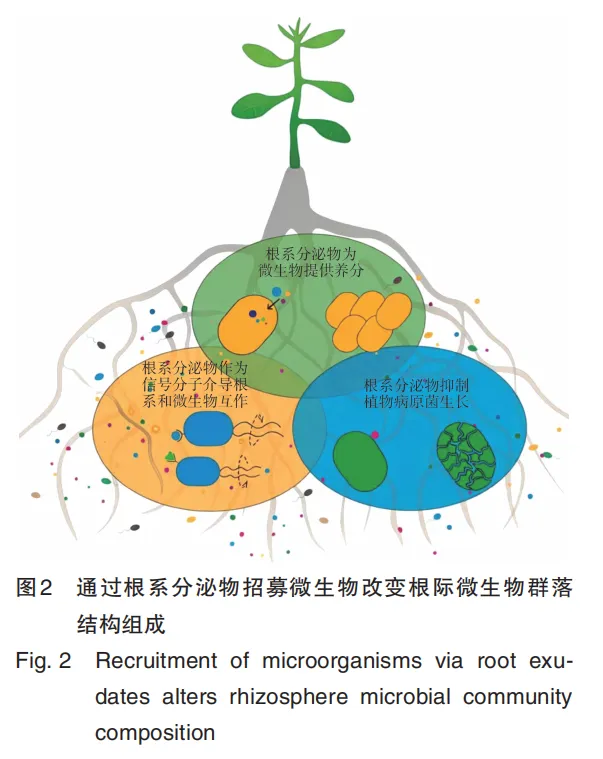
根系分泌物不仅作为营养物质吸引有益微生物,同时还作为信号分子选择性地招募或抑制特定的病原微生物群体,充当中药材与土壤的沟通媒介,从而动态地塑造根部相关微生物生态系统的结构和功能,进而增强植物的营养吸收和免疫反应[11]。中药材根系分泌物含有特定的次生代谢产物,通过调控微生物群落组成和集群进化,进而影响中药材免疫应答反应及品质形成。这种“根分泌物-微生物群落-代谢途径”的正反馈机制研究成为中药材生态栽培构建的新策略。

1

中药材根系分泌物的组成

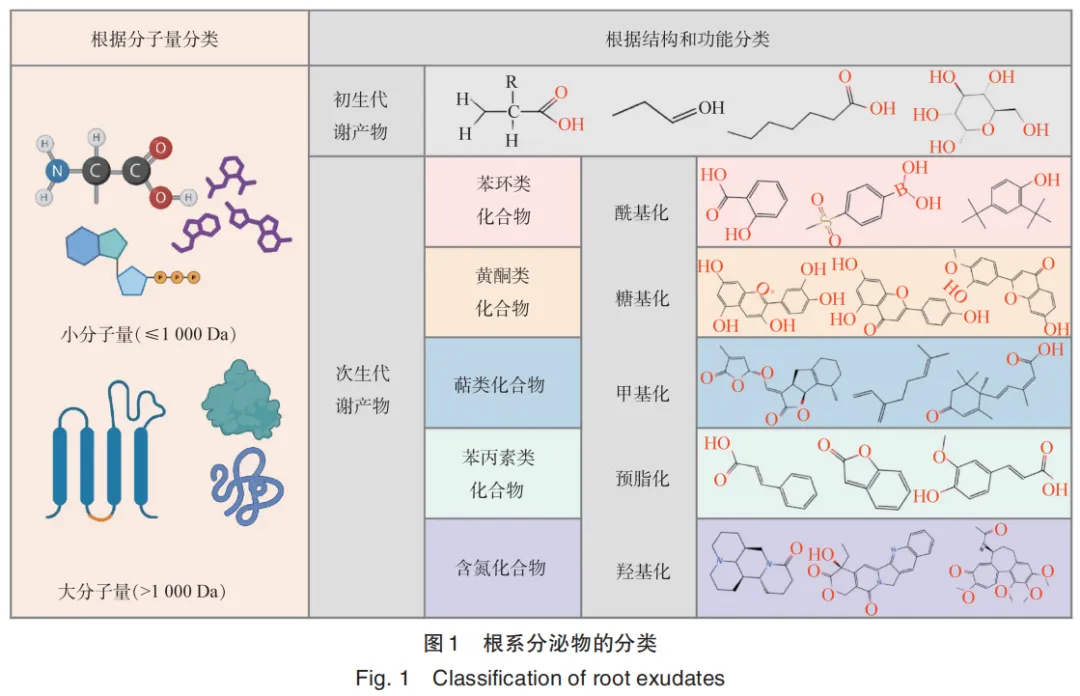
植物根系(特别是边缘细胞)在根系生长和凋亡沉积过程中会分泌大量的代谢物质[12]。目前已有20余万种代谢物被鉴定,但仍有大量的代谢物结构和功能尚未鉴定。广义的根系分泌物包括渗出物、分泌物、黏胶质和裂解物[13]。这些代谢物包括糖类、氨基酸和有机酸等初级代谢产物,以及萜类化合物、黄酮类化合物、维生素等次生代谢产物[14]。按分子量大小可以分为低分子量化合物(LMW)和高分子量化合物(HMW),低分子量化合物主要包括有机酸、氨基酸、糖分和次生代谢产物,而高分子量化合物包括黏液和蛋白质等。虽然根冠边界细胞是主要的分泌点,但其他根细胞通过膜转运蛋白同样会释放代谢物。这些代谢物不仅支持根系细菌群落的繁衍,同时还作为信号转导物质影响根际细菌基因表达和群落结构组成[15]。其丰度和成分因植物基因型、发育阶段、环境条件以及生物(根层群落、根类共振、植物病原体、土壤生态)和非生物(极端温度、干旱、盐度、重金属)因素的影响而有所差异[16]。越来越多的研究证实,可以通过改变基团的数量和位置,实现碳骨架的修饰,促使根系分泌物的结构和功能不断变化。最典型的是由聚酮化合物(Polyketides)和C5类异戊二烯单元融合形成的特定碳骨架,可因碳原子数的不同和含氮化合物的形式不同存在于植物根系分泌物中。类似的根系分泌物包括类黄酮、萜烯、苯丙素类、苯环类化合物和含氮化合物,其经历了糖基化、酰基化、甲基化、羟基化和异戊二烯化一个或多个修饰反应,导致在原始碳骨架及其修饰的衍生物之间具有相似的生物活性或毒性特征[17]。总之,根系分泌物的结构组成和功能解析需要不断整合有关结构修饰信息。根系分泌物的分类[18],见图1。

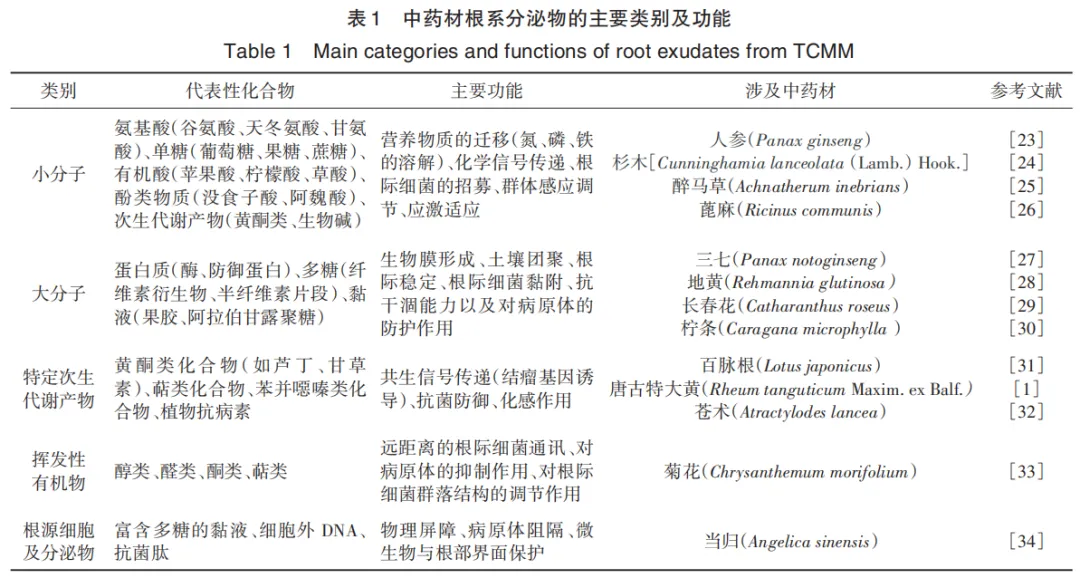
中药材根系分泌物在调节自身生长发育、土壤养分供给及招募微生物方面起着重要作用(表1)。一是通过分泌有机酸等小分子物质活化土壤养分,中药材一般为多年生植物,需要在同一地点生长多年,生长过程中通过根系分泌有机酸等小分子物质促进土壤难溶态养分的活化,保证自身养分,同时某些特定根系分泌物含有特定的碳源和氮源,对一些有益微生物具有招募作用,如人参根系分泌物可以招募枯草芽孢杆菌、链霉菌等有益微生物的增殖,增强抗病性[19];二是当中药材遭遇生物或非生物胁迫时,会通过根系分泌更多的酶、黏液、特定次生代谢产物及挥发性物质,以增强自身抗逆性,如菊花因含有萜类、酚类、醇类等多种挥发性成分,对大肠杆菌、金黄色葡萄球菌、变形链球菌、铜绿假单胞菌等多种病原微生物,具有显著的抗菌和驱离作用,其抗菌作用并非归因于单个成分和机制,而是细胞内多组分协同、多途径和多靶点作用的结果[20-21];三是根系分泌物分泌某些多糖及黏液,形成防御生物膜和团聚体等,进一步通过招募有益微生物,打造根际防御屏障,保持根际水分的同时,增强养分吸收和防病能力。值得注意的是,根系分泌物对于中药材来说是一把“双刃剑”,当一些根系分泌物过度积累则会出现“自毒现象”,直接影响中药材的下一代生长,出现“连作障碍”现象,这也是人参、三七等中药材种植难、成本高的原因之一[22]

2

根系分泌物对微生物的招募作用

及机制

中药材根系周边栖息着大量的微生物和无脊椎动物,使其环境极为复杂。植物利用根系分泌物从庞大的土壤微生物群落中吸引特定的有益微生物[35],见图2。根际有益微生物主要包括五大类功能:促进营养元素活化、产生植物激素、分泌信号物质、合成挥发性成分及合成抗生素[36]。已有研究证实,植物光合碳同化产物的5%~21%被作为根系分泌物参与到调控根际微生态网络[37]。不同的根系分泌物招募的目标微生物群体不同,采取的策略也不同。首先,根系分泌物为微生物提供了丰富的碳源和能源,从而增强了土壤微生物的活性。研究表明,根系分泌物中的多糖和氨基酸等可以促进抗病性土壤微生物群落形成,增加假单胞菌等有益微生物的数量[38]。其次,根系分泌物可以通过改变土壤的理化性质,如pH和氧化还原电位,形成生物膜等方式,间接抑制病原菌的生长[39]。此外,根系分泌物中的某些特定成分,如信号分子,可以直接吸引特定的有益微生物,建立植物与微生物的共生关系。如豆科植物的根系分泌物能够特异性地吸引根瘤菌,促进固氮作用。随着非靶向和靶向代谢组学和微生物组学研究的完善和成本的下降,目前豆科作物和主要粮食作物根系分泌物对微生物的招募策略和机制的研究相对清晰,而在中药材上的研究尚处于起步阶段。由于中药材具有多年生、次生代谢产物丰富的特点,独特的根系分泌物对有益微生物的招募策略和机制更为复杂[40]。因此,基于“根系分泌物-土壤微生物-代谢调控”路径探讨根系分泌物招募有益微生物对中药材品质的反馈作用研究成为新范式。

2.1  根系分泌物招募微生物的生态效应

2.1.1 提高土壤养分供给能力  根系活动在调节土壤功能和营养代谢方面所起的关键作用已成为地下生态研究的核心焦点[41],而中药材根系分泌物通过招募有益微生物直接或间接提高土壤养分供给能力。值得注意的是,根系不仅吸收营养物质,还会向周围土壤释放多种低分子量的含碳化合物,这些物质显著影响着微生物的生物量和活性,并在土壤有机物分解和营养循环等微生物过程中发挥着关键作用[42]。根系分泌物中含有丰富的碳源和氮源,为有益微生物提供碳氮营养物质。这类根系分泌物主要以糖类、氨基酸为主,吸引有益微生物在中药材根际富集。丹参根系分泌的萜类化合物,不仅可以吸引丛枝菌根真菌(AMF),还能为其生长提供所需营养,促进共生关系形成[43]

根系还可以分泌某些小分子物质,作为化学信号引诱微生物在中药材根系定殖。如一些有机酸、氨基酸和糖类等可与有益微生物表面的受体结合,诱导其向根部定向移动并定殖。人参根系分泌的酚酸类物质作为拮抗剂和信号分子,可以特异性招募芽孢杆菌属等有益菌定殖和活动[19]。黄芪根系分泌的黄芪多糖等物质可以招募假单胞菌属等有益菌,这些菌能产生铁载体,促进黄芪对铁元素的吸收,同时分泌磷酸酶活化土壤有机磷[44]。甘草根系分泌的甘草酸等化合物,可吸引AMF并扩大根系吸收范围,提高甘草对氮、磷、钾等养分的吸收效率[45]。此外,中药材在遭遇养分胁迫时,通过根系分泌物改变土壤pH,创造适宜有益微生物生长的环境,选择性地招募一些有益微生物。中药材通过以上途径不仅成功招募有益微生物,还协同微生物提高养分供给能力,维持生态系统稳定和健康。

不同生育期的中药材根系分泌物呈现出规律性变化,中药材生长旺盛期(营养生长为主)根系分泌物是以有机酸和氨基酸为主的初生代谢产物,而成熟至衰老阶段根系分泌物是以胺类和苯类为主的次生代谢产物。不同生育期根系分泌物招募的微生物也不同,唐古特大黄在生长旺盛期主要招募以贝杰林克氏菌科、丙酸杆菌科、鞘氨醇单胞菌科和拟茎点霉科等为主的有益微生物,而TRA3-20和假青霉科等病原微生物则受到胺类和苯类的抑制;衰老阶段根系活性成分合成能力显著下降,此时有益微生物丰度显著下降[1]

2.1.2 提高中药材抗非生物胁迫能力  中药材生长过程中除了面临养分匮乏等问题外,还会面临高温、水淹、干旱、重金属毒害等非生物胁迫,影响中药材生长及次生代谢产物的积累[46]。根是中药材与土壤直接接触部分,可优先招募有益微生物并提高非生物胁迫适应能力。当中药材遭遇非生物胁迫时,根系分泌物起到重要作用。研究发现,酚类、类黄酮、萜烯和苯甲酸甲酯等根系分泌物,既可以作为营养物质又可以作为化学引诱剂,选择性地招募有益微生物[47]。在这一过程中,根系分泌物作为中药材与微生物互作的群体感应信号发挥作用,增强中药材抗病性。人参、地黄等均存在连作障碍现象,其本质是中药材连续种植导致土壤微生物群落结构组成紊乱,病原微生物占据优势生态位所致[22]。地黄遭受病原微生物侵害时,与钙信号途径、免疫调节系统及程序性死亡相关的基因被诱导上调表达,PR1以及一系列与激素信号转导相关的基因在外源添加根系分泌物介导下显著上调表达,持续促进地黄的免疫反应,最终导致一系列的抗病防御反应[28]。如盐生植物补血草通过根系分泌棕榈酸、2-甲基丁酸、硬脂酸等有机酸,招募弯曲芽孢杆菌KLBMP 4941定殖,KLBMP 4941可有效促进光合作用,增加渗透调节剂含量,提高类黄酮含量及抗氧化酶活性,调节Na+/K+稳态,帮助补血草降低盐胁迫损害[48]。白芷变种(Angelica dahurica var. formosana)通过分泌黄酮和黄酮醇成分诱导假单胞菌等有益菌定殖,目的是促进有效氮磷钾的供给,保证自身的生长发育[49]。同时,中药材根际土壤养分含量、根际微生物及内生菌构成的根际微生态直接影响中药材的品质。砂仁根系分泌物主要是苯类化合物、脂质、有机酸及其衍生物、有机杂环化合物及莽草酸和苯丙素,这些根系分泌物能够招募变形菌门和担子菌门微生物定殖,同时抑制酸杆菌门和绿弯菌门物种的生长[50]。当归根际土壤养分及黄杆菌、窄养单胞菌和副球菌等微生物直接影响当归氨基酸、短肽及其衍生物的合成[34]。而白车轴草(Trifolium repens L.)在遭受重金属胁迫时,根系通过分泌L-脯氨酸和豆甾醇促进细杆菌属的增殖和细胞膜形成,达到招募和富集的目的[51]。不同种类和强度的非生物胁迫因素对中药材生长的压力不同,这些压力通常会改变中药材的新陈代谢并使活性氧(ROS)积累。为了增强对不利环境的适应能力,中药材会调整自身生理代谢并促进特定次生代谢物质积累,而这些代谢物又会通过根系分泌物对特定微生物进行招募,形成动态平衡。干旱胁迫下,蒙古黄芪根长、株高、干鲜质量均呈下降趋势,而黄芪甲苷等成分显著增加。进一步通过共网络分析并结合可培养微生物分离,构建了简单的合成菌群,该菌群可以有效增强蒙古黄芪适应活性氧毒害的能力并减轻细胞膜的氧化程度,但蒙古黄芪根系与土壤微生物间是否通过根系分泌物进行沟通还需进一步证实[41]。此外,中药材还可以吸引和招募特定内源微生物以缓解环境胁迫,内源微生物通过次生代谢产物及信号分子等途径适应环境变化和病原微生物侵袭[52]。三七内生真菌克氏链孢霉可以将重金属砷(As)封存于细胞壁内,以增强三七对重金属As的耐受性,同时激活抗氧化防御系统,并促进解毒、转运(ABC,HMA,GST)以及应激响应转录因子(bZIP,MYB,WRKY)相关基因的表达[53]

2.1.3 强化对生物胁迫的应对能力  中药材生长过程中不仅会遭受非生物胁迫,还会遭受病虫害等生物胁迫。由于中药材生长过程不能移动躲避病虫害,只能通过改变自身生理代谢途径提高抗性,其中通过根系分泌物招募有益微生物是其应对生物胁迫的重要策略[54]。根系分泌物强化生物胁迫的策略主要有通过招募有益微生物竞争生态位、诱导系统抗性及拮抗、驱离病虫害。丹参能分泌β-榄香酸特异性物质作为信号分子招募类芽孢杆菌,这些微生物通过竞争生态位及诱导系统抗性(ISR),进而影响中药材的品质[55]。有益微生物不仅会影响中药材的根系分泌物组成,还会重塑根系微生物群落结构组成和集群进化方向。玄参有益微生物弗雷德里克森氏木霉菌属(SR338)刺激玄参根系产生L-谷氨酰胺、2,6-二氨基丙酸、羟基肉桂酸等有益代谢物。同时提高有益微生物地表多样囊霉、格木慢生根瘤菌以及米曲霉的丰度,降低圆核腔菌、结节副孢子菌以及栗疫病菌丰度[56]。值得注意的是,中药材招募微生物也存在盲目性,西洋参生长过程中可以向土壤中释放包括F11,Rb1,Rb2,Rc,Rd,Re和Rg1等皂苷,这些皂苷可以提高土壤中菌恶疫霉菌(Phytophthora cactorum)、畸雌腐霉(Pythium irregulare)等多种西洋参病原菌的比例,进一步增加土传病害风险[57]

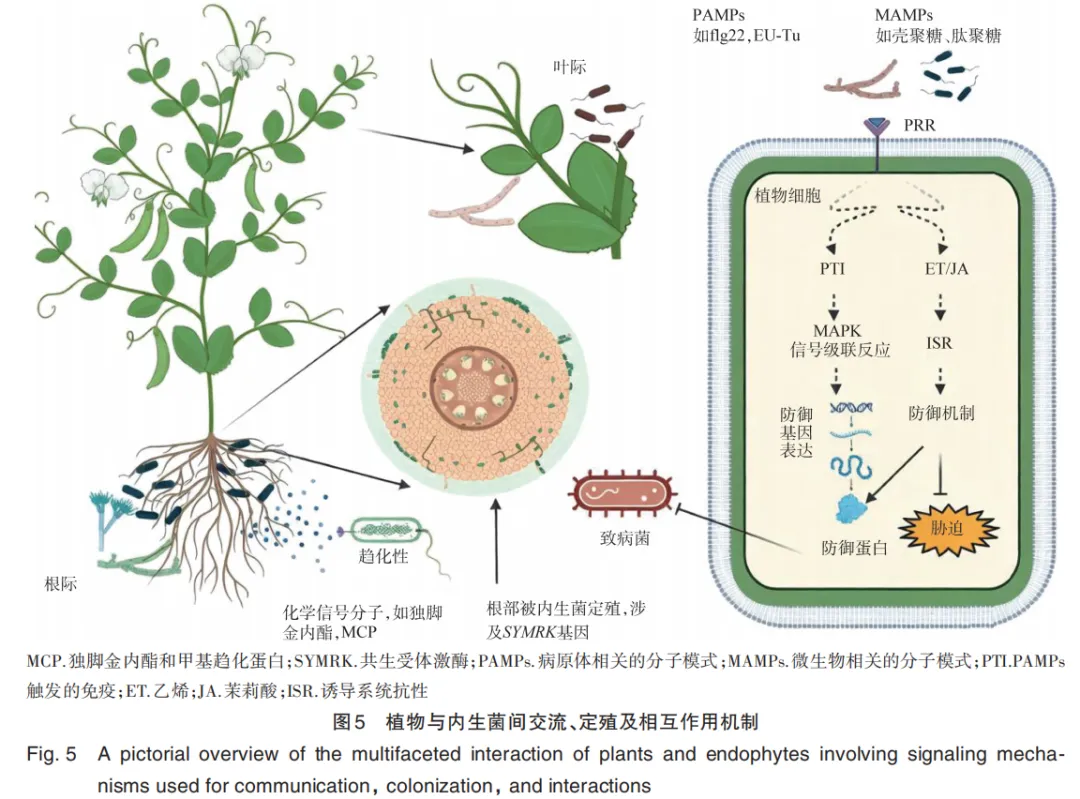
在对抗虫害方面,中药材根系分泌物发挥着间接防御作用。部分分泌物成分如挥发性萜烯、生物碱类不仅可以吸引昆虫天敌,也可以驱离地下害虫,同时还能诱导根际有益菌竞争生态位。三七根系分泌物黄酮类物质能够抑制有益微生物的生长,但是三七遭遇斜纹夜蛾(Spodoptera litura)啃食时,会促进叶片中茉莉酸(JA)的积累和防御化合物的产生,同时抑制根部黄酮类物质的分泌,进而间接促进有益微生物的富集,这些有益微生物能够阻止害虫侵害并增强三七的抗虫性[58]。此外,健康中药材根际微生物群落能增强植株整体抗逆性,降低害虫的侵袭。中药材通过根系分泌物招募有益微生物是一个级联放大的系统反应。根系分泌物能够促进关键养分利用,从而建立生理屏障和抗逆防御系统,这一过程涉及激素响应(如SA,JA以及ABA)和防御基因诱导表达过程,最终实现中药材免疫增强并提高对各种生物和非生物胁迫抗性[59]。与动物不同,植物免疫缺乏专门的免疫细胞和适应性免疫系统,完全依赖于结构、分子和生化防御组成的复杂且多层次的免疫反应系统。在该免疫系统中,由磷、钾、钙等元素组成的角质层、细胞壁等构建了中药材的第一道屏障系统,如人参生长中适度提高钙含量可增强植物强度及抗性。当第一道屏障系统被破坏时,分子防御系统通过2种途径被激活:模式识别受体(Pattern recognition receptors,PRRs)识别病原体相关分子模式(Pathogen-associated molecular patterns,PAMPs)和效应物触发免疫反应(Effector-triggered immunity,ETI)。这些分子会被位于植物细胞表面的模式识别受体(PRRs)识别[49]。这种相互作用会激活一个信号传导级联反应,从而启动防御反应,包括产生活性氧物质(ROS)、钙离子(Ca2+)内流、一氧化氮(NO)积累以及生理代谢调控反应。

根系分泌物也会对中药材产生不利影响,当中药材遭受逆境胁迫时会非靶向诱导根系分泌物的产生,部分根系分泌物的过度积累不仅起不到驱离病虫害的作用,甚至会主动引诱一些病原微生物定殖,影响中药材的生长。如蒙古黄芪连续种植中,由于土传病害根腐病的发生,诱发蒙古黄芪分泌2-氨基酚、奎宁酸、酒石酸和马来酸酯物质,这些物质在拮抗锈腐菌的同时,也会抑制蒙古黄芪的生长[60]

2.2 根系分泌物对微生物的招募机制

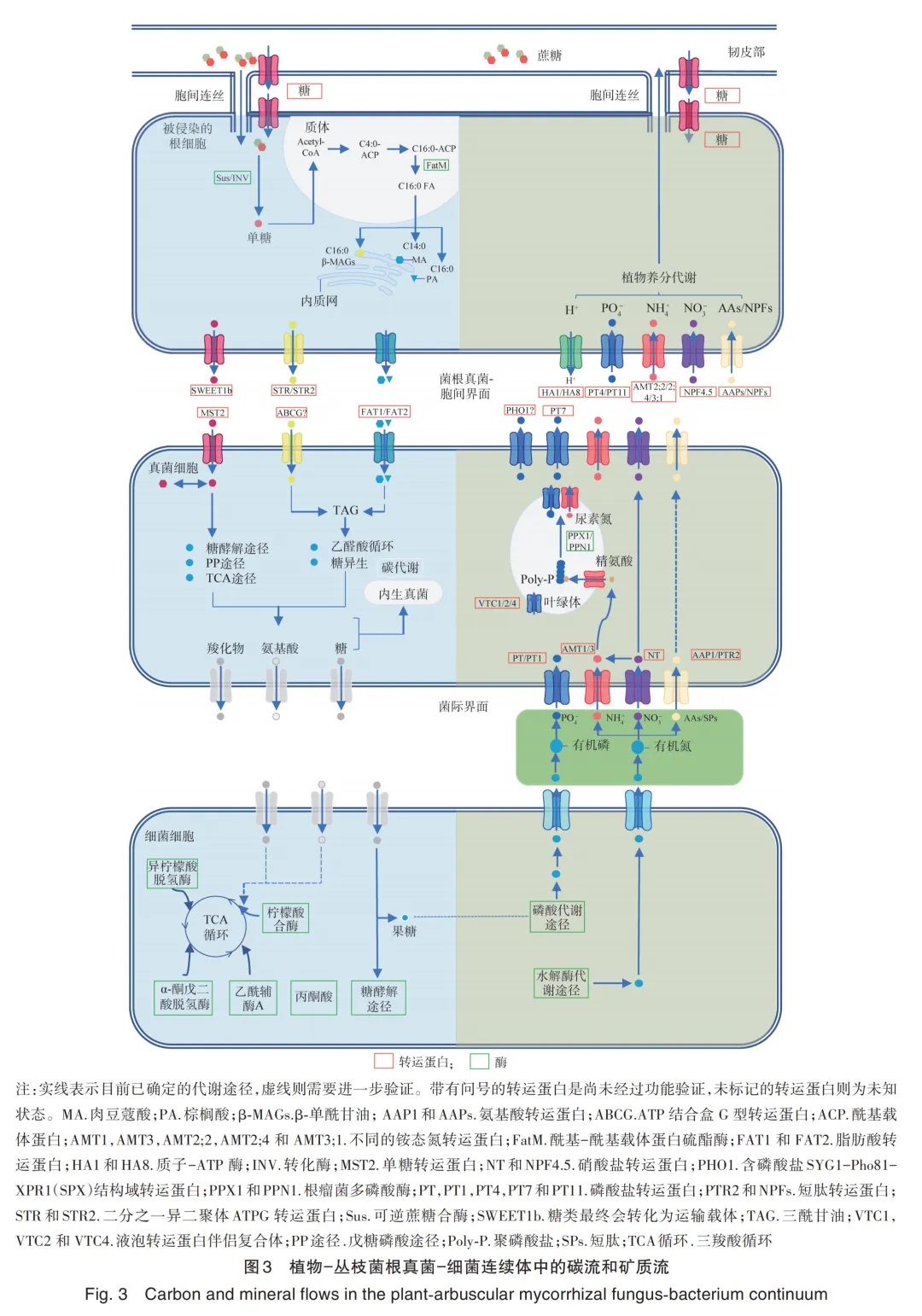
2.2.1 基于互利共生效应的招募机制  根系分泌物是中药材和土壤微生物进行物质交换和信息传递的重要载体,更是介导中药材响应生物胁迫和非生物胁迫的关键。中药材通过根系分泌的大分子物质为土壤微生物提供赖以生存的物质基础,同时微生物作为土壤生态系统中物质循环的原动力,为中药材保证养分需求,二者实现互利共生。最新研究表明,细菌参与丛枝菌根真菌(AMF)-植物共生体,特定的细菌生活在 AMF 内部,与AMF定殖于植物根系[61],见图3。该共生体是由连续体中自上而下的碳流和自下而上的矿质流(尤其是氮和磷)绑定所致。一方面,约6%的植物净光合产物以糖类和脂肪酸的形式作为丛枝菌根真菌及参与细菌的碳代谢物质,以弥补微生物不能从土壤中获取的养分需求。具体来说,光合产物中约6%以糖类和脂肪酸形式分泌至根际,供丛枝菌根真菌(AMF)作为碳源,通过糖酵解、TCA循环等形式满足能量需求,或在外部菌丝中通过糖异生和乙醛酸循环将甘油三酯转化为糖类并通过外部菌丝分泌,而细菌利用AMF分泌的糖类物质进行TCA循环和糖酵解途径,完成自上而下的碳代谢流。另一方面,细菌体内将果糖通过磷酸代谢途径和水解酶代谢途径,将有机磷和有机氮转化为无机氮和无机磷,AMF通过高亲和氮磷转运蛋白并运输至根部,以无机离子或小肽的形式供植物吸收利用,完成氮磷代谢流自下而上的运输。在该共生体中,本质是植物利用光合产物通过细菌和真菌换取自身生长所需的氮磷等矿物质营养。碳流自上而下驱动微生物代谢,矿物质营养自下而上反哺植物生长,构成一个自组织、自维持的生态连续体。

2.2.2 基于“求救信号”的群体感应机制  当中药材遭遇胁迫时,会通过根系分泌物招募目标微生物。群体感应是细菌通过调节基因表达来约束自身行为的机制,这种机制是基于对细菌群体密度的响应而实现的(图4)。根系分泌物除了实现中药材和微生物营养互补作用外,还能通过分泌模拟群体感应信号的化学物质影响细菌群落结构组成[62]。N-酰基羟赖氨酸(AHLs)是小信号分子代表之一,在细菌通讯中起着至关重要的作用,尤其是在群体感应的背景下。AHLs招募细菌在中药材根际形成生物膜、级联信号扩增等方面起着重要作用。如白芷(Angelica dahurica)通过根部分泌AHL类信号分子,影响白芷的抽薹和开花过程[63]

中药材大多为多年生植物,生长过程长期暴露于胁迫环境中,直接导致中药材体内积累大量代谢副产物活性氧(ROS)。ROS在中药材逆境胁迫时发挥双重作用,低浓度时作为氧化信号分子调控中药材生长发育和胁迫应急响应,而高浓度时则引发氧化应激反应,导致细胞损伤甚至程序性死亡。当非生物应激反应升高至毒性水平时,中药材通过调节自身生理反应合成一系列次生代谢产物以抵御不断变化的环境条件。研究发现,在拟南芥中呼吸爆发氧化酶同源物D(Respiratory burst oxidase homolog D,RBOH-D)编码基因上调表达,促使ROS水平升高,促进假单胞菌(Pseudomonas anguilliseptica)的根系定殖和体内5-氨基乙酰丙酸(5-ALA)编码基因的过表达,而5-ALA具有显著的促生作用。同时,P. anguilliseptica能显著抑制软腐病的发生。逆境胁迫会促使植物产生“求救信号”,而ROS等次生代谢产物作为信号分子主动招募有益微生物定殖,增强抗病性并促进生长[65]。根系分泌物作为群体感应信号招募有益微生物并为实现中药材“以菌治菌”提供新思路。

2.2.3 基于平衡拮抗的共生机制  药用植物生长环境是包括细菌、真菌及动物等多种生物栖息的微环境,这些生物之间形成既相互影响又互相约束的复杂生物群落[66],特别是根内生菌对于中药材健康生长至关重要。Schulz和Boyle[67]在2005年提出了平衡拮抗(Balanced antagonism)这一术语,指出内生菌的共生关系是依据有效交流和环境条件从积极的相互作用(共生)到消极的相互作用(拮抗)转变。各种类型的微生物可以侵入宿主植物并作为“短暂内生菌”发挥作用,这一过程涉及根系分泌物的产生和对微生物的招募作用。那些长期存在于宿主植物中的微生物则会同化寄主的遗传和生理特征,被称为“真正的共生体”[68]。内生菌与植物的共生关系由植物的基因型和内生菌种类共同决定。

内生菌与植物之间的相互作用主要通过2种方式实现:诱导产生不同的化学物质以及改变基因表达。宿主与内生菌互作是包含植物激素、挥发性有机化合物(VOCs)和植物次生代谢产物在内的复杂信号通路途径[69],见图5。某些内生细菌能够产生IAA,从而促进根部生长及营养吸收。如信号分子一氧化氮和ROS能够调节免疫反应并促进共生关系[70]。此外,内生菌还会改变植物对养分的吸收以及植物的稳态,进而调控植物的代谢。在内生菌与植物互作改变基因表达方面,植物利用检测和识别内生菌分子的化学感应系统,诱导一系列的信号转导途径实现改变植物的代谢过程及防御机制[71]。因此,整合转录组学和代谢组学,揭示根与病原微生物相互作用背后的调控网络,对复杂的“宿主-根系分泌物-病原微生物”相互作用进行系统性探索,将有助于揭示中药材与微生物间平衡拮抗共生机制并制定生态种植方案。

3

根系分泌物在中药材生态种植中

的应用

根系分泌物对有益微生物的招募作用在中药材生态种植中具有广泛的应用前景。首先,通过调控根系分泌物的种类和数量,可以优化根际微生物群落结构,提高中药材的抗病能力和品质。一些中药材在受到病原菌侵染时,会释放特定的根系分泌物,招募有益微生物来抑制病原菌的生长。其次,利用根系分泌物与有益微生物的相互作用,可以开发新型的微生物肥料和生物防治剂,减少化学农药的使用,提高中药材的安全性和品质。此外,依据根系分泌物在不同物种间的互利共生效应,构建中药材与其他作物的间作、套作生态种植模式,有助于实现中药材的可持续生产。

中药材具有生长周期长且对环境要求高的特点,依据“中药材-微生物-土壤”间的正负反馈效应,特别是根系分泌物对土壤微生物的招募及其效应,是逐步建立中药材可持续发展的关键。人参属植物均具有严重的连作障碍现象,其中锈腐菌是人参锈腐病的主要病原,而人参和东北天南星在原生境下属于伴生植物。生产实践中通过人参和东北天南星间作可以有效降低人参锈腐菌(Fusarium solaniIlyonectria robusta)的丰度。其原因是东北天南星的根系分泌物中生物碱和黄酮类成分均对2种病原有显著的抑菌效果[72]。同样,桔梗和韭葱间作可以缓解韭葱连作障碍,其原因是间作种植下可以提高根际总代谢物及含硫化合物等有益的次生代谢产物,促进根际假单胞菌、硝化螺旋菌、拟杆菌等与氮固定相关以及抑制病原菌或激素合成密切相关的有益微生物增加。同时,间作模式下细菌、真菌比例增加,但真菌和病原体的丰度则有所降低,进而提高了韭葱的产量、抗逆性和品质[73]。除此之外,轮作同样可以降低病害并招募有益微生物,如刺五加具有连作障碍,连作刺五加土壤中主要以绿原酸和阿魏酸为主,且二者均与刺五加尖孢镰刀菌和立枯丝核菌丰度相关,而轮作土壤中则以芦丁和齐墩果酸等代谢物为主,且对有益微生物有显著招募作用[74]

4

展   望

中药材根系分泌物通过招募有益微生物,对根际微生态环境的调节起着至关重要的作用。深入研究根系分泌物的组成成分、招募机制及其在中药材生态种植中的应用,不仅有助于揭示植物与微生物相互作用的复杂机制,也为中药材可持续发展提供新的思路和方法。为了促进中药材产业的高质量发展,未来基于根系分泌物的研究需要在以下几方面加强攻关:

一是构建根系分泌物介导中药材次生代谢产物的大模型。结合计算机技术精准调控根系分泌物,通过结合机器学习、深度学习以及大数据分析等技术手段,对中药材根系分泌物种类及含量进行精准监测与分析,并结合转录组学和代谢组学解析逆境下根系分泌物对中药材靶标成分的调控途径,逐步建立基于“逆境效应-根系分泌物-微生物”的研究路径和平台。

二是加强根系分泌物与根际微生物互作机制的研究。一种是以药用植物为导向,解析逆境信号传导、根系分泌物和植物激素管理下对有益微生物的招募作用以及根际微生物群落重构和集群进化效应,并定向设计应用;另一种以微生物群落为导向,开展功能菌种分离、改造并合成微生物,旨在增强“药用植物-微生物”系统的积极效应并减少负反馈效应。依据根系分泌物的正反馈效应,即促生或抑菌效应,为中药材寻找适宜生长的“好邻居”,降低“自毒效应”、打破连作障碍,构建适宜的间、套、轮、混作模式。

三是基于种植场景的微生物肥及生防菌剂开发和利用。根据不同中药材根系分泌物对促生及抗病微生物的招募作用,研发中药材专用微生物肥料及生防菌剂,建立基于根系分泌物调控效应的中药材生态种植策略及专用产品供应方案。

本文引用格式

孙海,邵财,王秋霞,等.中药材根系分泌物对有益微生物的招募策略及其潜在机制[J].吉林农业大学学报,2026,48(2):189-201.

参考文献

上下滑动查看更多

1. Li J N, Wang B, Ma H Y, et al. Root exudates drive plant⁃microbiome interactions influencing the quality of cultivated Rheum tanguticum during different growth development stages[J]. Industrial Crops and Products, 2025, 237: 122157.

2. Mazzio E, Barnes A, Badisa R, et al. Functional immune boosters; the herb or its dead microbiome? Antigenic TLR4 agonist MAMPs found in 65 medicinal roots and algae's[J]. Journal of Functional Foods, 2023, 107: 105687.

3. Sharma A, Das N, Pandey P, et al. Plant‑microbiome responses under drought stress and their metabolite‑mediated interactions towards enhanced crop resilience[J]. Current Plant Biology, 2025, 43: 100513.

4. Nikalje G C, Yadav K, Vashisht M, et al. Synergistic activity of endophytic phytobiome enhances stress tolerance and secondary metabolite production in plants[J]. Plant Stress, 2026, 19: 101140.

5. Xie L Y, Liu L F, Luo Y J, et al. Bacillus velezensis YC89-mediated recruitment of rhizosphere bacteria improves resistance against sugarcane red rot[J]. Chemical and Biological Technologies in Agriculture, 2024, 11: 114.

6. Guerrieri E, Rasmann S. Exposing belowground plant communication[J]. Science, 2024, 384(6693): 272-273.

7. Feng H C, Fu R X, Luo J Y, et al. Listening to plant's Esperanto via root exudates: Reprogramming the functional expression of plant growth‑promoting rhizobacteria[J]. New Phytologist, 2023, 239(6): 2307-2319.

8. Liu H J, Su Y W, Ye C, et al. Nucleotides enriched under heat stress recruit beneficial rhizomicrobes to protect plants from heat and root‑rot stresses[J]. Microbiome, 2025, 13: 160.

9. Tsai H H, Tang Y J, Jiang L M, et al. Localized glutamine leakage drives the spatial structure of root microbial colonization[J]. Science, 2025, 390(6768): eadu4235.

10. Liu Y P, Zhang H H, Wang J, et al. Nonpathogenic Pseudomonas syringae derivatives and its metabolites trigger the plant “cry for help” response to assemble disease suppressing and growth promoting rhizomicrobiome[J]. Nature Communications, 2024, 15: 1907.

11. Fang D L, He S D, Li L L, et al. Host plants shape rhizosphere microbiomes to counteract Fusarium: Molecular mechanisms and translational strategies[J]. Physiological and Molecular Plant Pathology, 2026, 141: 103044.

12. Chai Y N, Schachtman D P. Root exudates impact plant performance under abiotic stress[J]. Trends in Plant Science, 2022, 27(1): 80-91.

13. Warembourg F R, Billes G. Estimating carbon transfers in the plant rhizosphere[M]//The Soil-Root Interface. Amsterdam: Elsevier, 1979: 183-196.

14. Bais H P, Weir T L, Perry L G, et al. The role of root exudates in rhizosphere interactions with plants and other organisms[J]. Annual Review of Plant Biology, 2006, 57: 233-266.

15. Zhalnina K, Louie K B, Hao Z, et al. Dynamic root exudate chemistry and microbial substrate preferences drive patterns in rhizosphere microbial community assembly[J]. Nature Microbiology, 2018, 3(4): 470-480.

16. Jha Y, Macwan A A, Ghanaim A M, et al. Management of abiotic and biotic stresses by microbiome‑based engineering of the rhizosphere[J]. Biocatalysis and Agricultural Biotechnology, 2024, 61: 103365.

17. Wen Z H, Yu P, Shen J B, et al. Do rhizosphere microbiomes match root functional traits?[J]. Trends in Ecology & Evolution, 2025, 40(9): 885-899.

18. Fan X Y, Ge A H, Qi S S, et al. Root exudates and microbial metabolites: Signals and nutrients in plant‑microbe interactions[J]. Science China Life Sciences, 2025, 68(8): 2290-2302.

19. Wang J, Wang J R, Liu T T, et al. Bacillus amyloliquefaciens FG14 as a potential biocontrol strain against rusty root rot of Panax ginseng, and its impact on the rhizosphere microbial community[J]. Biological Control, 2023, 182: 105221.

20. Kim B S, Park S J, Kim M K, et al. Inhibitory effects of Chrysanthemum boreale essential oil on biofilm formation and virulence factor expression of Streptococcus mutans[J]. Evidence‑ Based Complementary and Alternative Medicine, 2015, 2015: 616309.

21. Carson C F, Mee B J, Riley T V. Mechanism of action of Melaleuca alternifolia(Tea tree) oil on Staphylococcus aureus Determined by time‑kill, lysis, leakage, and salt tolerance assays and electron microscopy[J]. Antimicrobial Agents and Chemotherapy, 2002, 46(6): 1914-1920.

22. Liao J M, Xia P G. Continuous cropping obstacles of medicinal plants: Focus on the plant‑soil‑microbe interaction system in the rhizosphere[J]. Scientia Horticulturae, 2024, 328: 112927.

23. 张爱华, 马文丽, 雷锋杰, 等. 人参黑斑病菌对人参根系分泌物中氨基酸的化学趋向性响应研究[J]. 中国中药杂志, 2017, 42(11): 2052-2057.

24. Ding Y J, Yao J B, Li F Q, et al. Unlocking rhizosphere phosphorus: Root exudate‑microbe synergy drives phosphorus activation in mixed Chinese fir species plantation[J]. Industrial Crops and Products, 2025, 237: 122220.

25. Liu R G, Wang C, Jin J, et al. Achnatherum inebrians tolerance to salt stress is linked with the changes of rhizosphere microbiome and root exudates[J]. Soil Ecology Letters, 2025, 7(4): 250359.

26. Li Y M, Yang F, Liu X, et al. Changes in composition and concentration of differential metabolites in root exudates are associated with aluminum‑tolerance of Ricinus communis under a high CO2 environment[J]. Plant Physiology and Biochemistry, 2024, 217: 109231.

27. Deng L M, Luo L F, Li Y, et al. Autotoxic ginsenoside stress induces changes in root exudates to recruit the beneficial Burkholderia strain B36 as revealed by transcriptomic and metabolomic approaches[J]. Journal of Agricultural and Food Chemistry, 2023, 71(11): 4536-4549.

28. Feng F J, Yang C Y, Li M J, et al. Key molecular events involved in root exudates‑mediated replanted disease of Rehmannia glutinosa[J]. Plant Physiology and Biochemistry, 2022, 172: 136-150.

29. Thakur R, Yadav S. Exopolysaccharides and biofilm forming microbial inoculant AB-13 acting in a consortium promotes growth of economically important medicinal plant Catharanthus roseus[J]. International Journal of Biological Macromolecules, 2025, 319: 145122.

30. Dong L G, Hu S L, Xu H, et al. Drought‑growth promoting bacteria enhance drought tolerance by improving root conformation of Caragana microphylla[J]. Rhizosphere, 2025, 34: 101095.

31. Ke D X, Li X Y, Han Y P, et al. ROP6 is involved in root hair deformation induced by Nod factors in Lotus japonicus[J]. Plant Physiology and Biochemistry, 2016, 108: 488-498.

32. Peng Z, Cao M Y, Zhu S D, et al. Interspecific rhizosphere interactions enhance secondary metabolite synthesis and volatile oil content in Atractylodes lancea through root exudates[J]. Industrial Crops and Products, 2025, 236: 122084.

33. Zhu L, Zhou W, Wang J F, et al. Root exudate‑mediated assemblage of rhizo‑microbiome enhances Fusarium wilt suppression in Chrysanthemum[J]. Microbiological Research, 2025, 292: 128031.

34. Guo X P, Zhang S L, Yin R S, et al. Soil nutrients, rhizosphere bacteria, and endophytes interact to influence the accumulation of amino acid‑short peptide components in Angelica sinensis roots, each playing distinct roles[J]. Rhizosphere, 2025, 33: 101027.

35. Zhao X Y, Du C Y, Zeng Q, et al. Root exudate‑microbiota interaction: Novel strategies for sustainable crop disease control[J]. Rhizosphere, 2026, 37: 101262.

36. 李笑淳, 宋凯, 陈博, 等. 植物根际促生菌: 作用机制与未来[J]. 激光生物学报, 2024, 33(3): 193-200.

37. Walker T S, Bais H P, Grotewold E, et al. Root exudation and rhizosphere biology[J]. Plant Physiology, 2003, 132(1): 44-51.

38. Iannucci A, Canfora L, Nigro F, et al. Relationships between root morphology, root exudate compounds and rhizosphere microbial community in durum wheat[J]. Applied Soil Ecology, 2021, 158: 103781.

39. Xu Z L, Zhang L, Shi X Y, et al. Response of soil enzyme activity, microbial community and root exudates in wheat rhizosphere to copper hydroxide nanopesticide[J]. Journal of Hazardous Materials, 2025, 499: 140197.

40. Fan L L, Wang J Q, Leng F F, et al. Effects of time‑space conversion on microflora structure, secondary metabolites composition and antioxidant capacity of Codonopsis pilosula root[J]. Plant Physiology and Biochemistry, 2023, 198: 107659.

41. Chen L Y, He Z, Quan Q M, et al. Increasing nitrogen addition reduces root exudates and suppresses microbial activity in the rhizosphere of medicinal Epimedium pubescens[J]. Rhizosphere, 2025, 35: 101127.

42. Nayak J, Chattopadhyay D, Giri M K, et al. Unearthing the secrets of drought‑driven root system architecture: Nutrient acquisition and rhizosphere microbe interplay[J]. Plant Science, 2026, 363: 112855.

43. Han T T, Li W Y, Li L, et al. AMF and DSE diversity and colonization characteristics of Salvia miltiorrhiza in different genotypes and growth periods[J]. Rhizosphere, 2025, 34: 101088.

44. Li S Y, Li P R, Ding H, et al. Rhizosphere bacterial community confers drought tolerance to Astragalus mongholicus[J]. Agricultural Water Management, 2025, 315: 109543.

45. Xie W, Hao Z P, Zhou J, et al. Integrated transcriptomics and metabolomics reveal specific phenolic and flavonoid accumulation in licorice (Glycyrrhiza uralensis Fisch.) induced by arbuscular mycorrhiza symbiosis under drought stress[J]. Plant Physiology and Biochemistry, 2023, 205: 108173.

46. Sorty A M, Kudjordjie E N, Meena K K, et al. Plant root exudates: Advances in belowground signaling networks, resilience, and ecosystem functioning for sustainable agriculture[J]. Plant Stress, 2025, 17: 100907.

47. de Oliveira Chagas M B, Prazeres dos Santos I, Nascimento da Silva L C, et al. Antimicrobial activity of cultivable endophytic fungi associated with Hancornia Speciosa gomes bark[J]. The Open Microbiology Journal, 2017, 11(1): 179-188.

48. Xiong Y W, Li X W, Wang T T, et al. Root exudates‑driven rhizosphere recruitment of the plant growth‑promoting rhizobacterium Bacillus flexus KLBMP 4941 and its growth⁃promoting effect on the coastal halophyte Limonium sinense under salt stress[J]. Ecotoxicology and Environmental Safety, 2020, 194: 110374.

49. Jiang M Y, Zhang K X, He L J, et al. The flavonoids in root regulated rhizosphere microbiome of Angelica dahurica var. formosana in genuine producing area[J]. Industrial Crops and Products, 2024, 219: 119164.

50. Du H B, Wang B T, Dawood M, et al. Root diameter⁃associated exudates drive the changes in rhizosphere microbial communities[J]. Journal of Soil Science and Plant Nutrition, 2025, 25(2): 2438-2450.

51. Yuan X Q, Liu Y Y, Wang S C, et al. Trifolium repens L. recruits root‑associated Microbacterium species to adapt to heavy metal stress in an abandoned Pb‑Zn mining area[J]. Science of the Total Environment, 2024, 946: 174057.

52. Vimal S R, Singh J S, Kumar A, et al. The plant endomicrobiome: Structure and strategies to produce stress resilient future crop[J]. Current Research in Microbial Sciences, 2024, 6: 100236.

53. Long X N, Bi Y, Zheng T X, et al. A multi‑faceted mechanism of Cladosporium cladosporioides‑mediated arsenic reduction in Panax notoginseng taproots: Insights from integrated multi‑omics and microbiome analyses[J]. Industrial Crops and Products, 2026, 240: 122585.

54. Wu X H, Li S H, Deng Y, et al. Multi‑omics and field experiments reveal the mechanism of Pseudomonas palleroniana P6 promoting the growth and polyphyllins accumulation in Paris polyphylla[J]. BMC Plant Biology, 2025, 25: 1214.

55. Jia H M, Zhou J, Zhao W C, et al. β-Elemonic acid mediated enrichment of Paenibacillus to help Salvia miltiorrhiza Bunge alleviate drought stress[J]. Microbiome, 2025, 13: 153.

56. Sun Q M, Wu Y T, Wang Q X, et al. Mycolicibacterium frederiksbergense SR338 enhanced root growth and active compound accumulation of Scrophularia ningpoensis by reshaping its rhizosphere microbial community and root exudate profile[J]. Industrial Crops and Products, 2026, 242: 123037.

57. Nicol R W, Yousef L, Traquair J A, et al. Ginsenosides stimulate the growth of soilborne pathogens of American ginseng[J]. Phytochemistry, 2003, 64(1): 257-264.

58. Zhang J X, Ye C, Luo L F, et al. Leaf‑herbivory induced trade‑off: Aboveground defense sacrifices root flavonoids to enrich microbes for dual resistance[J]. Agriculture, Ecosystems & Environment, 2025, 394: 109900.

59. Attia M S, Abdelaziz A M, Abdelglil M I, et al. Nutrient therapies: Boosting plant immunity for a sustainable future[J]. Physiological and Molecular Plant Pathology, 2025, 139: 102788.

60. Zhou Q, Wang Y, Yue L, et al. Impacts of continuous cropping on the rhizospheric and endospheric microbial communities and root exudates of Astragalus mongholicus[J]. BMC Plant Biology, 2024, 24: 340.

61. Duan S L, Feng G, Limpens E, et al. Cross‑Kingdom nutrient exchange in the plant‑arbuscular mycorrhizal fungus-bacterium continuum[J]. Nature Reviews Microbiology, 2024, 22(12): 773-790.

62. Rolfe S A, Griffiths J, Ton J. Crying out for help with root exudates: adaptive mechanisms by which stressed plants assemble health‑promoting soil microbiomes[J]. Current Opinion in Microbiology, 2019, 49: 73-82.

63. Feng W M, Ma R, Guo Y C, et al. Rhizosphere metagenomics and metabolomes provide new insights into the relationship between rhizosphere microecology and early bolting of Angelica dahurica[J]. Microbiological Research, 2026, 305: 128435.

64. Shafi Z, Shahid M. Root exudates as molecular architects shaping the rhizobacterial community: A review[J]. Rhizosphere, 2025, 36: 101212.

65. Guo X J, Dai H Y, Jia Z Y, et al. Reactive oxygen species in the rhizosphere orchestrate the recruitment of beneficial bacteria[J]. The EMBO Journal, 2026, 45(4): 1245-1263.

66. Mitter B, Petric A, Shin M W, et al. Comparative genome analysis of Burkholderia phytofirmans PsJN reveals a wide spectrum of endophytic lifestyles based on interaction strategies with host plants[J]. Frontiers in Plant Science, 2013, 4: 120.

67. Schulz B, Boyle C. The endophytic continuum[J]. Mycological Research, 2005, 109(6): 661-686.

68. Moricca S, Ragazzi A. Fungal endophytes in Mediterranean oak forests: A lesson from Discula quercina[J]. Phytopathology, 2008, 98(4): 380-386.

69. Biswas P R, Roy N, Ghosh S, et al. A review of molecular signaling and communication between root tissues and their endophytes[J]. Rhizosphere, 2025, 36: 101188.

70. Khan A L, Hamayun M, Kang S M, et al. Endophytic fungal association via gibberellins and indole acetic acid can improve plant growth under abiotic stress: an example of Paecilomyces formosus LHL10[J]. BMC Microbiology, 2012, 12: 3.

71. Boller T, Felix G. A renaissance of elicitors: Perception of microbe‑associated molecular patterns and danger signals by pattern‑recognition receptors[J]. Annual Review of Plant Biology, 2009, 60: 379-406.

72. Lv B C, Sun H, Cao W Y, et al. Intercropping between Panax ginseng and Arisaema amurense improves ginseng quality by improving soil properties and microbial communities[J]. Horticulturae, 2025, 11(2): 172.

73. Mei X G, Zhang L, Xu H B, et al. Intercropping improves plant biochemistry and soil microecology to realize healthy and sustainable production of Platycodon grandiflorus[J]. Journal of Cleaner Production, 2025, 507: 145529.

74. Jia H Q, Yao C H, Zhao L Z, et al. Hub metabolites at the root microbiome interface: Ecological targets for alleviating continuous cropping obstacles in Eleutherococcus senticosus[J]. Industrial Crops and Products, 2026, 240: 122593.

请点击下方二维码阅读期刊全文

期刊简介

《吉林农业大学学报》创刊于1979年,是吉林农业大学主办,由吉林省教育厅主管的农业综合类学术期刊,双月刊,国内外公开发行。《吉林农业大学学报》现为中国科学引文数据库(CSCD)收录期刊、北大核心期刊、中国科技核心期刊、中国核心学术期刊(RCCSE)A类期刊、中国农业工程领域高质量科技期刊分级目录T2级期刊、中国农业期刊集群创始成员刊、中国农业期刊最具传播力期刊。本刊已被《中国科学引文数据库》、《中文期刊全文数据库》、《中国科学技术期刊文摘(CSTA)数据库》、《中国学术期刊综合评价数据库》、《世界期刊影响力指数报告(WJCI)》、英国《国际农业与生物科学研究中心文摘》(CABI)、美国《化学文摘》(CA)、美国《农业文献题录》(B of A)、美国《国际药学文摘》(IPA)、英国《动物学记录》(ZR)、俄罗斯《文摘杂志》(AJ)等20多种国内外著名检索刊物及文献数据库摘引和全文收录。主要刊登作物栽培、遗传育种、植物保护、生物工程、生物技术、资源与环境科学、园艺科学、药用植物、中药学、动物科学与动物医学、食品科学与工程、农业工程、信息技术等学科及相关交叉学科的学术论文和文献综述等。读者对象是广大的科技工作者、高等院校的教师与研究生等。

吉林农业大学学报

文字|孙   海

初审|王   希

复审|林海

终审|鞠善宏

请长按二维码关注我们

最新文章

随机文章

基本 文件 流程 错误 SQL 调试
  1. 请求信息 : 2026-05-19 14:52:18 HTTP/2.0 GET : https://h.mffb.com.cn/a/524756.html
  2. 运行时间 : 0.273021s [ 吞吐率:3.66req/s ] 内存消耗:4,565.23kb 文件加载:140
  3. 缓存信息 : 0 reads,0 writes
  4. 会话信息 : SESSION_ID=9350769506497d378a63cba75dc38d67
  1. /yingpanguazai/ssd/ssd1/www/h.mffb.com.cn/public/index.php ( 0.79 KB )
  2. /yingpanguazai/ssd/ssd1/www/h.mffb.com.cn/vendor/autoload.php ( 0.17 KB )
  3. /yingpanguazai/ssd/ssd1/www/h.mffb.com.cn/vendor/composer/autoload_real.php ( 2.49 KB )
  4. /yingpanguazai/ssd/ssd1/www/h.mffb.com.cn/vendor/composer/platform_check.php ( 0.90 KB )
  5. /yingpanguazai/ssd/ssd1/www/h.mffb.com.cn/vendor/composer/ClassLoader.php ( 14.03 KB )
  6. /yingpanguazai/ssd/ssd1/www/h.mffb.com.cn/vendor/composer/autoload_static.php ( 4.90 KB )
  7. /yingpanguazai/ssd/ssd1/www/h.mffb.com.cn/vendor/topthink/think-helper/src/helper.php ( 8.34 KB )
  8. /yingpanguazai/ssd/ssd1/www/h.mffb.com.cn/vendor/topthink/think-validate/src/helper.php ( 2.19 KB )
  9. /yingpanguazai/ssd/ssd1/www/h.mffb.com.cn/vendor/topthink/think-orm/src/helper.php ( 1.47 KB )
  10. /yingpanguazai/ssd/ssd1/www/h.mffb.com.cn/vendor/topthink/think-orm/stubs/load_stubs.php ( 0.16 KB )
  11. /yingpanguazai/ssd/ssd1/www/h.mffb.com.cn/vendor/topthink/framework/src/think/Exception.php ( 1.69 KB )
  12. /yingpanguazai/ssd/ssd1/www/h.mffb.com.cn/vendor/topthink/think-container/src/Facade.php ( 2.71 KB )
  13. /yingpanguazai/ssd/ssd1/www/h.mffb.com.cn/vendor/symfony/deprecation-contracts/function.php ( 0.99 KB )
  14. /yingpanguazai/ssd/ssd1/www/h.mffb.com.cn/vendor/symfony/polyfill-mbstring/bootstrap.php ( 8.26 KB )
  15. /yingpanguazai/ssd/ssd1/www/h.mffb.com.cn/vendor/symfony/polyfill-mbstring/bootstrap80.php ( 9.78 KB )
  16. /yingpanguazai/ssd/ssd1/www/h.mffb.com.cn/vendor/symfony/var-dumper/Resources/functions/dump.php ( 1.49 KB )
  17. /yingpanguazai/ssd/ssd1/www/h.mffb.com.cn/vendor/topthink/think-dumper/src/helper.php ( 0.18 KB )
  18. /yingpanguazai/ssd/ssd1/www/h.mffb.com.cn/vendor/symfony/var-dumper/VarDumper.php ( 4.30 KB )
  19. /yingpanguazai/ssd/ssd1/www/h.mffb.com.cn/vendor/topthink/framework/src/think/App.php ( 15.30 KB )
  20. /yingpanguazai/ssd/ssd1/www/h.mffb.com.cn/vendor/topthink/think-container/src/Container.php ( 15.76 KB )
  21. /yingpanguazai/ssd/ssd1/www/h.mffb.com.cn/vendor/psr/container/src/ContainerInterface.php ( 1.02 KB )
  22. /yingpanguazai/ssd/ssd1/www/h.mffb.com.cn/app/provider.php ( 0.19 KB )
  23. /yingpanguazai/ssd/ssd1/www/h.mffb.com.cn/vendor/topthink/framework/src/think/Http.php ( 6.04 KB )
  24. /yingpanguazai/ssd/ssd1/www/h.mffb.com.cn/vendor/topthink/think-helper/src/helper/Str.php ( 7.29 KB )
  25. /yingpanguazai/ssd/ssd1/www/h.mffb.com.cn/vendor/topthink/framework/src/think/Env.php ( 4.68 KB )
  26. /yingpanguazai/ssd/ssd1/www/h.mffb.com.cn/app/common.php ( 0.03 KB )
  27. /yingpanguazai/ssd/ssd1/www/h.mffb.com.cn/vendor/topthink/framework/src/helper.php ( 18.78 KB )
  28. /yingpanguazai/ssd/ssd1/www/h.mffb.com.cn/vendor/topthink/framework/src/think/Config.php ( 5.54 KB )
  29. /yingpanguazai/ssd/ssd1/www/h.mffb.com.cn/config/app.php ( 0.95 KB )
  30. /yingpanguazai/ssd/ssd1/www/h.mffb.com.cn/config/cache.php ( 0.78 KB )
  31. /yingpanguazai/ssd/ssd1/www/h.mffb.com.cn/config/console.php ( 0.23 KB )
  32. /yingpanguazai/ssd/ssd1/www/h.mffb.com.cn/config/cookie.php ( 0.56 KB )
  33. /yingpanguazai/ssd/ssd1/www/h.mffb.com.cn/config/database.php ( 2.48 KB )
  34. /yingpanguazai/ssd/ssd1/www/h.mffb.com.cn/vendor/topthink/framework/src/think/facade/Env.php ( 1.67 KB )
  35. /yingpanguazai/ssd/ssd1/www/h.mffb.com.cn/config/filesystem.php ( 0.61 KB )
  36. /yingpanguazai/ssd/ssd1/www/h.mffb.com.cn/config/lang.php ( 0.91 KB )
  37. /yingpanguazai/ssd/ssd1/www/h.mffb.com.cn/config/log.php ( 1.35 KB )
  38. /yingpanguazai/ssd/ssd1/www/h.mffb.com.cn/config/middleware.php ( 0.19 KB )
  39. /yingpanguazai/ssd/ssd1/www/h.mffb.com.cn/config/route.php ( 1.89 KB )
  40. /yingpanguazai/ssd/ssd1/www/h.mffb.com.cn/config/session.php ( 0.57 KB )
  41. /yingpanguazai/ssd/ssd1/www/h.mffb.com.cn/config/trace.php ( 0.34 KB )
  42. /yingpanguazai/ssd/ssd1/www/h.mffb.com.cn/config/view.php ( 0.82 KB )
  43. /yingpanguazai/ssd/ssd1/www/h.mffb.com.cn/app/event.php ( 0.25 KB )
  44. /yingpanguazai/ssd/ssd1/www/h.mffb.com.cn/vendor/topthink/framework/src/think/Event.php ( 7.67 KB )
  45. /yingpanguazai/ssd/ssd1/www/h.mffb.com.cn/app/service.php ( 0.13 KB )
  46. /yingpanguazai/ssd/ssd1/www/h.mffb.com.cn/app/AppService.php ( 0.26 KB )
  47. /yingpanguazai/ssd/ssd1/www/h.mffb.com.cn/vendor/topthink/framework/src/think/Service.php ( 1.64 KB )
  48. /yingpanguazai/ssd/ssd1/www/h.mffb.com.cn/vendor/topthink/framework/src/think/Lang.php ( 7.35 KB )
  49. /yingpanguazai/ssd/ssd1/www/h.mffb.com.cn/vendor/topthink/framework/src/lang/zh-cn.php ( 13.70 KB )
  50. /yingpanguazai/ssd/ssd1/www/h.mffb.com.cn/vendor/topthink/framework/src/think/initializer/Error.php ( 3.31 KB )
  51. /yingpanguazai/ssd/ssd1/www/h.mffb.com.cn/vendor/topthink/framework/src/think/initializer/RegisterService.php ( 1.33 KB )
  52. /yingpanguazai/ssd/ssd1/www/h.mffb.com.cn/vendor/services.php ( 0.14 KB )
  53. /yingpanguazai/ssd/ssd1/www/h.mffb.com.cn/vendor/topthink/framework/src/think/service/PaginatorService.php ( 1.52 KB )
  54. /yingpanguazai/ssd/ssd1/www/h.mffb.com.cn/vendor/topthink/framework/src/think/service/ValidateService.php ( 0.99 KB )
  55. /yingpanguazai/ssd/ssd1/www/h.mffb.com.cn/vendor/topthink/framework/src/think/service/ModelService.php ( 2.04 KB )
  56. /yingpanguazai/ssd/ssd1/www/h.mffb.com.cn/vendor/topthink/think-trace/src/Service.php ( 0.77 KB )
  57. /yingpanguazai/ssd/ssd1/www/h.mffb.com.cn/vendor/topthink/framework/src/think/Middleware.php ( 6.72 KB )
  58. /yingpanguazai/ssd/ssd1/www/h.mffb.com.cn/vendor/topthink/framework/src/think/initializer/BootService.php ( 0.77 KB )
  59. /yingpanguazai/ssd/ssd1/www/h.mffb.com.cn/vendor/topthink/think-orm/src/Paginator.php ( 11.86 KB )
  60. /yingpanguazai/ssd/ssd1/www/h.mffb.com.cn/vendor/topthink/think-validate/src/Validate.php ( 63.20 KB )
  61. /yingpanguazai/ssd/ssd1/www/h.mffb.com.cn/vendor/topthink/think-orm/src/Model.php ( 23.55 KB )
  62. /yingpanguazai/ssd/ssd1/www/h.mffb.com.cn/vendor/topthink/think-orm/src/model/concern/Attribute.php ( 21.05 KB )
  63. /yingpanguazai/ssd/ssd1/www/h.mffb.com.cn/vendor/topthink/think-orm/src/model/concern/AutoWriteData.php ( 4.21 KB )
  64. /yingpanguazai/ssd/ssd1/www/h.mffb.com.cn/vendor/topthink/think-orm/src/model/concern/Conversion.php ( 6.44 KB )
  65. /yingpanguazai/ssd/ssd1/www/h.mffb.com.cn/vendor/topthink/think-orm/src/model/concern/DbConnect.php ( 5.16 KB )
  66. /yingpanguazai/ssd/ssd1/www/h.mffb.com.cn/vendor/topthink/think-orm/src/model/concern/ModelEvent.php ( 2.33 KB )
  67. /yingpanguazai/ssd/ssd1/www/h.mffb.com.cn/vendor/topthink/think-orm/src/model/concern/RelationShip.php ( 28.29 KB )
  68. /yingpanguazai/ssd/ssd1/www/h.mffb.com.cn/vendor/topthink/think-helper/src/contract/Arrayable.php ( 0.09 KB )
  69. /yingpanguazai/ssd/ssd1/www/h.mffb.com.cn/vendor/topthink/think-helper/src/contract/Jsonable.php ( 0.13 KB )
  70. /yingpanguazai/ssd/ssd1/www/h.mffb.com.cn/vendor/topthink/think-orm/src/model/contract/Modelable.php ( 0.09 KB )
  71. /yingpanguazai/ssd/ssd1/www/h.mffb.com.cn/vendor/topthink/framework/src/think/Db.php ( 2.88 KB )
  72. /yingpanguazai/ssd/ssd1/www/h.mffb.com.cn/vendor/topthink/think-orm/src/DbManager.php ( 8.52 KB )
  73. /yingpanguazai/ssd/ssd1/www/h.mffb.com.cn/vendor/topthink/framework/src/think/Log.php ( 6.28 KB )
  74. /yingpanguazai/ssd/ssd1/www/h.mffb.com.cn/vendor/topthink/framework/src/think/Manager.php ( 3.92 KB )
  75. /yingpanguazai/ssd/ssd1/www/h.mffb.com.cn/vendor/psr/log/src/LoggerTrait.php ( 2.69 KB )
  76. /yingpanguazai/ssd/ssd1/www/h.mffb.com.cn/vendor/psr/log/src/LoggerInterface.php ( 2.71 KB )
  77. /yingpanguazai/ssd/ssd1/www/h.mffb.com.cn/vendor/topthink/framework/src/think/Cache.php ( 4.92 KB )
  78. /yingpanguazai/ssd/ssd1/www/h.mffb.com.cn/vendor/psr/simple-cache/src/CacheInterface.php ( 4.71 KB )
  79. /yingpanguazai/ssd/ssd1/www/h.mffb.com.cn/vendor/topthink/think-helper/src/helper/Arr.php ( 16.63 KB )
  80. /yingpanguazai/ssd/ssd1/www/h.mffb.com.cn/vendor/topthink/framework/src/think/cache/driver/File.php ( 7.84 KB )
  81. /yingpanguazai/ssd/ssd1/www/h.mffb.com.cn/vendor/topthink/framework/src/think/cache/Driver.php ( 9.03 KB )
  82. /yingpanguazai/ssd/ssd1/www/h.mffb.com.cn/vendor/topthink/framework/src/think/contract/CacheHandlerInterface.php ( 1.99 KB )
  83. /yingpanguazai/ssd/ssd1/www/h.mffb.com.cn/app/Request.php ( 0.09 KB )
  84. /yingpanguazai/ssd/ssd1/www/h.mffb.com.cn/vendor/topthink/framework/src/think/Request.php ( 55.78 KB )
  85. /yingpanguazai/ssd/ssd1/www/h.mffb.com.cn/app/middleware.php ( 0.25 KB )
  86. /yingpanguazai/ssd/ssd1/www/h.mffb.com.cn/vendor/topthink/framework/src/think/Pipeline.php ( 2.61 KB )
  87. /yingpanguazai/ssd/ssd1/www/h.mffb.com.cn/vendor/topthink/think-trace/src/TraceDebug.php ( 3.40 KB )
  88. /yingpanguazai/ssd/ssd1/www/h.mffb.com.cn/vendor/topthink/framework/src/think/middleware/SessionInit.php ( 1.94 KB )
  89. /yingpanguazai/ssd/ssd1/www/h.mffb.com.cn/vendor/topthink/framework/src/think/Session.php ( 1.80 KB )
  90. /yingpanguazai/ssd/ssd1/www/h.mffb.com.cn/vendor/topthink/framework/src/think/session/driver/File.php ( 6.27 KB )
  91. /yingpanguazai/ssd/ssd1/www/h.mffb.com.cn/vendor/topthink/framework/src/think/contract/SessionHandlerInterface.php ( 0.87 KB )
  92. /yingpanguazai/ssd/ssd1/www/h.mffb.com.cn/vendor/topthink/framework/src/think/session/Store.php ( 7.12 KB )
  93. /yingpanguazai/ssd/ssd1/www/h.mffb.com.cn/vendor/topthink/framework/src/think/Route.php ( 23.73 KB )
  94. /yingpanguazai/ssd/ssd1/www/h.mffb.com.cn/vendor/topthink/framework/src/think/route/RuleName.php ( 5.75 KB )
  95. /yingpanguazai/ssd/ssd1/www/h.mffb.com.cn/vendor/topthink/framework/src/think/route/Domain.php ( 2.53 KB )
  96. /yingpanguazai/ssd/ssd1/www/h.mffb.com.cn/vendor/topthink/framework/src/think/route/RuleGroup.php ( 22.43 KB )
  97. /yingpanguazai/ssd/ssd1/www/h.mffb.com.cn/vendor/topthink/framework/src/think/route/Rule.php ( 26.95 KB )
  98. /yingpanguazai/ssd/ssd1/www/h.mffb.com.cn/vendor/topthink/framework/src/think/route/RuleItem.php ( 9.78 KB )
  99. /yingpanguazai/ssd/ssd1/www/h.mffb.com.cn/route/app.php ( 1.72 KB )
  100. /yingpanguazai/ssd/ssd1/www/h.mffb.com.cn/vendor/topthink/framework/src/think/facade/Route.php ( 4.70 KB )
  101. /yingpanguazai/ssd/ssd1/www/h.mffb.com.cn/vendor/topthink/framework/src/think/route/dispatch/Controller.php ( 4.74 KB )
  102. /yingpanguazai/ssd/ssd1/www/h.mffb.com.cn/vendor/topthink/framework/src/think/route/Dispatch.php ( 10.44 KB )
  103. /yingpanguazai/ssd/ssd1/www/h.mffb.com.cn/app/controller/Index.php ( 4.81 KB )
  104. /yingpanguazai/ssd/ssd1/www/h.mffb.com.cn/app/BaseController.php ( 2.05 KB )
  105. /yingpanguazai/ssd/ssd1/www/h.mffb.com.cn/vendor/topthink/think-orm/src/facade/Db.php ( 0.93 KB )
  106. /yingpanguazai/ssd/ssd1/www/h.mffb.com.cn/vendor/topthink/think-orm/src/db/connector/Mysql.php ( 5.44 KB )
  107. /yingpanguazai/ssd/ssd1/www/h.mffb.com.cn/vendor/topthink/think-orm/src/db/PDOConnection.php ( 52.47 KB )
  108. /yingpanguazai/ssd/ssd1/www/h.mffb.com.cn/vendor/topthink/think-orm/src/db/Connection.php ( 8.39 KB )
  109. /yingpanguazai/ssd/ssd1/www/h.mffb.com.cn/vendor/topthink/think-orm/src/db/ConnectionInterface.php ( 4.57 KB )
  110. /yingpanguazai/ssd/ssd1/www/h.mffb.com.cn/vendor/topthink/think-orm/src/db/builder/Mysql.php ( 16.58 KB )
  111. /yingpanguazai/ssd/ssd1/www/h.mffb.com.cn/vendor/topthink/think-orm/src/db/Builder.php ( 24.06 KB )
  112. /yingpanguazai/ssd/ssd1/www/h.mffb.com.cn/vendor/topthink/think-orm/src/db/BaseBuilder.php ( 27.50 KB )
  113. /yingpanguazai/ssd/ssd1/www/h.mffb.com.cn/vendor/topthink/think-orm/src/db/Query.php ( 15.71 KB )
  114. /yingpanguazai/ssd/ssd1/www/h.mffb.com.cn/vendor/topthink/think-orm/src/db/BaseQuery.php ( 45.13 KB )
  115. /yingpanguazai/ssd/ssd1/www/h.mffb.com.cn/vendor/topthink/think-orm/src/db/concern/TimeFieldQuery.php ( 7.43 KB )
  116. /yingpanguazai/ssd/ssd1/www/h.mffb.com.cn/vendor/topthink/think-orm/src/db/concern/AggregateQuery.php ( 3.26 KB )
  117. /yingpanguazai/ssd/ssd1/www/h.mffb.com.cn/vendor/topthink/think-orm/src/db/concern/ModelRelationQuery.php ( 20.07 KB )
  118. /yingpanguazai/ssd/ssd1/www/h.mffb.com.cn/vendor/topthink/think-orm/src/db/concern/ParamsBind.php ( 3.66 KB )
  119. /yingpanguazai/ssd/ssd1/www/h.mffb.com.cn/vendor/topthink/think-orm/src/db/concern/ResultOperation.php ( 7.01 KB )
  120. /yingpanguazai/ssd/ssd1/www/h.mffb.com.cn/vendor/topthink/think-orm/src/db/concern/WhereQuery.php ( 19.37 KB )
  121. /yingpanguazai/ssd/ssd1/www/h.mffb.com.cn/vendor/topthink/think-orm/src/db/concern/JoinAndViewQuery.php ( 7.11 KB )
  122. /yingpanguazai/ssd/ssd1/www/h.mffb.com.cn/vendor/topthink/think-orm/src/db/concern/TableFieldInfo.php ( 2.63 KB )
  123. /yingpanguazai/ssd/ssd1/www/h.mffb.com.cn/vendor/topthink/think-orm/src/db/concern/Transaction.php ( 2.77 KB )
  124. /yingpanguazai/ssd/ssd1/www/h.mffb.com.cn/vendor/topthink/framework/src/think/log/driver/File.php ( 5.96 KB )
  125. /yingpanguazai/ssd/ssd1/www/h.mffb.com.cn/vendor/topthink/framework/src/think/contract/LogHandlerInterface.php ( 0.86 KB )
  126. /yingpanguazai/ssd/ssd1/www/h.mffb.com.cn/vendor/topthink/framework/src/think/log/Channel.php ( 3.89 KB )
  127. /yingpanguazai/ssd/ssd1/www/h.mffb.com.cn/vendor/topthink/framework/src/think/event/LogRecord.php ( 1.02 KB )
  128. /yingpanguazai/ssd/ssd1/www/h.mffb.com.cn/vendor/topthink/think-helper/src/Collection.php ( 16.47 KB )
  129. /yingpanguazai/ssd/ssd1/www/h.mffb.com.cn/vendor/topthink/framework/src/think/facade/View.php ( 1.70 KB )
  130. /yingpanguazai/ssd/ssd1/www/h.mffb.com.cn/vendor/topthink/framework/src/think/View.php ( 4.39 KB )
  131. /yingpanguazai/ssd/ssd1/www/h.mffb.com.cn/vendor/topthink/framework/src/think/Response.php ( 8.81 KB )
  132. /yingpanguazai/ssd/ssd1/www/h.mffb.com.cn/vendor/topthink/framework/src/think/response/View.php ( 3.29 KB )
  133. /yingpanguazai/ssd/ssd1/www/h.mffb.com.cn/vendor/topthink/framework/src/think/Cookie.php ( 6.06 KB )
  134. /yingpanguazai/ssd/ssd1/www/h.mffb.com.cn/vendor/topthink/think-view/src/Think.php ( 8.38 KB )
  135. /yingpanguazai/ssd/ssd1/www/h.mffb.com.cn/vendor/topthink/framework/src/think/contract/TemplateHandlerInterface.php ( 1.60 KB )
  136. /yingpanguazai/ssd/ssd1/www/h.mffb.com.cn/vendor/topthink/think-template/src/Template.php ( 46.61 KB )
  137. /yingpanguazai/ssd/ssd1/www/h.mffb.com.cn/vendor/topthink/think-template/src/template/driver/File.php ( 2.41 KB )
  138. /yingpanguazai/ssd/ssd1/www/h.mffb.com.cn/vendor/topthink/think-template/src/template/contract/DriverInterface.php ( 0.86 KB )
  139. /yingpanguazai/ssd/ssd1/www/h.mffb.com.cn/runtime/temp/32b793ebdcbdb96aeb8bb24c123b0bef.php ( 11.98 KB )
  140. /yingpanguazai/ssd/ssd1/www/h.mffb.com.cn/vendor/topthink/think-trace/src/Html.php ( 4.42 KB )
  1. CONNECT:[ UseTime:0.000851s ] mysql:host=127.0.0.1;port=3306;dbname=h_mffb;charset=utf8mb4
  2. SHOW FULL COLUMNS FROM `fenlei` [ RunTime:0.001427s ]
  3. SELECT * FROM `fenlei` WHERE `fid` = 0 [ RunTime:0.015728s ]
  4. SELECT * FROM `fenlei` WHERE `fid` = 63 [ RunTime:0.010104s ]
  5. SHOW FULL COLUMNS FROM `set` [ RunTime:0.001313s ]
  6. SELECT * FROM `set` [ RunTime:0.014373s ]
  7. SHOW FULL COLUMNS FROM `article` [ RunTime:0.001552s ]
  8. SELECT * FROM `article` WHERE `id` = 524756 LIMIT 1 [ RunTime:0.020817s ]
  9. UPDATE `article` SET `lasttime` = 1779173538 WHERE `id` = 524756 [ RunTime:0.021362s ]
  10. SELECT * FROM `fenlei` WHERE `id` = 64 LIMIT 1 [ RunTime:0.002422s ]
  11. SELECT * FROM `article` WHERE `id` < 524756 ORDER BY `id` DESC LIMIT 1 [ RunTime:0.004239s ]
  12. SELECT * FROM `article` WHERE `id` > 524756 ORDER BY `id` ASC LIMIT 1 [ RunTime:0.022728s ]
  13. SELECT * FROM `article` WHERE `id` < 524756 ORDER BY `id` DESC LIMIT 10 [ RunTime:0.027548s ]
  14. SELECT * FROM `article` WHERE `id` < 524756 ORDER BY `id` DESC LIMIT 10,10 [ RunTime:0.018837s ]
  15. SELECT * FROM `article` WHERE `id` < 524756 ORDER BY `id` DESC LIMIT 20,10 [ RunTime:0.009708s ]
0.274579s