【引言】
近日,国际学术期刊《先进科学》(Advanced Science)在线发表了题为“Temporal Decoupling: A New Paradigm of 4D Photo-Responsive Carbon Dots Films With Modular Regulation of Color and Deformation”的研究论文。该研究由曲阜师范大学付强与山东农业大学刘昌团队提出并验证了一种基于萘酰亚胺功能化碳点(CDs)的“动力学电容器”能量调控新策略,实现了光致变形与多色荧光的时间解耦集成,为4D智能材料的设计和高安全级信息加密开辟了新路径。
传统光驱动4D智能材料长期面临两大核心瓶颈:光致变形与光响应多色荧光功能高度耦合于同一分子或结构单元,无法独立调控;基于可逆响应的加密系统存在反复解密与非法复制的安全隐患。针对上述挑战,研究团队从激发态电子结构本源出发,创新性地利用萘酰亚胺功能化碳点中长寿命S₁态(低振子强度)作为“动力学电容器”——激发态能量的缓冲单元,实现双通道独立分流:辐射跃迁用于荧光发射,非辐射弛豫产生的光热效应驱动变形。通过调节三乙醇胺(TEOA)投料比精准调控碳点HOMO-LUMO能隙,获得五种从橙红到绿色发射的光响应荧光碳点;进一步通过选用不同聚合物基体(PVA、CHC、CMC)的系统对比,阐明了变形行为由基体本征动态力学性能(储能模量、损耗因子)与光热温升诱导链段运动增强水平之间的匹配度协同调控的本质规律。该体系与常规耦合双响应系统存在本质区别——后者两种响应源于同一分子的同一化学反应、响应动力学完全同步,而本体系仅共享初始激发能量,其响应机制、调控路径和动力学行为完全独立,凭借光致变色与变形时间尺度的本征差异(相差两个数量级),实现了无需外部干预的自发时间解耦。基于此,研究团队以PVA为适配基体,成功制备了具备时间维度解耦特征的4D智能复合薄膜,完成了“光信号输入—时间依赖光输出—三维结构动态演化”的4D动态集成,实现了光致变色、光响应多色荧光与光致变形三重响应的4D动态集成。
在应用层面,该研究充分发挥材料不可逆光响应特性和时间差异化响应行为的核心优势,构建了集成三维空间结构、荧光波长、光照时间和变形序列的多维耦合动态加密系统。通过双层复合结构设计,上层薄膜紫外照射下选择性剥离、下层显现伪装荧光字符“NUFO”,需按变形时序解码后方可获得正确信息“QFN”;进一步以立方体三个正交面为载体,集成变形速率显著差异的三种响应薄膜,构建了三维立体防伪系统,解密须同时依赖荧光颜色解码(A-Z字母色块编码图)和三个面变形完成时序的二次拼接,最终获得完整密钥信息“CARBON”。该多维耦合密钥体系突破了传统单一荧光变色加密系统的维度与安全等级双重瓶颈,为高安全级动态信息加密、高端品牌溯源和机密文件分级保护等实际应用场景提供了具有明确转化路径的技术方案。该工作从根本上打破了传统耦合体系两种响应完全同步的致命缺陷,使多级分步解密成为可能,为4D智能材料从实验室概念验证向高安全防伪实际部署的跨越式发展提供了核心材料基础和全新设计范式。
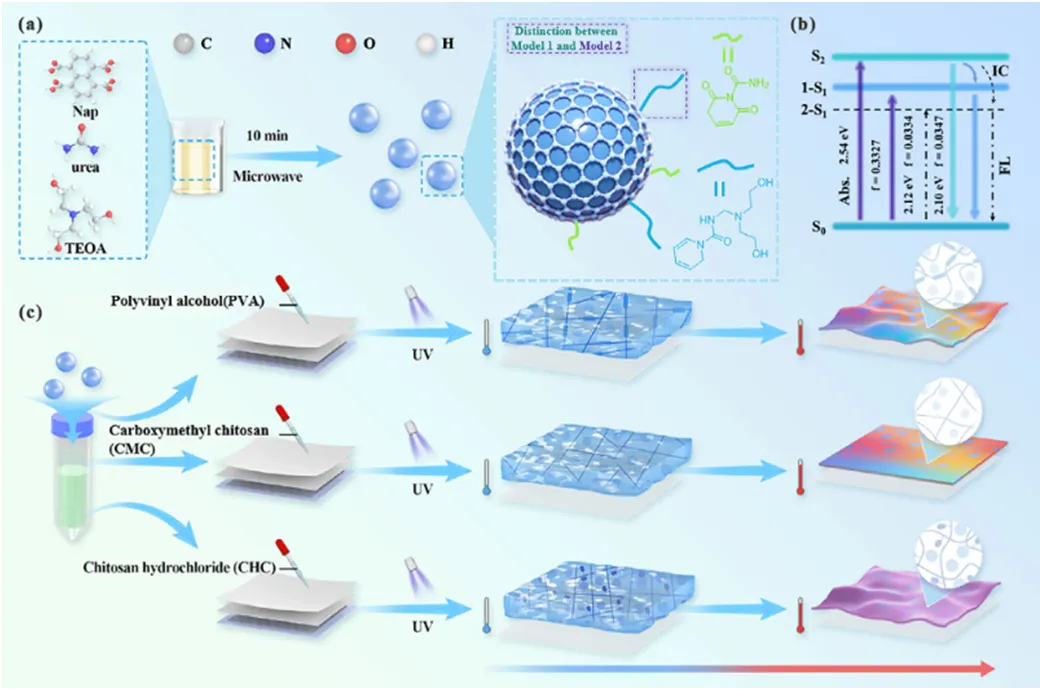
SCHEME 1 Schematic illustration of the preparation and photophysical mechanism of CDs/TEOA and its photo-responsive composite films.(a) Microwave-assisted synthesis process of CDs/TEOA; (b) Energy level transition and photophysical process of CDs/TEOA under UV irradiation; (c) Preparation of CDs/TEOA composite films and their response process of photoinduced deformation (photothermal effect) and photoinduced fluorescence chromism under UV irradiation.
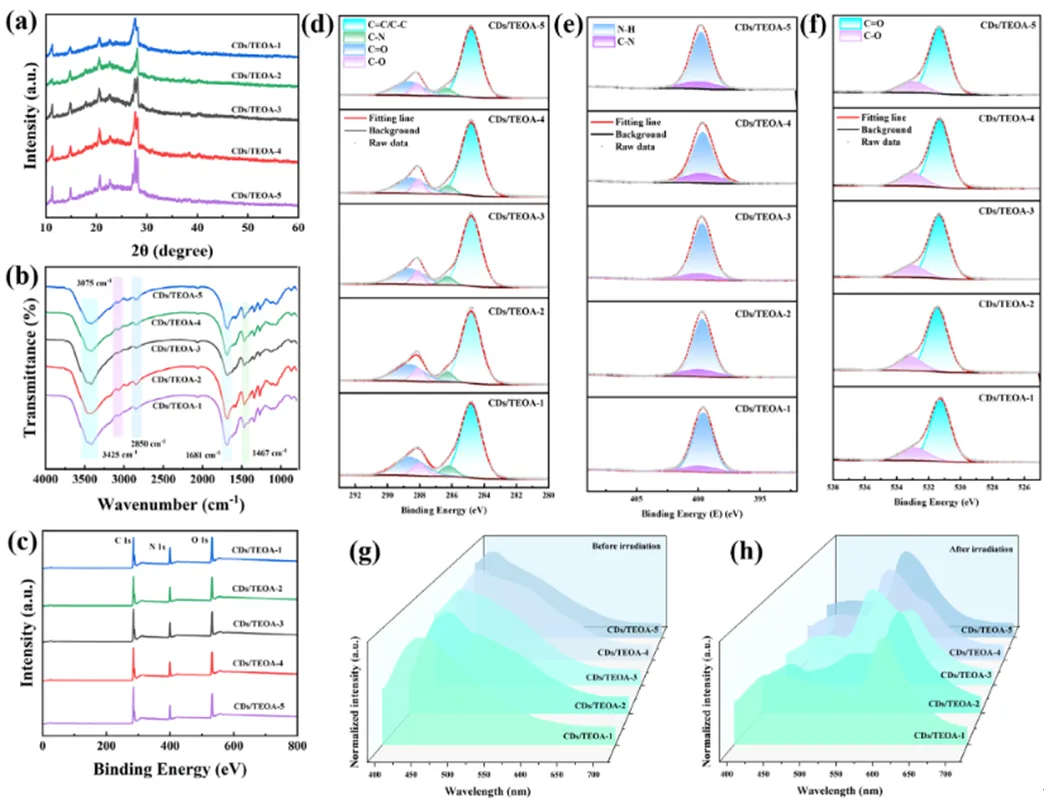
FIGURE 1 Characterization of the structure and optical properties of the CDs/TEOA-1–5 series samples: (a) XRD patterns; (b) FTIR spectra; (c) XPS full survey spectra; (d) High-resolution peak-fitting XPS spectra of C 1s; (e) High-resolution peak-fitting XPS spectra of N 1s; (f) High-resolution peak-fitting XPS spectra of O 1s; (g) Normalized fluorescence emission spectra of the CDs/TEOA-1–5 samples before UV light irradiation; (h) Normalized fluorescence emission spectra of the CDs/TEOA-1–5 samples after UV light irradiation.
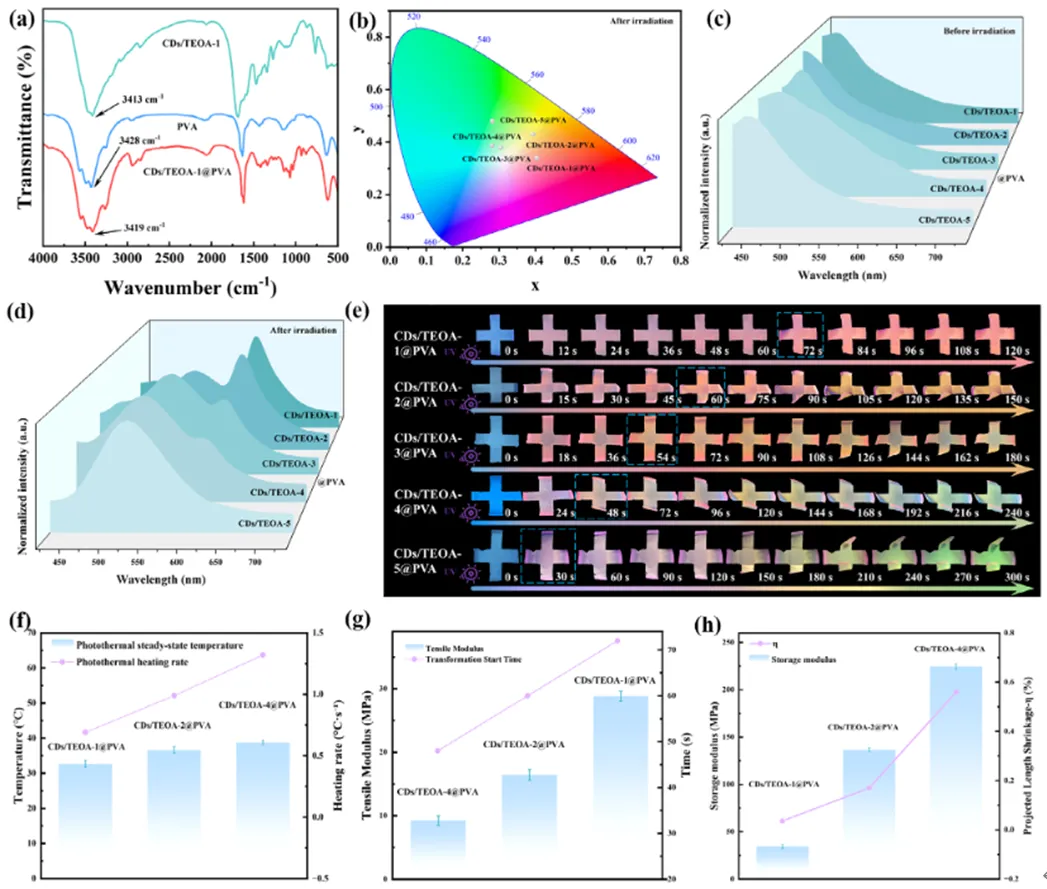
FIGURE 2 (a) FTIR spectra of PVA, CDs/TEOA-1 and CDs/TEOA-1@PVA; (b) CIE chromaticity coordinate diagrams of CDs/TEOA-1–5@PVA after UV light irradiation; (c-d) Normalized fluorescence emission spectra of CDs/TEOA-1–5@PVA before and after UV light irradiation; (e) Optical photographs of the photoinduced chromism and bending deformation processes of CDs/TEOA-1–5@PVA; (f) Photothermal steady-state temperatures and heating rates of different CDs/TEOA@PVA composite films; (g) Tensile moduli and deformation onset times of different CDs/TEOA@PVA composite films; (h) Storage moduli and projected length shrinkage rates of different CDs/TEOA@PVA composite films.
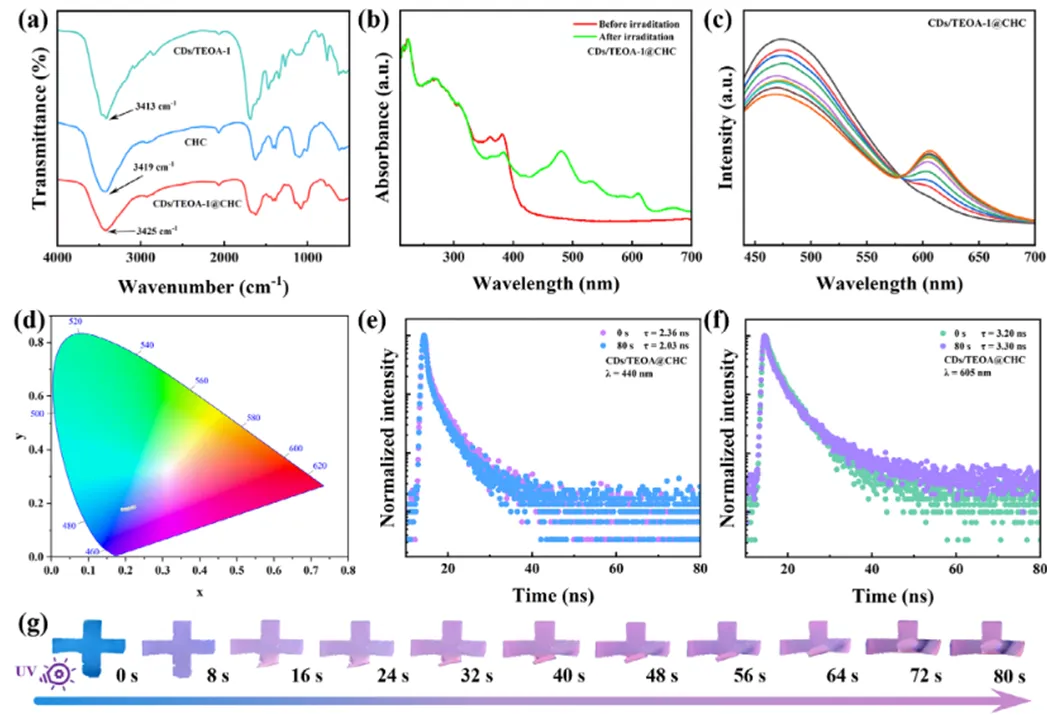
FIGURE 3 (a) FTIR spectra of CHC, CDs/TEOA-1 and CDs/TEOA-1@CHC composite films; (b) UV–vis absorption spectra of CDs/TEOA-1@CHC composite film before and after UV light irradiation; (c) Fluorescence emission spectra of CDs/TEOA-1@CHC composite film varying with UV light irradiation time; (d) CIE chromaticity coordinate diagram of CDs/TEOA-1@CHC composite film; (e-f) Fluorescence lifetime decay curves of CDs/TEOA-1@CHC composite film at 440 nm (e) and 605 nm (f) after 0 and 80 s of irradiation, respectively; (g) Optical photographs of the photo-induced bending deformation process of CDs/TEOA-1@CHC composite film under continuous UV light irradiation for 0–80 s
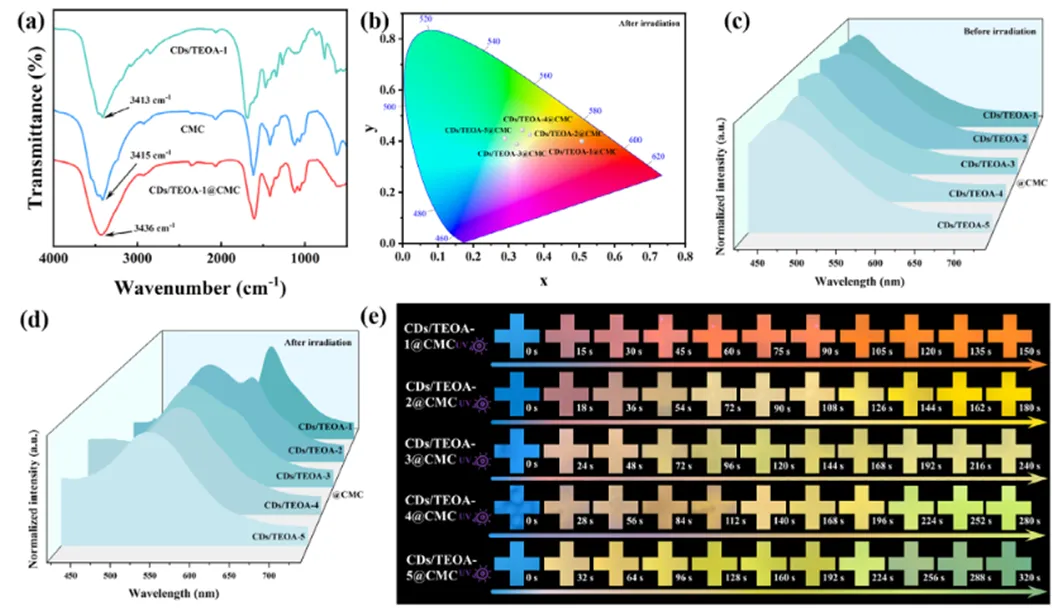
FIGURE 4 (a) FTIR spectra of CMC, CDs/TEOA-1 and CDs/TEOA-1@CMC; (b) CIE chromaticity coordinate diagrams of CDs/TEOA-1–5@CMC after UV light irradiation; (c, d) Normalized fluorescence emission spectra of CDs/TEOA-1–5@CMC before and after UV light irradiation; (e) Optical photographs of CDs/TEOA-1–5@CMC composite films under continuous UV light irradiation.
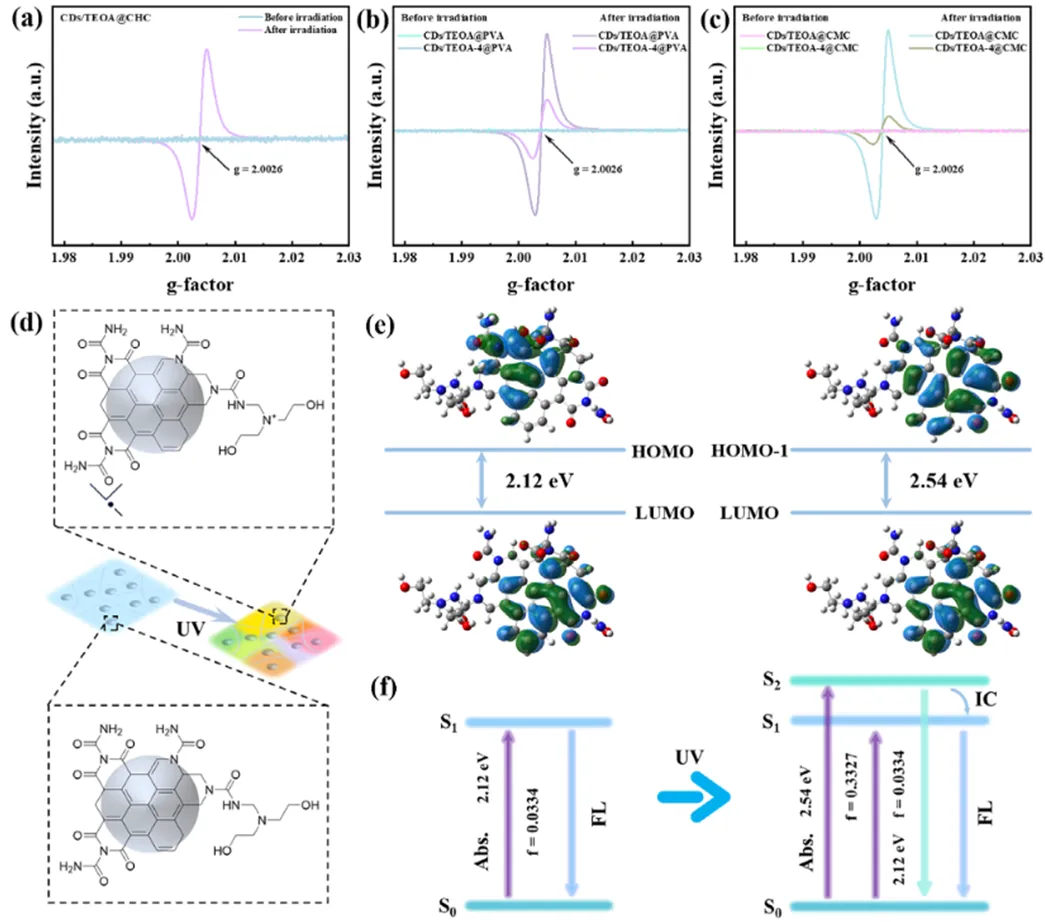
FIGURE 5 (a–c) EPR spectra of CDs/TEOA@CHC, CDs/TEOA@PVA and CDs/TEOA@CMC composite films before and after UV light irradiation; (d) Schematic diagram of the photoinduced fluorescence chromism mechanism of CDs/TEOA; (e) HOMO/LUMO electron cloud distributions and energy level differences of CDs/TEOA molecules before and after light irradiation (Model 1); (f) Schematic diagram of electron transition and fluorescence emission energy levels under UV light excitation.
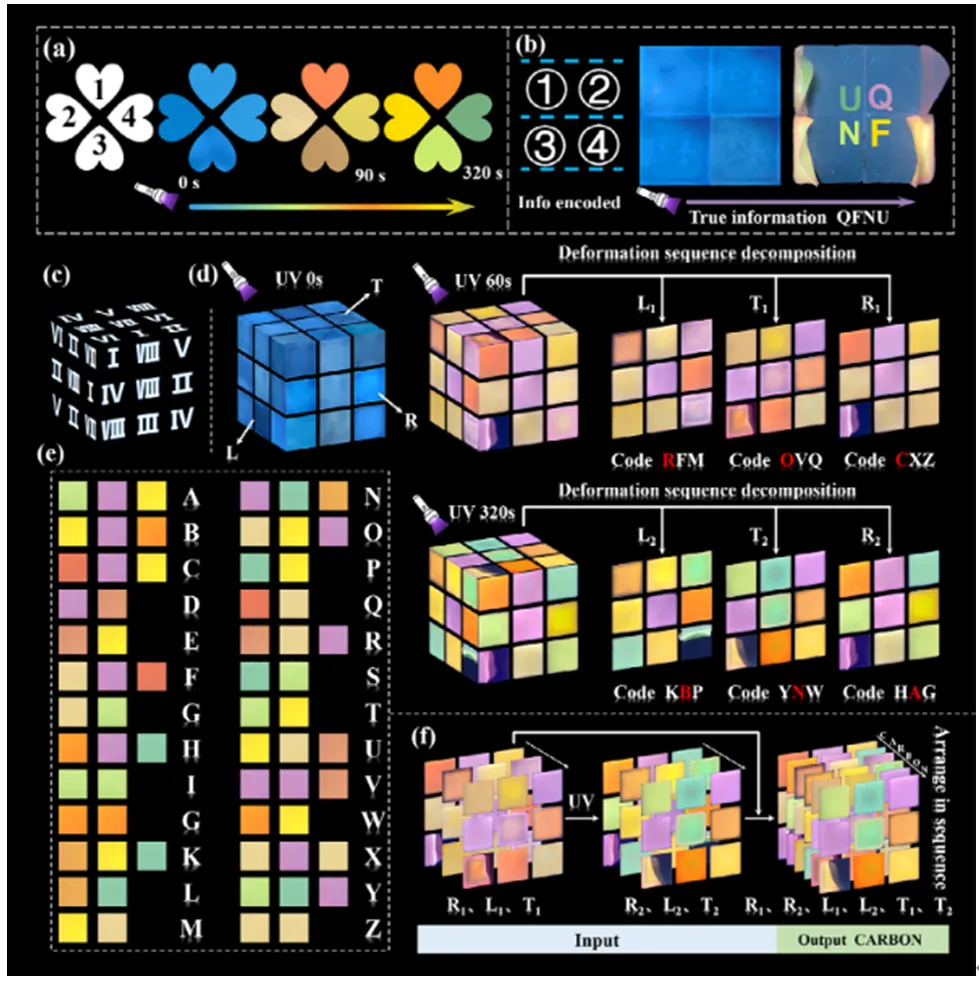
FIGURE 6 Multi-dimensional information encryption applications based on CDs/TEOA composite films (a) Dynamic color change process of the four-leaf clover pattern with UV irradiation time; (b) Demonstration of 2 × 2 array-based information encryption and decryption; (c) Structural design of the 3D Rubik’s cube-like encryption carrier (I-V correspond to CDs/TEOA-1–5@CMC, VI corresponds to CDs/TEOA-2@PVA, VII corresponds to CDs/TEOA-5@PVA, and VIII corresponds to CDs/TEOA-1@CHC); (d) Color change and deformation process, as well as deformation sequence decomposition of the 3D Rubik’s cube at different UV irradiation durations; (e) Color coding-based alphabet codebook; (f) Working workflow of the color-deformation-time multi-dimensional.
【原文链接】
Temporal Decoupling: A New Paradigm of 4D Photo-Responsive Carbon Dots Films With Modular Regulation of Color and Deformation
Jianye Zhang, Meichen Meng, Zhimeng Ma, Mingbo Yue, Xiaoyu Xu, Chang Liu, Qiang Fu
Advanced Science
DOI: 10.1002/advs.76955
科研服务




 10个月宝宝每天需要喝多少奶粉?