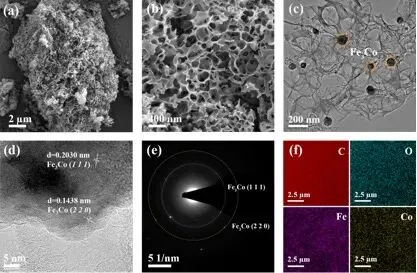
Fig. 1. (a, b) SEM image, (c) TEM image, (d) HRTEM image, (e) SAED pattern, and (f) EDS images of 0.5Fe3Co@BC. Panel (d) confirms the presence of C, O, Fe, and Co in the sample.
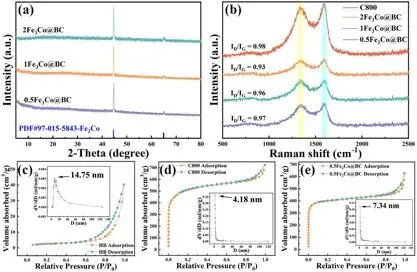
Fig. 2. (a) XRD patterns and (b) Raman images of the different samples; N2adsorption–desorption curves and pore size distributions (insets) of (c) HB, (d) C800, and (e) 0.5Fe3Co@BC.
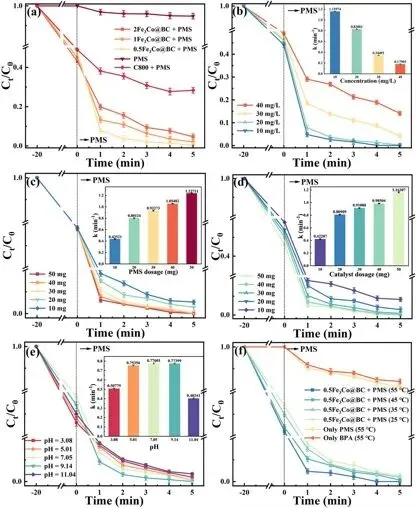
Fig. 3. (a) BPA removal efficiencies of the prepared catalysts; effects of (b) initial BPA concentration (c) PMS dosage, (d) catalyst dosage (e) pH, and (f) temperature on the removal efficiencies of the catalyst.
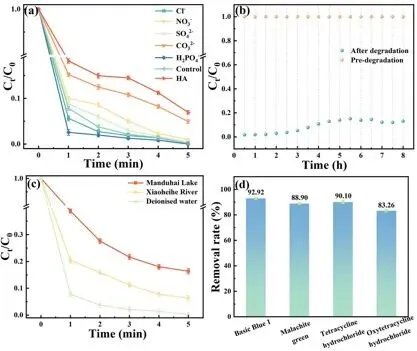
Fig. 4. (a) Effects of different inorganic ions and HA on BPA degradation. All anions (NaCl, NaH2PO4, NaNO3, Na2SO4, and Na2CO3) are added at 5 mM and the HA dosage is 20 mg. (b) Reusability, (c) BPA degradation efficiency in different environments, and (d) removal efficiencies of antibiotics and dyes by 0.5Fe3Co@BC. Basic Blue 1 (pH = 7.12), malachite green (pH = 6.83), tetracycline hydrochloride (pH = 7.01), and oxytetracycline hydrochloride (pH = 6.97) were each dosed at 20 mg/L in a volume of 100 mL.
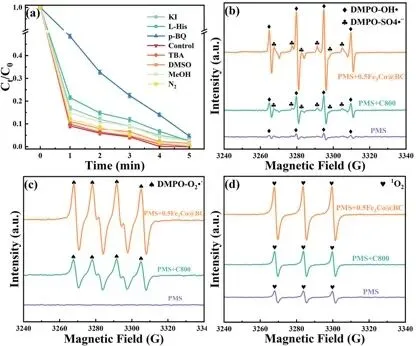
Fig. 5. (a) Effects of different scavengers on BPA removal via PMS activation by 0.5Fe3Co@BC. Initial BPA concentration = 20 mg/L, volume = 100 mL, catalyst dosage = 20 mg, PMS dosage = 20 mg, pH = 7.1, KI = L-His = p-BQ dosage = 2 mM, TBA = MeOH = DMSO dosage = 50 mM, temperature = 25 ℃. EPR spectra of the 0.5Fe3Co@BC + PMS system: (b) DMPO for trapping OH• and SO4•−, (c) DMPO for trapping O2•−, and (d) TEMP for trapping 1O2.
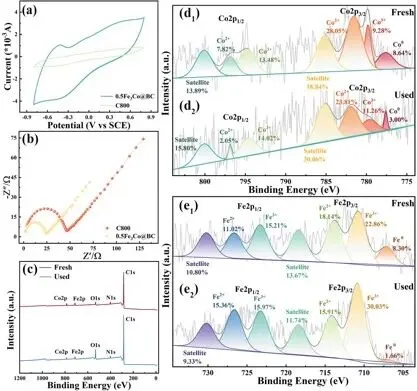
Fig. 6. CV plots and (b) electrochemical impedance spectroscopy results of the 0.5Fe3Co@BC and C800 composites; XPS survey spectra of the fresh and used 0.5Fe3Co@BC catalysts; high-resolution XPS spectra of the fresh and used 0.5Fe3Co@BC composite: (d) Co 2p and (e) Fe 2p.
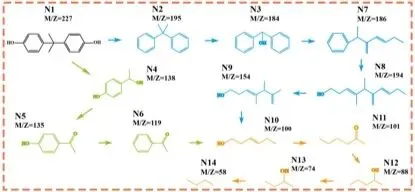
Fig. 7. Possible pathways and intermediates of BPA degradation.
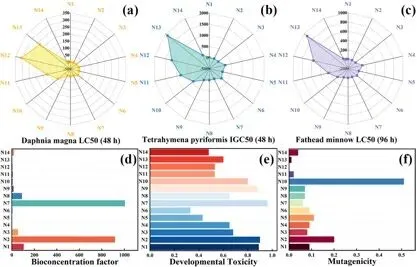
Fig. 8. Hazard analysis of the intermediates: (a) 48-h LC50 in large water flea (Daphnia magna) (b) 48-h IGC50 in Tetrahymena pyriformis; (c) 96-h LC50 in fathead minnow (Pimephales promelas); (d) bioconcentration factors, (e) developmental toxicities, and (f) mutagenicities of the individual intermediates.