《EuroChoices》农业食物贸易与可持续性专刊 | 2026年第25卷第1期目录及摘要
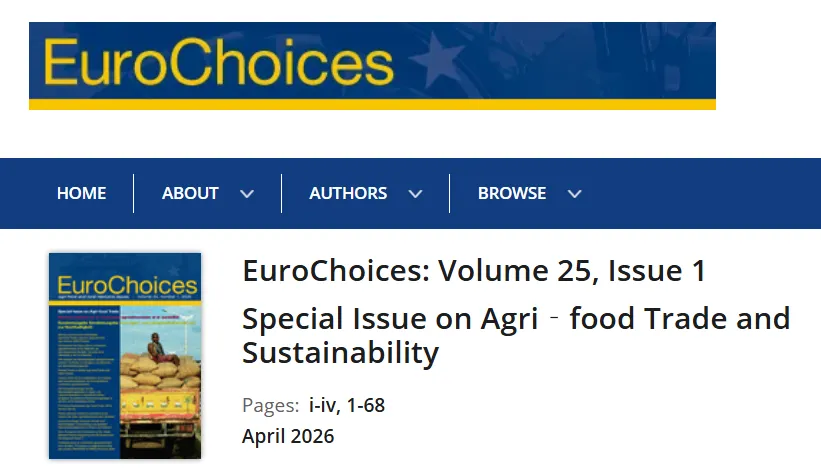 官网链接:https://onlinelibrary.wiley.com/toc/1746692x/2026/25/1
目录 (Table of Contents)
Moving Toward more Sustainable Agri-food Trade: Lessons Learned from two Horizon 2020 Projects迈向更可持续的农产品贸易:从两个 Horizon 2020 项目中汲取的经验教训Attila Jambor, Bodo SteinerUnderstanding the Linkages between Agri-food Trade and SDGs: Literature and Research Gaps了解农产品贸易与可持续发展目标之间的联系:文献和研究差距Sophia Davidova, Attila Jambor, Qiuzhen Chen, Bodo SteinerModel-based Lessons on How Policy Measures Affect the Sustainability of Agri-food Trade关于政策措施如何影响农产品贸易可持续性的基于模型的经验教训Martin Banse, Andrea M. Bassi, Sergio Rene Araujo Enciso, Nina Hyytiä, Vitaliy Krupin, Verena Laquai, Tamas Revesz, Bodo Steiner, Katarzyna ZawalinskaHow Trade and Sustainability are Seen: Insights from Citizens and Value-Chain Actors如何看待贸易和可持续发展:公民和价值链参与者的见解Alastair Bailey, Qiuzhen Chen, Sophia Davidova, Attila Jambor, Bodo SteinerRecent Trends in Global Agri-food Trade and Value ChainsAttila Jambor, Federica De MariaThe Challenges Facing Sub-Saharan African Agri-food Value Chains: Tasks for EU- and sub-Saharan African Policymakers撒哈拉以南非洲农产品价值链面临的挑战:欧盟和撒哈拉以南非洲政策制定者的任务Hoseana Bohela Lunogelo, Jane Nalunga, Bodo SteinerPromoting Sustainable Agri-food Trade: What the EU Can DoKey Leverage Points for Making Agri-food Trade and Value Chains More SustainableBodo Steiner, María Bustamante LiriaLinks between Trade and Sustainability: Lessons from Global Value Chains in Ghana and Vietnam贸易与可持续发展之间的联系:加纳和越南全球价值链的经验教训Federica Demaria, Raffaele D'Annolfo, Ilenia Manetti, Roberto Henke, Maria Rosaria Pupo D'Andrea, Felicetta Carillo, Federica Morandi, Marco Vassallo, Sara Romano, Ralph Armah, Emmanuel Abbey, Mawuenyega Makafui Butu, Peter Quartey, Festus E. Turkson, Viet HoangHow To Improve the Coherence of EU Trade-Related Policies Regarding the UN Sustainable Development Goals?如何提高欧盟贸易相关政策与联合国可持续发展目标的一致性?Hilkka Vihinen, Michael Kull, Pasi Rikkonen, Jyrki Niemi, George Vlahos, Pavlos Karanikolas, Spyridon KarytsasKey Policy Lessons for More Sustainable Agri-food Trade from TRADE4SD and MATS Horizon 2020 projectsTRADE4SD 和 MATS Horizon 2020 项目中关于更可持续农产品贸易的关键政策经验教训Bodo Steiner, Attila Jambor摘要 (Abstracts)
Moving Toward more Sustainable Agri-food Trade: Lessons Learned from two Horizon 2020 Projects迈向更可持续的农产品贸易:从两个 Horizon 2020 项目中汲取的经验教训Attila Jambor, Bodo Steiner全文链接:https://onlinelibrary.wiley.com/doi/10.1111/1746-692x.70024Understanding the Linkages between Agri-food Trade and SDGs: Literature and Research Gaps了解农产品贸易与可持续发展目标之间的联系:文献和研究差距Sophia Davidova, Attila Jambor, Qiuzhen Chen, Bodo SteinerAbstract: This article synthesises findings from the literature reviews of two EU funded projects, TRADE4SD and MATS, to explore the multidimensional linkages between agri-food trade and sustainability, with a focus on the UN Sustainable Development Goals. Through structured literature reviews, we assess the economic, environmental and social sustainability implications of trade and trade policy, explore spillover effects and identify emerging pathways and solutions for making trade more sustainable from identifying literature gaps relevant for policymaking. Our analysis reveals a dominant focus on economic sustainability in current research, with limited attention to environmental and social dimensions while keeping agency and multi-stakeholder perspectives neglected. We conclude by identifying methodological and thematic gaps and propose directions for more systems-based research and policy action in the future accounting for coherence and trade-offs to foster sustainable agri-food trade.本文综合了两个欧盟资助项目 TRADE4SD 和 MATS 的文献综述结果,探讨农产品贸易与可持续发展之间的多维联系,重点关注联合国可持续发展目标。通过结构化文献综述,我们评估贸易和贸易政策对经济、环境和社会可持续性的影响,探索溢出效应,并通过确定与政策制定相关的文献差距来确定使贸易更具可持续性的新兴途径和解决方案。我们的分析表明,当前研究主要关注经济可持续性,对环境和社会层面的关注有限,同时忽视了机构和多利益相关者的观点。最后,我们确定了方法和主题上的差距,并提出了未来更多基于系统的研究和政策行动的方向,以促进可持续农产品贸易的一致性和权衡。全文链接:https://onlinelibrary.wiley.com/doi/10.1111/1746-692x.70035Model-based Lessons on How Policy Measures Affect the Sustainability of Agri-food Trade关于政策措施如何影响农产品贸易可持续性的基于模型的经验教训Martin Banse, Andrea M. Bassi, Sergio Rene Araujo Enciso, Nina Hyytiä, Vitaliy Krupin, Verena Laquai, Tamas Revesz, Bodo Steiner, Katarzyna ZawalinskaAbstract: In an era marked by intensifying global interdependence, trade policy has emerged as a decisive force influencing agricultural development, food security, environmental integrity and social equity. The European Union (EU), as a major actor in global agricultural trade, has embraced a dual agenda: to promote trade in food and agricultural products and to foster sustainable development. However, while EU trade agreements increasingly reflect sustainability principles, critical gaps remain in understanding the implications of trade liberalisation through the lens of the EU's Sustainable Development Goals (SDGs). This article synthesises the model-based findings of the two TRADE4SD and MATS H2020 projects as both are focusing on social, environmental and economic impacts of international agricultural trade and trade policies in complementary ways. The article demonstrates that while liberalised trade can improve market efficiency and food availability, it can also exacerbate inequality and environmental degradation if not accompanied by robust institutional and financial support measures. The model-based results affirm that EU trade policy must adopt an integrated approach – embedding economic, social and environmental dimensions in its framework while accounting for local conditions – to fully realise the potential of trade as a driver of sustainable development.在全球相互依存日益加深的时代,贸易政策已成为影响农业发展、粮食安全、环境完整性和社会公平的决定性力量。欧盟(EU)作为全球农产品贸易的主要参与者,制定了双重议程:促进粮食和农产品贸易并促进可持续发展。然而,尽管欧盟贸易协定越来越多地反映可持续性原则,但从欧盟可持续发展目标的角度理解贸易自由化的影响方面仍存在重大差距。本文综合了 TRADE4SD 和 MATS H2020 两个项目基于模型的研究结果,因为这两个项目都以互补的方式关注国际农业贸易和贸易政策的社会、环境和经济影响。文章表明,虽然自由化贸易可以提高市场效率和粮食供应,但如果不辅之以强有力的制度和金融支持措施,它也可能加剧不平等和环境退化。基于模型的结果证实,欧盟贸易政策必须采取综合方法——在其框架中融入经济、社会和环境维度,同时考虑当地条件——才能充分发挥贸易作为可持续发展驱动力的潜力。全文链接:https://onlinelibrary.wiley.com/doi/10.1111/1746-692x.70025How Trade and Sustainability are Seen: Insights from Citizens and Value-Chain Actors如何看待贸易和可持续发展:公民和价值链参与者的见解Alastair Bailey, Qiuzhen Chen, Sophia Davidova, Attila Jambor, Bodo SteinerAbstract: How citizens prioritise sustainability dimensions in the context of agri-food trade – and how actors working inside value chains think sustainability can be improved – matters greatly for policymaking. Using evidence from two Horizon 2020 projects, TRADE4SD and MATS, this Parlons Graphiques highlights (1) what citizens believe about trade and sustainability dimensions, and (2) what value-chain actors consider are the strongest levers available to policymakers for achieving improved sustainability outcomes within food value chains. Together, these findings offer a powerful indication of what kinds of policies can be both effective and publicly supported.公民如何在农产品贸易背景下优先考虑可持续发展维度,以及价值链内的参与者如何认为可持续发展可以得到改善,对于政策制定至关重要。本 Parlons Graphiques 利用两个 Horizon 2020 项目 TRADE4SD 和 MATS 的证据,强调了(1)公民对贸易和可持续发展维度的看法,以及(2)价值链参与者认为政策制定者在食品价值链中实现改善可持续发展成果的最有力杠杆。总之,这些发现有力地表明了什么样的政策既有效又得到公众支持。全文链接:https://onlinelibrary.wiley.com/doi/10.1111/1746-692x.70026Recent Trends in Global Agri-food Trade and Value ChainsAttila Jambor, Federica De MariaAbstract: Over the last decade, the rate of global agri-food trade growth has slowed. The value of global agri-food trade increased more than twelve times in constant terms from 1996 to 2016. It then stagnated until 2020 and significantly decreased after then. In the meantime, the share of agri-food trade in total trade has remained constant (7–10 per cent), while the share of agri-food exports embedded in global value chains (GVCs) modestly increased from 28 per cent in 1996 to 33 per cent in 2023. Much of this increase is attributable to developing countries – particularly emerging economies – whose trade structures are often more heavily specialised in agri-food products than those of high-income countries. This rise in GVC participation does not extend to Least Developed Countries (LDCs), whose integration remains limited. The trend is especially visible in large emerging markets in Asia and Latin America, such as China, Brazil and India, which have become increasingly active in both exporting and importing along agri-food value chains.在过去十年中,全球农产品贸易增长速度有所放缓。1996年至2016年,全球农产品贸易额按不变价格计算增长了12倍以上。此后一直停滞到2020年,此后显著下降。同时,农产品贸易在总贸易中的份额保持不变(7-10%),而嵌入全球价值链(GVCs)的农产品出口份额从1996年的28%小幅上升到2023年的33%。这一增长很大程度上归因于发展中国家——特别是新兴经济体——与高收入国家相比,这些国家的贸易结构往往更加专业化于农产品。这种全球价值链参与率的上升并未延伸到最不发达国家(LDCs),其一体化仍然有限。这一趋势在中国、巴西和印度等亚洲和拉丁美洲的大型新兴市场尤其明显,这些市场在农产品价值链的进出口方面日益活跃。全文链接:https://onlinelibrary.wiley.com/doi/10.1111/1746-692x.70027The Challenges Facing Sub-Saharan African Agri-food Value Chains: Tasks for EU- and sub-Saharan African Policymakers撒哈拉以南非洲农产品价值链面临的挑战:欧盟和撒哈拉以南非洲政策制定者的任务Hoseana Bohela Lunogelo, Jane Nalunga, Bodo SteinerAbstract: Sub-Saharan African (SSA) governments have recently implemented policies that promote farmer productivity and value addition to support export-oriented agricultural commodity value chains (VCs) such as coffee and cocoa. The efforts are expected to raise incomes and welfare of the stakeholders engaged in these VCs, contributing to the UN's SDG1 (no poverty). The SSA countries have historically received financial and technical support from the EU through trade-related policies and initiatives. Despite these combined efforts by SSA governments and the EU, SSA farmers are still unable to produce sufficient commodities at sufficient quality to meet both domestic and export market needs. Given this situation, recent developments related to the implementation of Economic Partnership Agreements (EPAs), the EU Deforestation Regulation (EUDR) and related EU Green Deal measures are considered not helpful in motivating smallholder farmers to realise the desired levels of production, productivity and VC development. It is therefore argued that both the EU and local governments should take a more holistic approach to support multiple activities at multiple VC levels, while supporting SSA smallholder farmers. In doing so, it is important to avoid or at least minimise conflicting sustainability impacts and food security implications, while accounting for diverging needs of African farmers, processors and traders. Additionally, it is argued that it will be especially important to address the capacity-building needs of Africa's smallholder farmers. This involves improvements in both quality and scope of agricultural extension services, enhancing product quality and supporting the adoption of value addition technologies and packaging methods in SSA countries.撒哈拉以南非洲(SSA)政府最近实施了提高农民生产力和附加值的政策,以支持咖啡和可可等出口导向型农业商品价值链。这些努力预计将提高参与这些价值链的利益相关者的收入和福利,为联合国可持续发展目标1(无贫困)做出贡献。撒哈拉以南非洲国家历来通过贸易相关政策和举措获得了欧盟的财政和技术支持。尽管撒哈拉以南非洲各国政府和欧盟共同努力,撒哈拉以南非洲农民仍然无法生产足够质量的商品来满足国内和出口市场的需求。鉴于这种情况,与实施经济伙伴协定(EPA)、欧盟毁林法规(EUDR)和相关欧盟绿色新政措施有关的最新进展被认为无助于激励小农实现预期的产量、生产力和价值链发展水平。因此,有人认为,欧盟和地方政府都应采取更全面的方法来支持多个价值链层面的多项活动,同时支持撒哈拉以南非洲小农。在此过程中,重要的是要避免或至少最大限度地减少可持续发展影响和粮食安全影响之间的冲突,同时考虑到非洲农民、加工商和贸易商的不同需求。此外,有人认为解决非洲小农的能力建设需求尤为重要。这涉及提高农业推广服务的质量和范围、提高产品质量并支持在撒哈拉以南非洲国家采用增值技术和包装方法。全文链接:https://onlinelibrary.wiley.com/doi/10.1111/1746-692x.70037Promoting Sustainable Agri-food Trade: What the EU Can DoAbstract: Agri-food trade has contributed positively to the Sustainable Development Goals (SDGs), especially in economic terms, but growing concerns over environmental and social harms have pushed the EU to pursue new governance efforts at multilateral, bilateral, and unilateral levels. This Point de Vue critically assesses the strengths and limitations of different governance pillars in a global landscape marked by geopolitical uncertainty, rising economic nationalism, and weakening multilateral momentum, taking into account evidence from the two Horizon 2020 projects MATS and TRADE4SD. Despite limited appetite for formal multilateral solutions, the EU could build on open plurilateral initiatives to form 'coalitions of the willing' around higher environmental standards. Bilateral Free Trade Agreements remain a promising avenue if framed not as compliance tools, but as partnerships based on mutual benefit and shared priorities. Unilateral measures can play a role if they are targeted, evidence-based and WTO-compliant – but they should be used sparingly and strategically. Ultimately, trade governance alone cannot resolve the sustainability challenges embedded in global agri-food supply chains; a mix of trade and non-trade measures, including capacity-building, investment and cooperative partnerships, will be essential.农产品贸易对可持续发展目标做出了积极贡献,特别是在经济方面,但对环境和社会危害的日益担忧促使欧盟在多边、双边和单边层面寻求新的治理努力。本 Point de Vue 批判性地评估了地缘政治不确定性、经济民族主义抬头和多边势头减弱的全球格局中不同治理支柱的优势和局限性,同时考虑了 Horizon 2020 项目 MATS 和 TRADE4SD 两个项目的证据。尽管对正式多边解决方案的兴趣有限,但欧盟可以在开放的诸边倡议的基础上,围绕更高的环境标准形成"自愿联盟"。如果双边自由贸易协定不被视为合规工具,而是基于互利和共同优先事项的伙伴关系,那么它仍然是一个有前途的途径。如果单边措施具有针对性、基于证据且符合世贸组织的规定,那么它们可以发挥作用,但应谨慎且有策略地使用。最终,仅靠贸易治理无法解决全球农产品供应链中的可持续性挑战;贸易和非贸易措施的结合,包括能力建设、投资和合作关系,至关重要。全文链接:https://onlinelibrary.wiley.com/doi/10.1111/1746-692x.70000Key Leverage Points for Making Agri-food Trade and Value Chains More SustainableBodo Steiner, María Bustamante LiriaAbstract: Based on evidence from 15 case studies in Africa, Europe (with domestic policy focus of 2 studies), and parts of Latin America and Asia (3 studies) analysed under the Horizon 2020 MATS project, we show how agricultural trade may contribute to achieving Sustainable Development Goals by leveraging policy-relevant points of intervention in trade regimes applicable to agri-food value chains. Key leverage points identified as part of a mixed-methods approach integrating institutional and legal frameworks analyses relate to accountability and transparency, due diligence, collaboration and justice mechanisms in governance. In practice this means that relatively small changes in governance through strengthening property rights and land titles, lowering transaction and thus compliance costs for sustainability standards adoption in value chains, and supporting the adoption of sustainability impact assessments as part of trade regimes could achieve significant benefits to the EU, its trading partners and local value-chain stakeholders. Furthermore, EU policymakers could be placing gender-based conditions on credit and loan support, or extend existing trade agreements and policy initiatives by integrating them with ex-ante and ex-post sustainability impact assessments that further support capacity building and transparency, hence good governance. Overall, reducing inequalities as a key leverage point was identified as instrumental for systems change toward more sustainable agricultural trade. If acted upon by policymakers, the above leverage points hold promise that the EU and its trading partners could in the future address triple bottom line sustainability challenges more effectively than at present.基于 Horizon 2020 MATS 项目下分析的非洲、欧洲(其中2项研究以国内政策为重点)以及拉丁美洲和亚洲部分地区(3项研究)的15个案例研究的证据,我们展示了农业贸易如何通过利用适用于农业食品价值链的贸易制度中的政策相关干预点来促进实现可持续发展目标。作为整合制度和法律框架分析的混合方法的一部分,确定的关键杠杆点涉及治理中的问责制和透明度、尽职调查、协作和司法机制。在实践中,这意味着通过加强产权和土地所有权、降低交易以及价值链中采用可持续发展标准的合规成本,以及支持采用可持续发展影响评估作为贸易制度的一部分,在治理方面进行相对较小的改变,可以为欧盟、其贸易伙伴和当地价值链利益相关者带来重大利益。此外,欧盟政策制定者可以将基于性别的条件放在信贷和贷款支持上,或通过将事前和事后可持续发展影响评估与支持能力建设和透明度(即良好治理)相结合,将现有贸易协定和政策倡议加以扩展。总体而言,减少不平等作为一个关键杠杆点被认为有助于系统变革以实现更可持续的农业贸易。如果政策制定者采取行动,上述杠杆点有望使欧盟及其贸易伙伴在未来能够比现在更有效地应对三重底线可持续发展挑战。全文链接:https://onlinelibrary.wiley.com/doi/10.1111/1746-692x.70034Links between Trade and Sustainability: Lessons from Global Value Chains in Ghana and Vietnam贸易与可持续发展之间的联系:加纳和越南全球价值链的经验教训Federica Demaria, Raffaele D'Annolfo, Ilenia Manetti, Roberto Henke, Maria Rosaria Pupo D'Andrea, Felicetta Carillo, Federica Morandi, Marco Vassallo, Sara Romano, Ralph Armah, Emmanuel Abbey, Mawuenyega Makafui Butu, Peter Quartey, Festus E. Turkson, Viet HoangAbstract: Within the EU-funded Trade4Sustainable Development (TRADE4SD) project, this study examines trade and sustainability linkages under Ghana's Economic Partnership Agreement (EPA) and Vietnam's EU-Vietnam Free Trade Agreement (EVFTA). Using a multi-country and multi-crop approach, the effects of trade on sustainability are assessed across five value chains – cocoa and cashew in Ghana, and rice, tea and dragon fruit in Vietnam – and the key issues they face are mapped to the relevant Sustainable Development Goals (SDGs). The case studies are analysed through desk research, interviews and questionnaires conducted with local stakeholders, including policymakers and farmers. Key insights for each value chain are reported, and outcomes are compared in terms of government support, value chain structures and socio-economic and environmental issues shaping trade-sustainability linkages. Finally, common and country-specific policy recommendations are presented, covering issues linked to the three pillars of sustainability and accounting for local challenges and needs.在欧盟资助的 Trade4Sustainable Development (TRADE4SD) 项目中,本研究探讨了加纳经济伙伴协定(EPA)和越南欧盟-越南自由贸易协定(EVFTA)下的贸易和可持续发展联系。采用多国家和多作物方法,评估了五个价值链(加纳的可可和腰果,越南的大米、茶叶和火龙果)贸易对可持续性的影响,并将它们面临的关键问题映射到相关的可持续发展目标。案例研究通过案头研究、访谈和与当地利益相关者(包括政策制定者和农民)进行的问卷调查进行分析。报告了每个价值链的关键见解,并在政府支持、价值链结构以及塑造贸易与可持续性联系的社会经济和环境问题方面对结果进行了比较。最后,提出了共同和针对具体国家的政策建议,涵盖与可持续发展三大支柱相关的问题,并考虑到当地的挑战和需求。全文链接:https://onlinelibrary.wiley.com/doi/10.1111/1746-692x.70036How To Improve the Coherence of EU Trade-Related Policies Regarding the UN Sustainable Development Goals?如何提高欧盟贸易相关政策与联合国可持续发展目标的一致性?Hilkka Vihinen, Michael Kull, Pasi Rikkonen, Jyrki Niemi, George Vlahos, Pavlos Karanikolas, Spyridon KarytsasAbstract: In view of the EU's sustainability goals, policy coherence aims to reduce contradictions, enhance synergies and boost the effectiveness of actions across various policy areas to achieve the goals set and deliver aligned, sustainable outcomes. Two EU projects provide evidence on how to improve coherence between the EU policies involved in international agricultural trade and in promoting sustainability objectives. Three main issues are identified: coherence limitations within the Farm-to-Fork (F2F) strategy, inconsistencies between governance levels (EU, Member State, regional/local), and insufficient dynamics in EU policy processes. A systemic approach to agriculture is needed that considers the whole interconnected system rather than isolated parts. The first version of F2F focused heavily on the supply side (i.e. farmers and food producers), while neglecting the demand side (i.e. consumers, markets, and structural incentives to shift consumption). A 'F2F 2.0' is needed to balance supply and demand side policies. Environmental goals currently take precedence over social and economic sustainability aspects. Enhancing policy coherence is needed via a long-term commitment, alongside clear expectations and robust policy making skills. The incorporation of sustainability indicators and proofing is essential for translating sustainability commitments into concrete and coherent policies. Policy coherence is not just a technical exercise – it is a challenge that demands political will, strategic capacity and institutional innovation.鉴于欧盟的可持续发展目标,政策一致性旨在减少矛盾、增强协同效应并提高各个政策领域行动的有效性,以实现既定目标并交付一致的可持续成果。两个欧盟项目提供了关于如何提高欧盟涉及国际农业贸易和促进可持续发展目标的政策之间的一致性的证据。确定了三个主要问题:从农场到餐桌(F2F)战略的一致性限制、治理级别(欧盟、成员国、区域/地方)之间的不一致以及欧盟政策进程的动力不足。需要一种系统的农业方法,考虑整个相互关联的系统而不是孤立的部件。F2F的第一版主要关注供应方(即农民和粮食生产者),同时忽视了需求方(即消费者、市场和改变消费的结构性激励)。需要"F2F 2.0"来平衡供需双方政策。目前,环境目标优先于社会和经济可持续性方面。需要通过长期承诺、明确的期望和强大的政策制定技能来增强政策的一致性。纳入可持续性指标和证明对于将可持续性承诺转化为具体和连贯的政策至关重要。政策一致性不仅仅是一项技术工作,也是一项需要政治意愿、战略能力和制度创新的挑战。全文链接:https://onlinelibrary.wiley.com/doi/10.1111/1746-692x.70038Key Policy Lessons for More Sustainable Agri-food Trade from TRADE4SD and MATS Horizon 2020 projectsTRADE4SD 和 MATS Horizon 2020 项目中关于更可持续农产品贸易的关键政策经验教训Bodo Steiner, Attila JamborAbstract: Two Horizon 2020 projects tasked with assessing the sustainability impacts of agricultural trade collaboratively applied macro models and perspectives (Computable General Equilibrium models, participatory systems approach, customised quantitative systems models) together with micro-perspectives (3 TRADE4SD case studies, 15 MATS case studies) for delivering an integrated, systems-based and multi-disciplinary approach. The multi-level outcomes of policy intervention were assessed across sectors, economic actors and dimensions of sustainable development, over time and spatially. The integrated methods approach highlights the need for comprehensive policy responses that acknowledge the interconnectedness of domestic, EU and international factors for achieving more sustainable agricultural trade. The sustainability of agricultural trade is intimately tied to the economic, social and environmental sustainability of domestic production. Key policy conclusions are: support local contexts in markets exporting to the EU through institutional, investment and technical assistance for cooperative capacity-building (multi-stakeholder) and standards alignment that accounts for compliance costs differences; inclusive and robust trade governance needs investment into actor empowerment as part of capacity-building; redesign trade agreements for closer SDG alignment through institutionalised sustainability impact assessments with a systems perspective; increase policy coherence through coordinated, predictable and impact-assessment-based policy instrument implementation (SDG-proofing) and reform. If EU policymakers want to credibly defend 'values' (EU standards) in the contested agri-food trade arena, it is time to move forward collaboratively and substantively as has been achieved by both the Mercosur and India free trade agreements.两个 Horizon 2020 项目的任务是评估农业贸易的可持续性影响,协作应用宏观模型和视角(可计算一般均衡模型、参与式系统方法、定制定量系统模型)以及微观视角(3个TRADE4SD案例研究、15个MATS案例研究),以提供综合的、基于系统的多学科方法。政策干预的多层次成果是在时间和空间上跨部门、经济参与者和可持续发展的维度进行评估的。综合方法强调需要采取全面的政策应对措施,承认国内、欧盟和国际因素的相互关联性,以实现更可持续的农业贸易。农产品贸易的可持续性与国内生产的经济、社会和环境可持续性密切相关。主要政策结论是:通过机构、投资和技术援助以及考虑合规成本差异的标准调整,支持向欧盟出口市场的当地情况,进行合作能力建设(多方利益相关者);包容性和稳健的贸易治理需要对行为体赋权进行投资,作为能力建设的一部分;从系统角度进行制度化的可持续发展影响评估,重新设计贸易协定,使可持续发展目标更加一致;通过协调、可预测和基于影响评估的政策工具实施(SDG验证)和改革,提高政策一致性。如果欧盟政策制定者希望在有争议的农产品贸易领域可信地捍卫"价值观"(欧盟标准),那么现在是时候像南方共同市场和印度自由贸易协定所实现的那样,以合作和实质性的方式向前推进。全文链接:https://onlinelibrary.wiley.com/doi/10.1111/1746-692x.70033 10个月宝宝每天需要喝多少奶粉?

