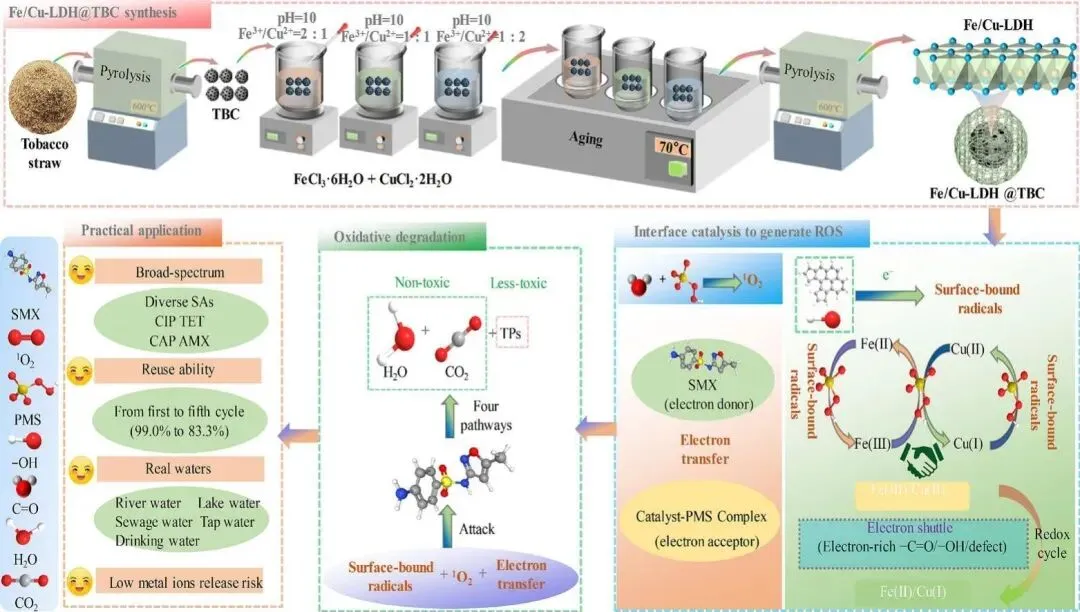
本研究旨在:(1) 通过优化Fe/Cu的摩尔比,制备一种用于PMS降解SAs的高效Fe/Cu-LDH与TBC复合催化剂(Fe/Cu-LDH@TBC);(2) 研究影响Fe/Cu-LDH@TBC/PMS体系中SAs降解性能的关键因素(如反应条件、水化学性质); (3) 通过结合淬灭实验、电子顺磁共振(EPR)信号、电化学测试、表征及密度泛函理论(DFT)计算,阐明参与SAs去除的主要活性氧(ROS)及其生成机制; (4) 结合已鉴定的中间体与DFT计算预测降解路径,并评估中间体的急性/慢性生态毒性;(5) 通过分析该体系在实际水体中对SAs的去除能力、可持续性、安全性及广谱特性,评估Fe/Cu-LDH@TBC/PMS体系的实际应用潜力。
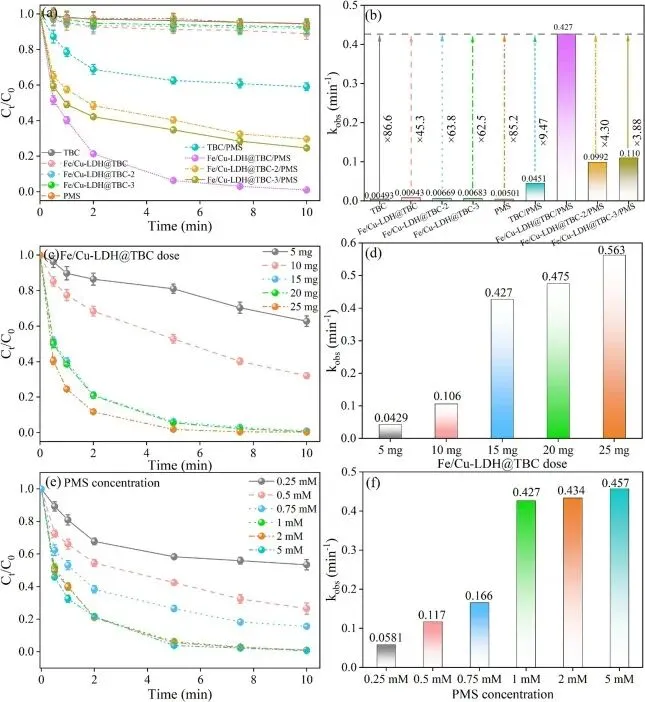
Fig. 1. SMX removal efficiency (a) and kinetic rate (kobs) (b) in different reaction systems ([SMX] = 2 mg/L, [PMS] = 1 mM, [catalyst] = 15 mg, V = 0.05 L, and T = 25 °C); Effects of Fe/Cu-LDH@TBC dosage ([Fe/Cu-LDH@TBC] = 5–25 mg, [PMS] = 1 mM) (c and d) and PMS concentration ([PMS] = 0.25–5 mM, [Fe/Cu-LDH@TBC] = 15 mg) (e and f) on SMX degradation efficiency and kinetic rate ([SMX] = 2 mg/L, V = 0.05 L, and T = 25 °C) by Fe/Cu-LDH@TBC/PMS system.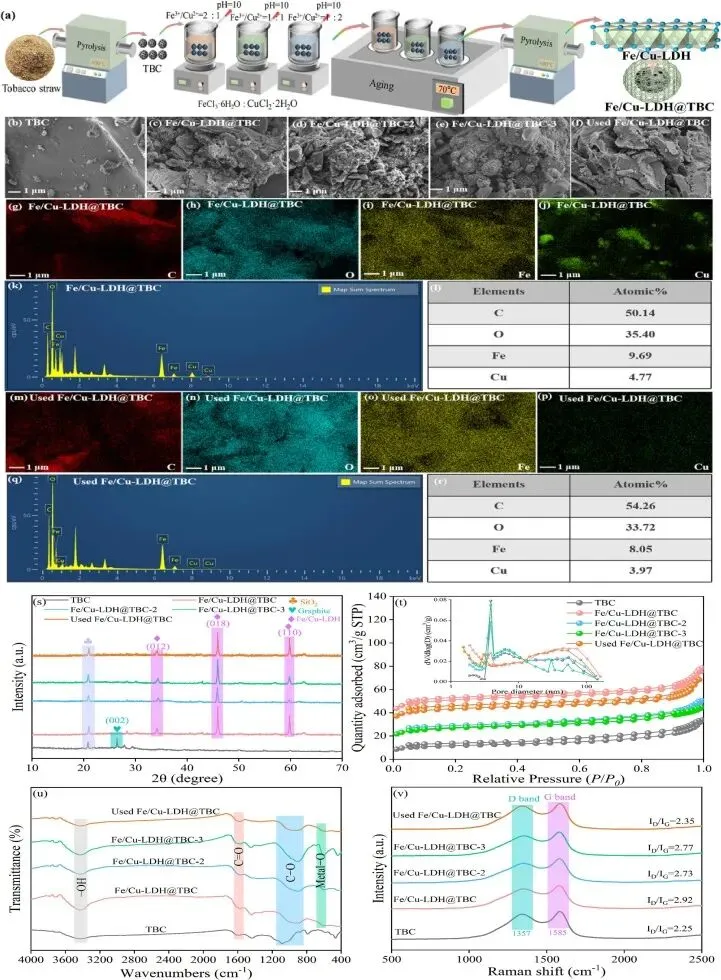
Fig. 2. The preparation of TBC and Fe/Cu-LDH functionalized TBC (a); The surface morphology of TBC (b), Fe/Cu-LDH functionalized TBC (c-e) and used Fe/Cu-LDH@TBC (f); The elemental mapping of Fe/Cu-LDH@TBC (g-j) and used Fe/Cu-LDH@TBC (m-p); The Map Sum Spectrum (k and q) and atomic ratio of elements (l and r) of Fe/Cu-LDH@TBC and used Fe/Cu-LDH@TBC; XRD patterns (s), pore structure (t), FTIR (u) and Raman spectrum (v) of TBC, Fe/Cu-LDH functionalized TBC and used Fe/Cu-LDH@TBC.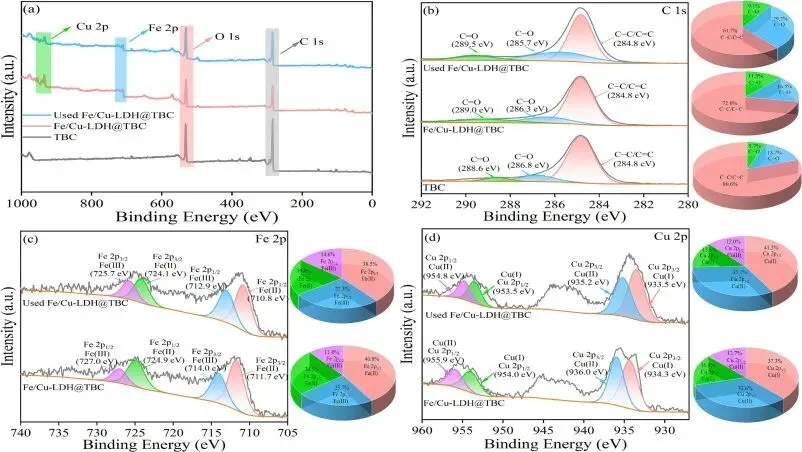
Fig. 3. XPS survey (a) and high resolution C 1 s (b) spectrum of TBC, Fe/Cu-LDH@TBC and used Fe/Cu-LDH@TBC; The high resolution Fe 2p (c) and Cu 2p (d) spectra of Fe/Cu-LDH@TBC and used Fe/Cu-LDH@TBC.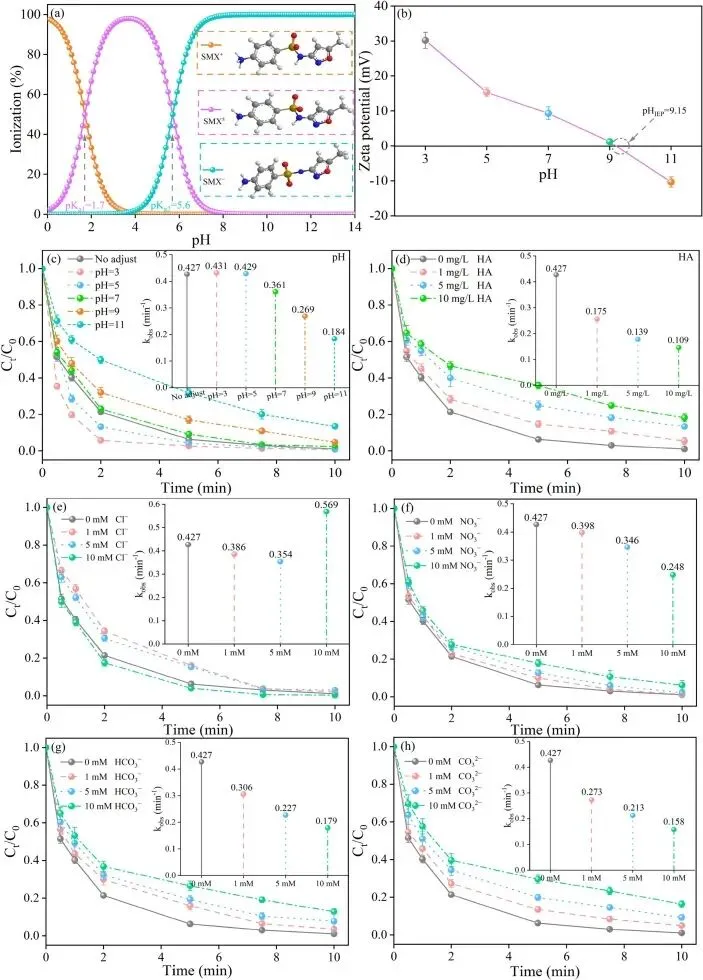
Fig. 4. The species of SMX (a) and zeta potential of Fe/Cu-LDH@TBC (b) at different pH; Effects of solution pH ([pH] = 3–11) (c), HA ([HA] = 0–10 mg/L) (d) and anionic concentrations ([Cl− (e), NO3− (f), HCO3− (g), and CO32− (h)] = 0–10 mM) on SMX degradation efficiency and kinetic rate by Fe/Cu-LDH@TBC/PMS system ([SMX] = 2 mg/L, [PMS] = 1 mM, [Fe/Cu-LDH@TBC] = 15 mg, V = 0.05 L, and T = 25 °C).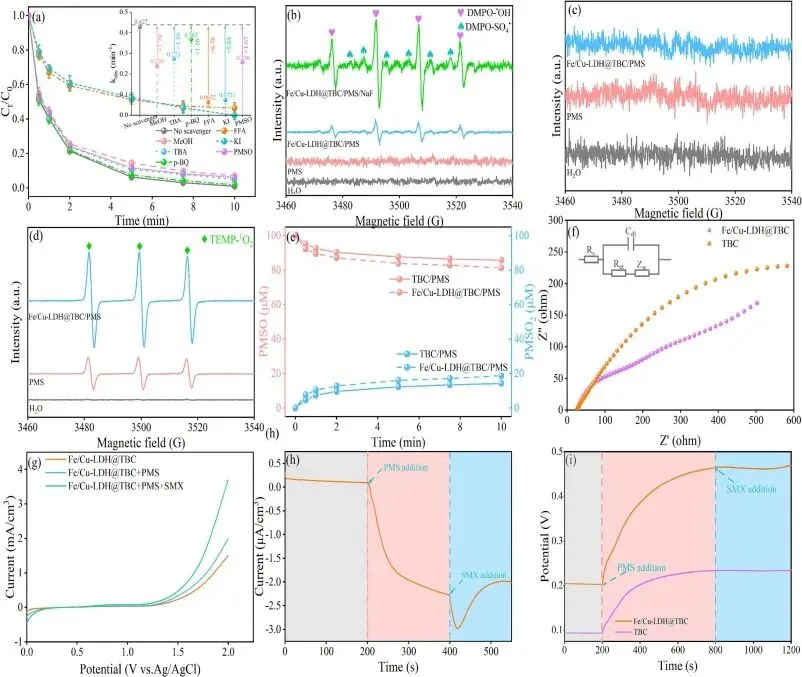
Fig. 5. The degradation performance of SMX in Fe/Cu-LDH@TBC/PMS system with addition of different scavengers (a); EPR spectra of H2O, PMS and Fe/Cu-LDH@TBC/PMS systems using DMPO for capturing SO4▪−/▪OH (b), O2▪− (c), and TEMP for capturing 1O2 (d); PMSO and PMSO2 concentrations in PMS and Fe/Cu-LDH@TBC/PMS systems (e); EIS curves of TBC and Fe/Cu-LDH@TBC (f); LSV curves of Fe/Cu-LDH@TBC, Fe/Cu-LDH@TBC + PMS, and Fe/Cu-LDH@TBC + PMS + SMX systems (g); The i-t curve of Fe/Cu-LDH@TBC with injection of PMS and SMX (h); The OCP of TBC and Fe/Cu-LDH@TBC with addition of PMS and SMX (i) ([PMS] = 1 mM, [Fe/Cu-LDH@TBC] = 15 mg, [PMSO] = 100 μM, V = 0.05 L, and T = 25 °C);通过共沉淀和热解法优化Fe/Cu的摩尔比,合成了Fe/Cu-LDH@TBC新型材料,该材料在广谱降解磺胺类药物(五/六元环磺胺类)及其他抗生素方面表现出卓越的PMS催化能力。淬火、溶剂置换、PMSO 探针、EPR、电化学测试和 DFT 计算证实,在 Fe/Cu-LDH@TBC 的界面处发生了增强的共价键驱动的 PMS 吸附和活化,从而产生了表面结合的自由基、1O2 以及用于 SMX 分解的电子转移。这些界面氧化机制保证了 Fe/Cu-LDH@TBC/PMS 体系对 pH 范围和共存的无机/有机化学物质具有良好的抗干扰性,这一点已在实际水体实验中得到进一步验证。Fe/Cu-LDH@TBC 上的富电子 C-O 双键、-OH 基团和结构缺陷通过断裂 PMS 的 O-O 键直接参与了 PMS 的活化,此外,这些富电子结构还能促进 Fe(II)/Fe(III) 和 Cu(I)/Cu(II) 的氧化还原循环,而双金属的价态转变进一步加速了上述过程。此外,本研究承认催化剂构型设计在阐明 PMS 活化机制方面存在局限性,因为实际催化剂的界面非常复杂。通过鉴定生成的有毒物质和 SMX 的易受攻击的反应位点,提出了四种降解途径,尽管其中一些有毒物质仍表现出不可忽视的慢性毒性,但所有有毒物质的总体生态毒性均呈下降趋势。本研究为双金属-LDH 功能化生物炭触发的抗生素催化降解提供了新的见解,拓展了生物质废物的抗生素降解和资源利用。
Yongfei Ma, Keyi Li, Feifei Zhang, Zhaojun Nie, Shiyu Qin, Haiyang Liu, Yupeng Zhang, Jiayang Xu, Zulin Zhang, Peng Zhao, Hongen Liu, Ultra-fast degradation of sulfonamides by Fe/Cu-LDH functionalized biochar activated peroxymonosulfate: Interfacial catalysis driven multiple reactive oxygen species, Chemical Engineering Journal, 2026, https://doi.org/10.1016/j.cej.2026.178435
声明:本公众号仅分享前沿学术成果,无商业用途。如涉及侵权,请立刻联系公众号后台或发送邮件,我们将及时修改或删除!
邮箱:Environ2022@163.com