当前位置:首页>农业>北京第二外国语学院 王玥棠:摩洛哥妇女农业合作社可持续赋能:构建韧性治理与包容性数字未来 | UNSP学术 x SDG5

北京第二外国语学院 王玥棠:摩洛哥妇女农业合作社可持续赋能:构建韧性治理与包容性数字未来 | UNSP学术 x SDG5

  • 2026-05-12 09:24:46
北京第二外国语学院 王玥棠:摩洛哥妇女农业合作社可持续赋能:构建韧性治理与包容性数字未来 | UNSP学术 x SDG5

SDG5:性别平等

性别平等是联合国可持续发展目标 SDG5 聚焦的全球性重要议题。该目标致力于保障女性能够全面、有效地参与政治、经济及公共事务各层级决策,并获得平等的领导发展机遇。然而当下父权制传统观念依旧根深蒂固,持续制约着女性在各行各业跻身领导层、发挥引领作用。教育领域同样存在这一困境:虽然全球从业女性在教育行业的占比持续攀升,但各类教育机构的管理决策层仍以男性为主导。伴随女权主义理念的持续普及,部分发达国家的现状虽稍有好转,但从全球整体来看,女性领导权失衡的局面依旧亟待改善。

本文作者

王玥棠 Yuetang Wang

UN Spotlight项目第39期队员

北京第二外国语学院

倡议书前言 / Preface

性别平等固然是重要议题,但其意义远不止于女性数量的简单递增;它更是衡量发展质量的核心标尺,是通往公平且可持续未来的关键路径。所以我聚焦摩洛哥女性农业合作社,旨在揭示性别平等议题的深层复杂性:我们既要追求公平正义,更要警惕结构性障碍以隐蔽形式制约女性经济潜能的释放。真正的性别平等不是统计数字的叠加,而是让每个女性都能在公正制度下充分实现自己的价值。

感谢Mellisa老师在初稿上写给我的批注和修改意见,帮助我进一步捋顺逻辑,润色内容,锚定文笔风格。感谢WFUNA官员Vicky老师在1v1指导环节对我倡议书思路的肯定,我得以更深入地将SDG5和SDG8内容结合起来思考问题本质。感谢老师们在前提提供的相关官方网址,提升了我在查找相关数据的效率。

可持续发展目标绝非彼此割裂的标签,而是密不可分的有机整体。在此,我们呼吁更多青年关注可持续发展目标,真正理解发展议题的交织性与复杂性,方能推动构建一个更加公平、包容且可持续的未来。

Sustainable Empowerment for Moroccan Women's Agricultural Cooperatives: Building Resilient Governance and Inclusive Digital Futures

Yuetang Wang

Introduction: The Urgency of Intervention

Over the past two decades, women's agricultural cooperatives in Morocco have successfully improved rural incomes and visibility in local economies. However, many of these cooperatives are now entering a phase of institutional stagnation: productivity gains are not translating into long-term resilience, younger generations are disengaging, and governance capacity remains fragile. Without targeted structural support, these cooperatives risk losing their transformative role in advancing gender equality and rural development.

Morocco hosts approximately 7,730 women-only agricultural cooperatives, with the argan oil sector engaging thousands of women in collective economic activities. Studies indicate that women participating in cooperatives achieve 73% higher income levels compared to individual entrepreneurship, creating over 2,847 direct employment opportunities in sampled regions (Jiménez & Müller, 2023). Yet beneath these achievements lies a structural vulnerability: cooperatives are hitting a sustainability ceiling where initial economic gains cannot translate into scalable development.

Three interconnected deficits drive this crisis. First, educational barriers persist: rural women face illiteracy rates of 60.4%, compared to 13.7% for urban men, limiting capacity for financial management and contract negotiation (Boutayeb, 2024). Second, governance weaknesses undermine collective potential, with opaque profit distribution and concentrated decision-making power creating vulnerability to elite capture (Réseau F3E, 2022). Third, digital exclusion and youth drain compound these challenges—while mobile internet penetration reaches 46% in Africa, rural connectivity lags below 10%, and educated young women increasingly leave rural areas, hollowing out leadership pipelines (Mohac Africa, 2025).

This initiative addresses that gap through a Cooperative Sustainability Ecosystem—an integrated framework combining visual-first digital tools, youth knowledge transfer programs, and governance certification incentives. Without targeted intervention to address these structural barriers, Morocco's celebrated women's cooperatives risk stagnation or collapse, with devastating consequences for rural women's empowerment and community resilience.

Problem Identification

The Critical Challenge: From Initial Success to Sustainability Crisis

The Literacy and Skills Gap

Despite Morocco's progress in education, rural women remain disproportionately affected by illiteracy. The national adult illiteracy rate stands at 32%, but rural women face rates of 60.4%, compared to 13.7% for urban men (Boutayeb, 2024). Among women aged 65 and older, literacy drops to merely 19%. Research from the High Atlas Foundation (2023) indicates that 90% of women in rural Morocco are illiterate, severely limiting their ability to engage with modern agricultural value chains.

This educational deficit creates immediate operational challenges: cooperative members often lack capacity for financial management, digital marketing, contract negotiation, and quality control. Consequently, cooperatives remain trapped in low-margin, primary production activities, unable to capture value-added opportunities in processing, branding, and direct-to-consumer sales.

Governance and Leadership Deficits

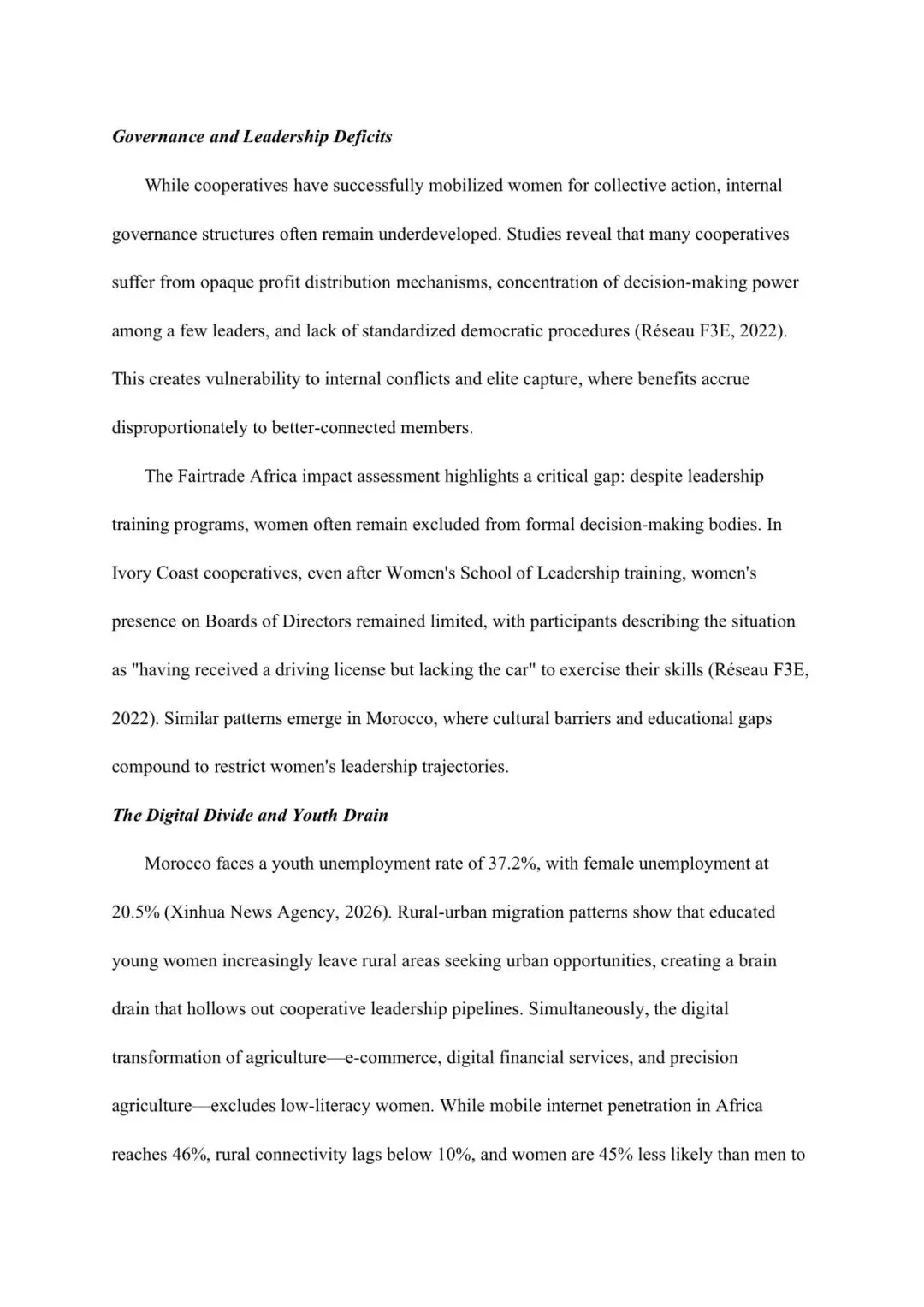
While cooperatives have successfully mobilized women for collective action, internal governance structures often remain underdeveloped. Studies reveal that many cooperatives suffer from opaque profit distribution mechanisms, concentration of decision-making power among a few leaders, and lack of standardized democratic procedures (Réseau F3E, 2022). This creates vulnerability to internal conflicts and elite capture, where benefits accrue disproportionately to better-connected members.

The Fairtrade Africa impact assessment highlights a critical gap: despite leadership training programs, women often remain excluded from formal decision-making bodies. In Ivory Coast cooperatives, even after Women's School of Leadership training, women's presence on Boards of Directors remained limited, with participants describing the situation as "having received a driving license but lacking the car" to exercise their skills (Réseau F3E, 2022). Similar patterns emerge in Morocco, where cultural barriers and educational gaps compound to restrict women's leadership trajectories.

The Digital Divide and Youth Drain

Morocco faces a youth unemployment rate of 37.2%, with female unemployment at 20.5% (Xinhua News Agency, 2026). Rural-urban migration patterns show that educated young women increasingly leave rural areas seeking urban opportunities, creating a brain drain that hollows out cooperative leadership pipelines. Simultaneously, the digital transformation of agriculture—e-commerce, digital financial services, and precision agriculture—excludes low-literacy women. While mobile internet penetration in Africa reaches 46%, rural connectivity lags below 10%, and women are 45% less likely than men to own smartphones (Mohac Africa, 2025).

Root Cause Analysis

Structural Roots: Historical Educational Deprivation

The current skills deficit among cooperative members stems from decades of educational exclusion. Until recent reforms, rural girls faced systemic barriers: 23.4% of rural girls drop out by grade 6, compared to 13.6% of rural boys (Boutayeb, 2024). Early marriage (affecting 16% of Moroccan girls before age 18, with 98% of early marriage requests originating from rural areas) and domestic labor expectations truncate educational attainment (High Atlas Foundation, 2023). The result is a generation of women entrepreneurs with limited formal schooling, now struggling to navigate increasingly complex market environments.

Institutional Roots: Policy and Support Gaps

Current government support for cooperatives concentrates on startup formation rather than sustained capacity building. The Moroccan government's "Green Plan" (Project Vert) and social economy initiatives have successfully expanded cooperative numbers, but longitudinal support for governance professionalization, digital integration, and leadership succession remains fragmented (UNESCO, 2025). Training programs, when available, often employ generic curricula ill-suited to adult learners with low literacy, failing to account for gender-specific barriers or cooperative-specific needs.

Technical and Behavioral Roots

The intersection of low literacy and digital transformation creates double exclusion. Digital tools designed for literate users exclude cooperative members, while training programs fail to adapt to oral-learning preferences and practical, hands-on pedagogical needs. Simultaneously, social norms persist that discourage women from public leadership roles, and economic pressures drive educated youth away from rural areas, breaking intergenerational knowledge transfer chains.

Impact Analysis: Direct and Indirect Consequences

Direct Impacts

Without intervention, cooperatives face economic stagnation: inability to diversify products, access premium markets, or negotiate favorable contracts. Internal governance failures risk cooperative dissolution, potentially returning women to pre-cooperative economic vulnerability. Research from Cambodia's agricultural cooperatives demonstrates that low-capacity leadership directly correlates with cooperative inefficiency and member disillusionment (Barriers of Women in Acquiring Leadership Positions in Agricultural Cooperatives, 2023).

Indirect Impacts: SDG Interconnections

The sustainability crisis reverberates across SDG 5 (Gender Equality) and SDG 8 (Decent Work and Economic Growth).

SDG 5 (Gender Equality): Unsustainable cooperatives undermine women's economic empowerment gains, potentially reversing social norm shifts and discouraging future female entrepreneurship. The cooperatives have served as visible proof that collective economic organization can dismantle patriarchal barriers and transform women's social standing. Their failure would signal that gender equality gains in rural Morocco are temporary rather than transformative.

SDG 8 (Decent Work and Economic Growth): Income stagnation prevents poverty reduction and quality job creation. Morocco's rural unemployment rate (16.4%) exceeds urban rates (6.6%), with women facing compounded disadvantages (Xinhua News Agency, 2026). Without functional cooperatives, rural women lose critical pathways to decent work, and the rural economy loses engines of inclusive growth. The loss would perpetuate spatial and gender inequalities in economic opportunity.
Solutions and Innovations

Overview of Existing Solutions

Current interventions include short-term literacy and agricultural training by NGOs and government agencies; microcredit and equipment provision to enhance production capacity; and market linkage events such as trade fairs. These have successfully established cooperatives and demonstrated women's economic potential. However, evaluations reveal critical gaps:

1. Training-content mismatch: Programs focus on basic literacy rather than cooperative-specific business skills (e-commerce, quality certification, financial management).

2. Project-dependency: Support ends when funding concludes, lacking mechanisms for endogenous capacity development.

3. Superficial interventions: Technical assistance rarely addresses governance structures, leadership succession, or systemic barriers to women's decision-making participation.

Innovative Solution: The "Cooperative Sustainability Ecosystem"

We propose a comprehensive Cooperative Sustainability Ecosystem integrating three interconnected innovations:

Visual-First Digital Empowerment Toolkit

Developing a suite of mobile applications utilizing visual interfaces, voice interaction, and icon-based navigation specifically designed for low-literacy women. Tools would cover financial record-keeping, inventory management, customer relationship management, and digital marketing. In India, graphical-interface mobile applications for women micro-entrepreneurs improved revenue recording accuracy by 70% and business management efficiency. Similar voice-based agricultural advisory services in Africa have demonstrated high adoption rates among low-literacy farmers, directly addressing technical barriers and structural educational deficits by circumventing literacy requirements while building digital confidence.

Youth Mentor Return Program ("Community Catalysts")

Establishing a structured program funding short-term returns of educated rural-origin youth (university students or young professionals) to their home cooperatives. These "Community Catalysts" would provide skills transfer in digital tools, business planning, and modern agricultural techniques, while receiving leadership development mentorship and scholarship support tied to community service commitments. Kenya's "Rural Innovation Scholarship" program, which funded university students to implement community development projects during academic breaks, achieved over 40% project retention rates and successfully transferred new technologies and perspectives to rural communities. Research on youth return migration indicates that even short-term engagement can shift aspirations and build local social capital, addressing behavioral patterns of youth outmigration and institutional leadership succession gaps by creating structured knowledge transfer mechanisms.

Cooperative Governance Certification System

Partner with Moroccan government agencies (Ministry of Agriculture, Ministry of Solidarity, Social Protection and Family) to establish a voluntary certification system recognizing cooperatives meeting standards in: democratic decision-making structures, financial transparency, equitable profit distribution, youth inclusion, and women's leadership representation. Certified cooperatives would receive preferential access to government procurement contracts, subsidized credit, and tax incentives. Fairtrade certification demonstrates that standards-based incentives can drive governance improvements: certified cooperatives show higher rates of democratic participation and gender inclusion compared to non-certified counterparts, with certified products commanding market premiums of 10-30%. Research on social startups confirms that collaborative governance structures significantly enhance both economic and social performance, addressing institutional governance deficits by creating external accountability mechanisms and internal incentives for professionalization.

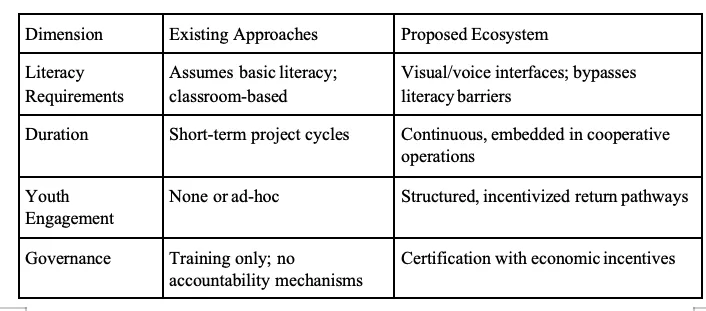
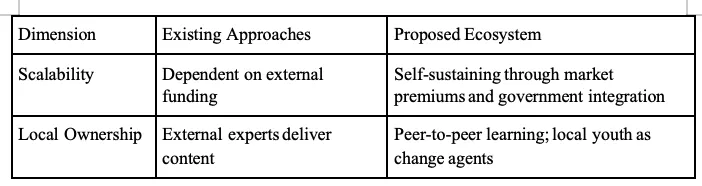
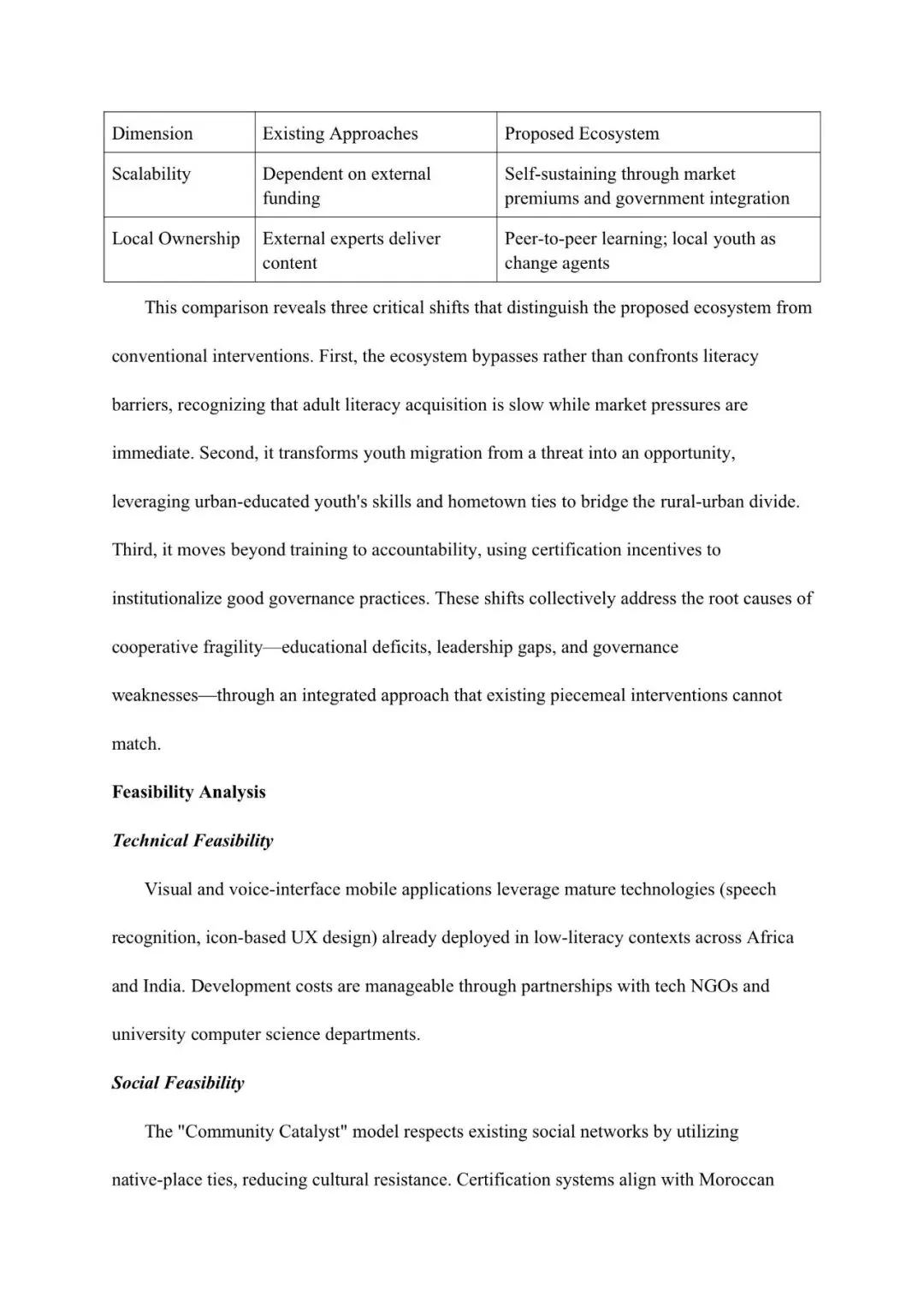
Comparative Analysis: New vs. Existing Approaches

This comparison reveals three critical shifts that distinguish the proposed ecosystem from conventional interventions. First, the ecosystem bypasses rather than confronts literacy barriers, recognizing that adult literacy acquisition is slow while market pressures are immediate. Second, it transforms youth migration from a threat into an opportunity, leveraging urban-educated youth's skills and hometown ties to bridge the rural-urban divide. Third, it moves beyond training to accountability, using certification incentives to institutionalize good governance practices. These shifts collectively address the root causes of cooperative fragility—educational deficits, leadership gaps, and governance weaknesses—through an integrated approach that existing piecemeal interventions cannot match.

Feasibility Analysis

Technical Feasibility

Visual and voice-interface mobile applications leverage mature technologies (speech recognition, icon-based UX design) already deployed in low-literacy contexts across Africa and India. Development costs are manageable through partnerships with tech NGOs and university computer science departments.

Social Feasibility

The "Community Catalyst" model respects existing social networks by utilizing native-place ties, reducing cultural resistance. Certification systems align with Moroccan government priorities for social economy development and gender equality, ensuring policy coherence.

Economic Feasibility

Initial funding requires international development agency or CSR investment (estimated €2-3 million for 3-year pilot covering 50 cooperatives). Long-term sustainability emerges through: certified cooperative market premiums; government integration of certification into existing support programs; reduced training costs through digital tool scalability.

Implementation Framework

Execution Partners and Roles

International Development Agencies (UNDP, IFAD): Seed funding, technical expertise, monitoring and evaluation frameworks

Moroccan Government (Ministry of Agriculture, Ministry of Solidarity): Certification system endorsement, policy integration, procurement preferences

Local Universities and NGOs: Youth mentor recruitment, training program management, community mobilization

Cooperative Federations: Pilot site selection, feedback mechanisms, peer learning networks

Technology Partners: Digital toolkit development, localization, maintenance

Risk Mitigation

Cultural Resistance: Engage male community leaders and cooperative members early, demonstrating economic benefits of women's digital engagement and leadership.

Sustainability Risk: Design digital tools for local maintenance; build certification fees into cooperative operating costs; train local "Digital Ambassadors" for ongoing support.

Youth Retention: Structure mentor commitments flexibly around academic calendars; create alumni networks for ongoing engagement.

Call to Action

We call upon the following stakeholders to commit to implementing the Cooperative Sustainability Ecosystem:

To the Moroccan Government: Integrate the governance certification system into the national social economy strategy; allocate 5% of rural development budgets to digital inclusion for women cooperatives; establish youth service-learning credits for university students participating in mentor programs.

To International Development Partners: Fund a 3-year pilot program reaching 200 cooperatives; support randomized controlled trials to measure impact on income, governance quality, and youth retention; facilitate South-South learning with successful models from Kenya and India.

To Private Sector Actors: Prioritize procurement from certified cooperatives; provide CSR funding for digital toolkit development; offer internship pathways for returning youth mentors.

To Civil Society: Document and disseminate best practices; advocate for policy reforms supporting cooperative professionalization; monitor implementation to ensure gender-transformative outcomes.

Conclusion

Morocco's women agricultural cooperatives represent a remarkable achievement in gender-responsive economic development, but their sustainability cannot be taken for granted. Without addressing the interconnected challenges of educational barriers, governance deficits, and digital exclusion, these cooperatives risk stagnation or collapse, with devastating consequences for rural women's empowerment and community resilience.

The proposed Cooperative Sustainability Ecosystem offers an integrated, evidence-based pathway forward. By leveraging visual digital technologies to circumvent literacy barriers, creating structured opportunities for youth knowledge transfer, and establishing certification incentives for governance professionalization, we can transform cooperatives from vulnerable startups into resilient, self-sustaining engines of inclusive growth.

The cost of inaction is measured not only in lost economic potential but in the erosion of hard-won gains for gender equality. The time to act is now—before the current generation of cooperative leaders ages out, before digital transformation further marginalizes low-literacy women, and before rural communities lose their most promising youth to irreversible urban migration.

Let us work together to ensure that Morocco's women cooperatives not only survive but thrive, becoming enduring pillars of sustainable development and models for gender-equal economic participation across the Global South.

References

Barriers of Women in Acquiring Leadership Positions in Agricultural Cooperatives: The Case of Cambodia. (2023). Rural Sociology, 88(2). https://doi.org/10.1111/ruso.12345

Boutayeb, A. (2024). Unfulfilled promises of Morocco's Vision 2015--2030: Gaps in educational equity and quality (ERIC Document No. ED673895). ERIC.

https://eric.ed.gov/?id=ED673895

Dyorama. (2025). Heritage in action: How Morocco's women-led cooperatives are driving economic change.

https://thedyorama.com/p/heritage-in-action-how-morocco-s-women-led-cooperatives-are-driving-economic-change

European Parliament. (2020). EU development cooperation and ethical certification schemes: Impact, transparency and traceability (EXPO Study). European Parliament. 

https://www.europarl.europa.eu/

GSMA. (2024). Mobile for development impact reports. GSMA. 

https://www.gsma.com/mobilefordevelopment/

High Atlas Foundation. (2023). Education barriers in Morocco. 

https://highatlasfoundation.org/en/insights/education-barriers-in-morocco-oped

International Organization for Migration. (2023). Youth return migration and rural development in Africa. IOM. 

https://www.iom.int/

Jiménez, P., & Müller, O. (2023). Promoting local entrepreneurship in rural Morocco through women-led cooperatives. Journal of Global Scientific Research, 2(1), 1–12.

Kim, S., & Lee, J. (2024). The effect of collaborative governance in social startups on social performance: The mediating effect of economic performance. Journal of Open Innovation: Technology, Market, and Complexity, 10(5), Article 1005. 

https://doi.org/10.1016/j.joitmc.2024.1005

Mohac Africa. (2025). Digital inclusion for African youths: Bridging the digital gap in Africa 2025 stats & strategies. 

https://mohacafrica.org/digital-inclusion-for-african-youths/

Réseau F3E. (2022). Impact assessment of the Fairtrade Africa Women School of Leadership Programme: Final report. Réseau F3E.

UNESCO. (2025). Functional literacy programme of women of the argan cooperative through Amazigh (Berber) language DVDs, Morocco. UIL Literacy Base. https://uil.unesco.org/

World Bank. (2022). Digital technologies and women's economic empowerment: Evidence from India. World Bank.

https://www.worldbank.org/

Xinhua News Agency. (2026, February 3). Morocco's unemployment rate drops slightly to 13 pct in 2025.

http://english.news.cn/20260203/84425f394f1740f9a6f81890278c507d/c.html

*附倡议书源文件

最新文章

随机文章

基本 文件 流程 错误 SQL 调试
  1. 请求信息 : 2026-05-13 10:37:04 HTTP/2.0 GET : https://h.mffb.com.cn/a/528486.html
  2. 运行时间 : 0.109679s [ 吞吐率:9.12req/s ] 内存消耗:4,416.70kb 文件加载:140
  3. 缓存信息 : 0 reads,0 writes
  4. 会话信息 : SESSION_ID=e0322d1f2111568d9b44d5f5b6563f46
  1. /yingpanguazai/ssd/ssd1/www/h.mffb.com.cn/public/index.php ( 0.79 KB )
  2. /yingpanguazai/ssd/ssd1/www/h.mffb.com.cn/vendor/autoload.php ( 0.17 KB )
  3. /yingpanguazai/ssd/ssd1/www/h.mffb.com.cn/vendor/composer/autoload_real.php ( 2.49 KB )
  4. /yingpanguazai/ssd/ssd1/www/h.mffb.com.cn/vendor/composer/platform_check.php ( 0.90 KB )
  5. /yingpanguazai/ssd/ssd1/www/h.mffb.com.cn/vendor/composer/ClassLoader.php ( 14.03 KB )
  6. /yingpanguazai/ssd/ssd1/www/h.mffb.com.cn/vendor/composer/autoload_static.php ( 4.90 KB )
  7. /yingpanguazai/ssd/ssd1/www/h.mffb.com.cn/vendor/topthink/think-helper/src/helper.php ( 8.34 KB )
  8. /yingpanguazai/ssd/ssd1/www/h.mffb.com.cn/vendor/topthink/think-validate/src/helper.php ( 2.19 KB )
  9. /yingpanguazai/ssd/ssd1/www/h.mffb.com.cn/vendor/topthink/think-orm/src/helper.php ( 1.47 KB )
  10. /yingpanguazai/ssd/ssd1/www/h.mffb.com.cn/vendor/topthink/think-orm/stubs/load_stubs.php ( 0.16 KB )
  11. /yingpanguazai/ssd/ssd1/www/h.mffb.com.cn/vendor/topthink/framework/src/think/Exception.php ( 1.69 KB )
  12. /yingpanguazai/ssd/ssd1/www/h.mffb.com.cn/vendor/topthink/think-container/src/Facade.php ( 2.71 KB )
  13. /yingpanguazai/ssd/ssd1/www/h.mffb.com.cn/vendor/symfony/deprecation-contracts/function.php ( 0.99 KB )
  14. /yingpanguazai/ssd/ssd1/www/h.mffb.com.cn/vendor/symfony/polyfill-mbstring/bootstrap.php ( 8.26 KB )
  15. /yingpanguazai/ssd/ssd1/www/h.mffb.com.cn/vendor/symfony/polyfill-mbstring/bootstrap80.php ( 9.78 KB )
  16. /yingpanguazai/ssd/ssd1/www/h.mffb.com.cn/vendor/symfony/var-dumper/Resources/functions/dump.php ( 1.49 KB )
  17. /yingpanguazai/ssd/ssd1/www/h.mffb.com.cn/vendor/topthink/think-dumper/src/helper.php ( 0.18 KB )
  18. /yingpanguazai/ssd/ssd1/www/h.mffb.com.cn/vendor/symfony/var-dumper/VarDumper.php ( 4.30 KB )
  19. /yingpanguazai/ssd/ssd1/www/h.mffb.com.cn/vendor/topthink/framework/src/think/App.php ( 15.30 KB )
  20. /yingpanguazai/ssd/ssd1/www/h.mffb.com.cn/vendor/topthink/think-container/src/Container.php ( 15.76 KB )
  21. /yingpanguazai/ssd/ssd1/www/h.mffb.com.cn/vendor/psr/container/src/ContainerInterface.php ( 1.02 KB )
  22. /yingpanguazai/ssd/ssd1/www/h.mffb.com.cn/app/provider.php ( 0.19 KB )
  23. /yingpanguazai/ssd/ssd1/www/h.mffb.com.cn/vendor/topthink/framework/src/think/Http.php ( 6.04 KB )
  24. /yingpanguazai/ssd/ssd1/www/h.mffb.com.cn/vendor/topthink/think-helper/src/helper/Str.php ( 7.29 KB )
  25. /yingpanguazai/ssd/ssd1/www/h.mffb.com.cn/vendor/topthink/framework/src/think/Env.php ( 4.68 KB )
  26. /yingpanguazai/ssd/ssd1/www/h.mffb.com.cn/app/common.php ( 0.03 KB )
  27. /yingpanguazai/ssd/ssd1/www/h.mffb.com.cn/vendor/topthink/framework/src/helper.php ( 18.78 KB )
  28. /yingpanguazai/ssd/ssd1/www/h.mffb.com.cn/vendor/topthink/framework/src/think/Config.php ( 5.54 KB )
  29. /yingpanguazai/ssd/ssd1/www/h.mffb.com.cn/config/app.php ( 0.95 KB )
  30. /yingpanguazai/ssd/ssd1/www/h.mffb.com.cn/config/cache.php ( 0.78 KB )
  31. /yingpanguazai/ssd/ssd1/www/h.mffb.com.cn/config/console.php ( 0.23 KB )
  32. /yingpanguazai/ssd/ssd1/www/h.mffb.com.cn/config/cookie.php ( 0.56 KB )
  33. /yingpanguazai/ssd/ssd1/www/h.mffb.com.cn/config/database.php ( 2.48 KB )
  34. /yingpanguazai/ssd/ssd1/www/h.mffb.com.cn/vendor/topthink/framework/src/think/facade/Env.php ( 1.67 KB )
  35. /yingpanguazai/ssd/ssd1/www/h.mffb.com.cn/config/filesystem.php ( 0.61 KB )
  36. /yingpanguazai/ssd/ssd1/www/h.mffb.com.cn/config/lang.php ( 0.91 KB )
  37. /yingpanguazai/ssd/ssd1/www/h.mffb.com.cn/config/log.php ( 1.35 KB )
  38. /yingpanguazai/ssd/ssd1/www/h.mffb.com.cn/config/middleware.php ( 0.19 KB )
  39. /yingpanguazai/ssd/ssd1/www/h.mffb.com.cn/config/route.php ( 1.89 KB )
  40. /yingpanguazai/ssd/ssd1/www/h.mffb.com.cn/config/session.php ( 0.57 KB )
  41. /yingpanguazai/ssd/ssd1/www/h.mffb.com.cn/config/trace.php ( 0.34 KB )
  42. /yingpanguazai/ssd/ssd1/www/h.mffb.com.cn/config/view.php ( 0.82 KB )
  43. /yingpanguazai/ssd/ssd1/www/h.mffb.com.cn/app/event.php ( 0.25 KB )
  44. /yingpanguazai/ssd/ssd1/www/h.mffb.com.cn/vendor/topthink/framework/src/think/Event.php ( 7.67 KB )
  45. /yingpanguazai/ssd/ssd1/www/h.mffb.com.cn/app/service.php ( 0.13 KB )
  46. /yingpanguazai/ssd/ssd1/www/h.mffb.com.cn/app/AppService.php ( 0.26 KB )
  47. /yingpanguazai/ssd/ssd1/www/h.mffb.com.cn/vendor/topthink/framework/src/think/Service.php ( 1.64 KB )
  48. /yingpanguazai/ssd/ssd1/www/h.mffb.com.cn/vendor/topthink/framework/src/think/Lang.php ( 7.35 KB )
  49. /yingpanguazai/ssd/ssd1/www/h.mffb.com.cn/vendor/topthink/framework/src/lang/zh-cn.php ( 13.70 KB )
  50. /yingpanguazai/ssd/ssd1/www/h.mffb.com.cn/vendor/topthink/framework/src/think/initializer/Error.php ( 3.31 KB )
  51. /yingpanguazai/ssd/ssd1/www/h.mffb.com.cn/vendor/topthink/framework/src/think/initializer/RegisterService.php ( 1.33 KB )
  52. /yingpanguazai/ssd/ssd1/www/h.mffb.com.cn/vendor/services.php ( 0.14 KB )
  53. /yingpanguazai/ssd/ssd1/www/h.mffb.com.cn/vendor/topthink/framework/src/think/service/PaginatorService.php ( 1.52 KB )
  54. /yingpanguazai/ssd/ssd1/www/h.mffb.com.cn/vendor/topthink/framework/src/think/service/ValidateService.php ( 0.99 KB )
  55. /yingpanguazai/ssd/ssd1/www/h.mffb.com.cn/vendor/topthink/framework/src/think/service/ModelService.php ( 2.04 KB )
  56. /yingpanguazai/ssd/ssd1/www/h.mffb.com.cn/vendor/topthink/think-trace/src/Service.php ( 0.77 KB )
  57. /yingpanguazai/ssd/ssd1/www/h.mffb.com.cn/vendor/topthink/framework/src/think/Middleware.php ( 6.72 KB )
  58. /yingpanguazai/ssd/ssd1/www/h.mffb.com.cn/vendor/topthink/framework/src/think/initializer/BootService.php ( 0.77 KB )
  59. /yingpanguazai/ssd/ssd1/www/h.mffb.com.cn/vendor/topthink/think-orm/src/Paginator.php ( 11.86 KB )
  60. /yingpanguazai/ssd/ssd1/www/h.mffb.com.cn/vendor/topthink/think-validate/src/Validate.php ( 63.20 KB )
  61. /yingpanguazai/ssd/ssd1/www/h.mffb.com.cn/vendor/topthink/think-orm/src/Model.php ( 23.55 KB )
  62. /yingpanguazai/ssd/ssd1/www/h.mffb.com.cn/vendor/topthink/think-orm/src/model/concern/Attribute.php ( 21.05 KB )
  63. /yingpanguazai/ssd/ssd1/www/h.mffb.com.cn/vendor/topthink/think-orm/src/model/concern/AutoWriteData.php ( 4.21 KB )
  64. /yingpanguazai/ssd/ssd1/www/h.mffb.com.cn/vendor/topthink/think-orm/src/model/concern/Conversion.php ( 6.44 KB )
  65. /yingpanguazai/ssd/ssd1/www/h.mffb.com.cn/vendor/topthink/think-orm/src/model/concern/DbConnect.php ( 5.16 KB )
  66. /yingpanguazai/ssd/ssd1/www/h.mffb.com.cn/vendor/topthink/think-orm/src/model/concern/ModelEvent.php ( 2.33 KB )
  67. /yingpanguazai/ssd/ssd1/www/h.mffb.com.cn/vendor/topthink/think-orm/src/model/concern/RelationShip.php ( 28.29 KB )
  68. /yingpanguazai/ssd/ssd1/www/h.mffb.com.cn/vendor/topthink/think-helper/src/contract/Arrayable.php ( 0.09 KB )
  69. /yingpanguazai/ssd/ssd1/www/h.mffb.com.cn/vendor/topthink/think-helper/src/contract/Jsonable.php ( 0.13 KB )
  70. /yingpanguazai/ssd/ssd1/www/h.mffb.com.cn/vendor/topthink/think-orm/src/model/contract/Modelable.php ( 0.09 KB )
  71. /yingpanguazai/ssd/ssd1/www/h.mffb.com.cn/vendor/topthink/framework/src/think/Db.php ( 2.88 KB )
  72. /yingpanguazai/ssd/ssd1/www/h.mffb.com.cn/vendor/topthink/think-orm/src/DbManager.php ( 8.52 KB )
  73. /yingpanguazai/ssd/ssd1/www/h.mffb.com.cn/vendor/topthink/framework/src/think/Log.php ( 6.28 KB )
  74. /yingpanguazai/ssd/ssd1/www/h.mffb.com.cn/vendor/topthink/framework/src/think/Manager.php ( 3.92 KB )
  75. /yingpanguazai/ssd/ssd1/www/h.mffb.com.cn/vendor/psr/log/src/LoggerTrait.php ( 2.69 KB )
  76. /yingpanguazai/ssd/ssd1/www/h.mffb.com.cn/vendor/psr/log/src/LoggerInterface.php ( 2.71 KB )
  77. /yingpanguazai/ssd/ssd1/www/h.mffb.com.cn/vendor/topthink/framework/src/think/Cache.php ( 4.92 KB )
  78. /yingpanguazai/ssd/ssd1/www/h.mffb.com.cn/vendor/psr/simple-cache/src/CacheInterface.php ( 4.71 KB )
  79. /yingpanguazai/ssd/ssd1/www/h.mffb.com.cn/vendor/topthink/think-helper/src/helper/Arr.php ( 16.63 KB )
  80. /yingpanguazai/ssd/ssd1/www/h.mffb.com.cn/vendor/topthink/framework/src/think/cache/driver/File.php ( 7.84 KB )
  81. /yingpanguazai/ssd/ssd1/www/h.mffb.com.cn/vendor/topthink/framework/src/think/cache/Driver.php ( 9.03 KB )
  82. /yingpanguazai/ssd/ssd1/www/h.mffb.com.cn/vendor/topthink/framework/src/think/contract/CacheHandlerInterface.php ( 1.99 KB )
  83. /yingpanguazai/ssd/ssd1/www/h.mffb.com.cn/app/Request.php ( 0.09 KB )
  84. /yingpanguazai/ssd/ssd1/www/h.mffb.com.cn/vendor/topthink/framework/src/think/Request.php ( 55.78 KB )
  85. /yingpanguazai/ssd/ssd1/www/h.mffb.com.cn/app/middleware.php ( 0.25 KB )
  86. /yingpanguazai/ssd/ssd1/www/h.mffb.com.cn/vendor/topthink/framework/src/think/Pipeline.php ( 2.61 KB )
  87. /yingpanguazai/ssd/ssd1/www/h.mffb.com.cn/vendor/topthink/think-trace/src/TraceDebug.php ( 3.40 KB )
  88. /yingpanguazai/ssd/ssd1/www/h.mffb.com.cn/vendor/topthink/framework/src/think/middleware/SessionInit.php ( 1.94 KB )
  89. /yingpanguazai/ssd/ssd1/www/h.mffb.com.cn/vendor/topthink/framework/src/think/Session.php ( 1.80 KB )
  90. /yingpanguazai/ssd/ssd1/www/h.mffb.com.cn/vendor/topthink/framework/src/think/session/driver/File.php ( 6.27 KB )
  91. /yingpanguazai/ssd/ssd1/www/h.mffb.com.cn/vendor/topthink/framework/src/think/contract/SessionHandlerInterface.php ( 0.87 KB )
  92. /yingpanguazai/ssd/ssd1/www/h.mffb.com.cn/vendor/topthink/framework/src/think/session/Store.php ( 7.12 KB )
  93. /yingpanguazai/ssd/ssd1/www/h.mffb.com.cn/vendor/topthink/framework/src/think/Route.php ( 23.73 KB )
  94. /yingpanguazai/ssd/ssd1/www/h.mffb.com.cn/vendor/topthink/framework/src/think/route/RuleName.php ( 5.75 KB )
  95. /yingpanguazai/ssd/ssd1/www/h.mffb.com.cn/vendor/topthink/framework/src/think/route/Domain.php ( 2.53 KB )
  96. /yingpanguazai/ssd/ssd1/www/h.mffb.com.cn/vendor/topthink/framework/src/think/route/RuleGroup.php ( 22.43 KB )
  97. /yingpanguazai/ssd/ssd1/www/h.mffb.com.cn/vendor/topthink/framework/src/think/route/Rule.php ( 26.95 KB )
  98. /yingpanguazai/ssd/ssd1/www/h.mffb.com.cn/vendor/topthink/framework/src/think/route/RuleItem.php ( 9.78 KB )
  99. /yingpanguazai/ssd/ssd1/www/h.mffb.com.cn/route/app.php ( 1.72 KB )
  100. /yingpanguazai/ssd/ssd1/www/h.mffb.com.cn/vendor/topthink/framework/src/think/facade/Route.php ( 4.70 KB )
  101. /yingpanguazai/ssd/ssd1/www/h.mffb.com.cn/vendor/topthink/framework/src/think/route/dispatch/Controller.php ( 4.74 KB )
  102. /yingpanguazai/ssd/ssd1/www/h.mffb.com.cn/vendor/topthink/framework/src/think/route/Dispatch.php ( 10.44 KB )
  103. /yingpanguazai/ssd/ssd1/www/h.mffb.com.cn/app/controller/Index.php ( 4.81 KB )
  104. /yingpanguazai/ssd/ssd1/www/h.mffb.com.cn/app/BaseController.php ( 2.05 KB )
  105. /yingpanguazai/ssd/ssd1/www/h.mffb.com.cn/vendor/topthink/think-orm/src/facade/Db.php ( 0.93 KB )
  106. /yingpanguazai/ssd/ssd1/www/h.mffb.com.cn/vendor/topthink/think-orm/src/db/connector/Mysql.php ( 5.44 KB )
  107. /yingpanguazai/ssd/ssd1/www/h.mffb.com.cn/vendor/topthink/think-orm/src/db/PDOConnection.php ( 52.47 KB )
  108. /yingpanguazai/ssd/ssd1/www/h.mffb.com.cn/vendor/topthink/think-orm/src/db/Connection.php ( 8.39 KB )
  109. /yingpanguazai/ssd/ssd1/www/h.mffb.com.cn/vendor/topthink/think-orm/src/db/ConnectionInterface.php ( 4.57 KB )
  110. /yingpanguazai/ssd/ssd1/www/h.mffb.com.cn/vendor/topthink/think-orm/src/db/builder/Mysql.php ( 16.58 KB )
  111. /yingpanguazai/ssd/ssd1/www/h.mffb.com.cn/vendor/topthink/think-orm/src/db/Builder.php ( 24.06 KB )
  112. /yingpanguazai/ssd/ssd1/www/h.mffb.com.cn/vendor/topthink/think-orm/src/db/BaseBuilder.php ( 27.50 KB )
  113. /yingpanguazai/ssd/ssd1/www/h.mffb.com.cn/vendor/topthink/think-orm/src/db/Query.php ( 15.71 KB )
  114. /yingpanguazai/ssd/ssd1/www/h.mffb.com.cn/vendor/topthink/think-orm/src/db/BaseQuery.php ( 45.13 KB )
  115. /yingpanguazai/ssd/ssd1/www/h.mffb.com.cn/vendor/topthink/think-orm/src/db/concern/TimeFieldQuery.php ( 7.43 KB )
  116. /yingpanguazai/ssd/ssd1/www/h.mffb.com.cn/vendor/topthink/think-orm/src/db/concern/AggregateQuery.php ( 3.26 KB )
  117. /yingpanguazai/ssd/ssd1/www/h.mffb.com.cn/vendor/topthink/think-orm/src/db/concern/ModelRelationQuery.php ( 20.07 KB )
  118. /yingpanguazai/ssd/ssd1/www/h.mffb.com.cn/vendor/topthink/think-orm/src/db/concern/ParamsBind.php ( 3.66 KB )
  119. /yingpanguazai/ssd/ssd1/www/h.mffb.com.cn/vendor/topthink/think-orm/src/db/concern/ResultOperation.php ( 7.01 KB )
  120. /yingpanguazai/ssd/ssd1/www/h.mffb.com.cn/vendor/topthink/think-orm/src/db/concern/WhereQuery.php ( 19.37 KB )
  121. /yingpanguazai/ssd/ssd1/www/h.mffb.com.cn/vendor/topthink/think-orm/src/db/concern/JoinAndViewQuery.php ( 7.11 KB )
  122. /yingpanguazai/ssd/ssd1/www/h.mffb.com.cn/vendor/topthink/think-orm/src/db/concern/TableFieldInfo.php ( 2.63 KB )
  123. /yingpanguazai/ssd/ssd1/www/h.mffb.com.cn/vendor/topthink/think-orm/src/db/concern/Transaction.php ( 2.77 KB )
  124. /yingpanguazai/ssd/ssd1/www/h.mffb.com.cn/vendor/topthink/framework/src/think/log/driver/File.php ( 5.96 KB )
  125. /yingpanguazai/ssd/ssd1/www/h.mffb.com.cn/vendor/topthink/framework/src/think/contract/LogHandlerInterface.php ( 0.86 KB )
  126. /yingpanguazai/ssd/ssd1/www/h.mffb.com.cn/vendor/topthink/framework/src/think/log/Channel.php ( 3.89 KB )
  127. /yingpanguazai/ssd/ssd1/www/h.mffb.com.cn/vendor/topthink/framework/src/think/event/LogRecord.php ( 1.02 KB )
  128. /yingpanguazai/ssd/ssd1/www/h.mffb.com.cn/vendor/topthink/think-helper/src/Collection.php ( 16.47 KB )
  129. /yingpanguazai/ssd/ssd1/www/h.mffb.com.cn/vendor/topthink/framework/src/think/facade/View.php ( 1.70 KB )
  130. /yingpanguazai/ssd/ssd1/www/h.mffb.com.cn/vendor/topthink/framework/src/think/View.php ( 4.39 KB )
  131. /yingpanguazai/ssd/ssd1/www/h.mffb.com.cn/vendor/topthink/framework/src/think/Response.php ( 8.81 KB )
  132. /yingpanguazai/ssd/ssd1/www/h.mffb.com.cn/vendor/topthink/framework/src/think/response/View.php ( 3.29 KB )
  133. /yingpanguazai/ssd/ssd1/www/h.mffb.com.cn/vendor/topthink/framework/src/think/Cookie.php ( 6.06 KB )
  134. /yingpanguazai/ssd/ssd1/www/h.mffb.com.cn/vendor/topthink/think-view/src/Think.php ( 8.38 KB )
  135. /yingpanguazai/ssd/ssd1/www/h.mffb.com.cn/vendor/topthink/framework/src/think/contract/TemplateHandlerInterface.php ( 1.60 KB )
  136. /yingpanguazai/ssd/ssd1/www/h.mffb.com.cn/vendor/topthink/think-template/src/Template.php ( 46.61 KB )
  137. /yingpanguazai/ssd/ssd1/www/h.mffb.com.cn/vendor/topthink/think-template/src/template/driver/File.php ( 2.41 KB )
  138. /yingpanguazai/ssd/ssd1/www/h.mffb.com.cn/vendor/topthink/think-template/src/template/contract/DriverInterface.php ( 0.86 KB )
  139. /yingpanguazai/ssd/ssd1/www/h.mffb.com.cn/runtime/temp/32b793ebdcbdb96aeb8bb24c123b0bef.php ( 11.98 KB )
  140. /yingpanguazai/ssd/ssd1/www/h.mffb.com.cn/vendor/topthink/think-trace/src/Html.php ( 4.42 KB )
  1. CONNECT:[ UseTime:0.000504s ] mysql:host=127.0.0.1;port=3306;dbname=h_mffb;charset=utf8mb4
  2. SHOW FULL COLUMNS FROM `fenlei` [ RunTime:0.000935s ]
  3. SELECT * FROM `fenlei` WHERE `fid` = 0 [ RunTime:0.000334s ]
  4. SELECT * FROM `fenlei` WHERE `fid` = 63 [ RunTime:0.007314s ]
  5. SHOW FULL COLUMNS FROM `set` [ RunTime:0.000637s ]
  6. SELECT * FROM `set` [ RunTime:0.000218s ]
  7. SHOW FULL COLUMNS FROM `article` [ RunTime:0.000599s ]
  8. SELECT * FROM `article` WHERE `id` = 528486 LIMIT 1 [ RunTime:0.000972s ]
  9. UPDATE `article` SET `lasttime` = 1778639824 WHERE `id` = 528486 [ RunTime:0.009028s ]
  10. SELECT * FROM `fenlei` WHERE `id` = 64 LIMIT 1 [ RunTime:0.002498s ]
  11. SELECT * FROM `article` WHERE `id` < 528486 ORDER BY `id` DESC LIMIT 1 [ RunTime:0.010029s ]
  12. SELECT * FROM `article` WHERE `id` > 528486 ORDER BY `id` ASC LIMIT 1 [ RunTime:0.006618s ]
  13. SELECT * FROM `article` WHERE `id` < 528486 ORDER BY `id` DESC LIMIT 10 [ RunTime:0.001060s ]
  14. SELECT * FROM `article` WHERE `id` < 528486 ORDER BY `id` DESC LIMIT 10,10 [ RunTime:0.001012s ]
  15. SELECT * FROM `article` WHERE `id` < 528486 ORDER BY `id` DESC LIMIT 20,10 [ RunTime:0.002551s ]
0.111115s