华中农业大学Food Chemistry:蛋黄颗粒-壳聚糖复合物体系的结构和化学特性研究:pH调节如何改善其功能特性
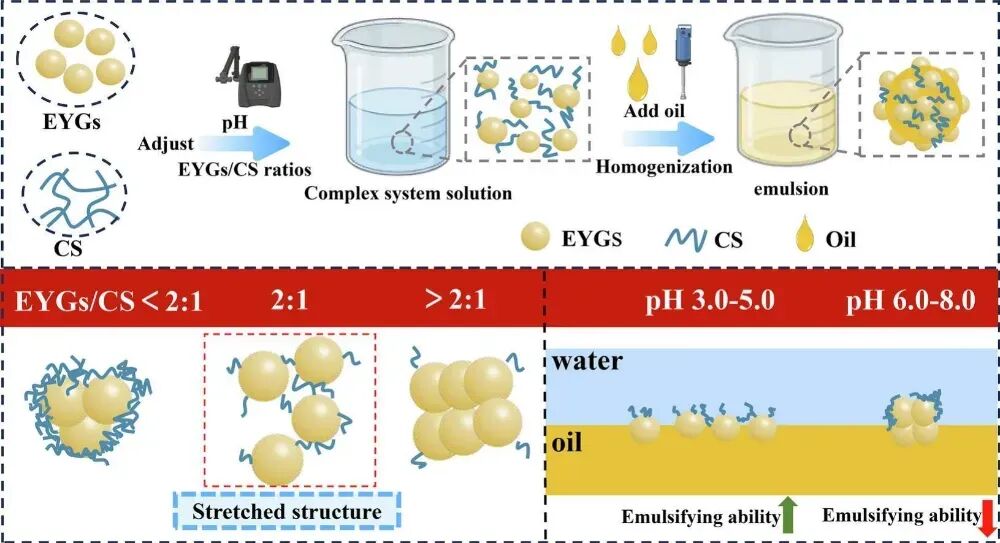
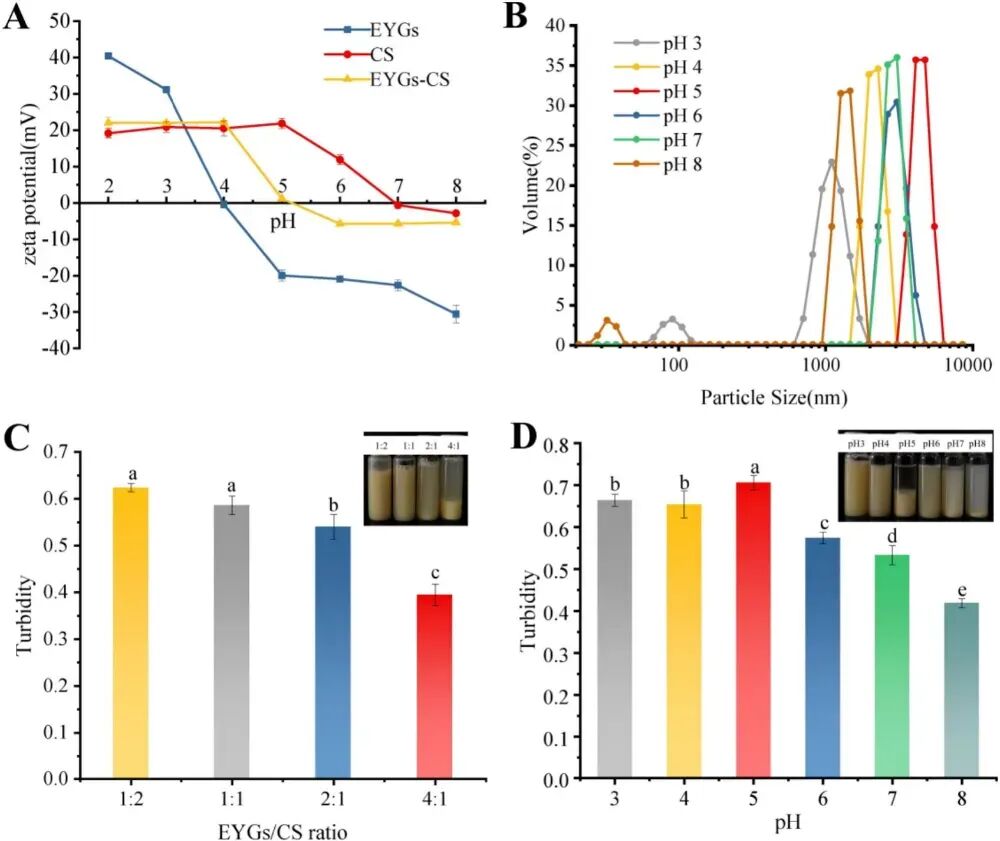
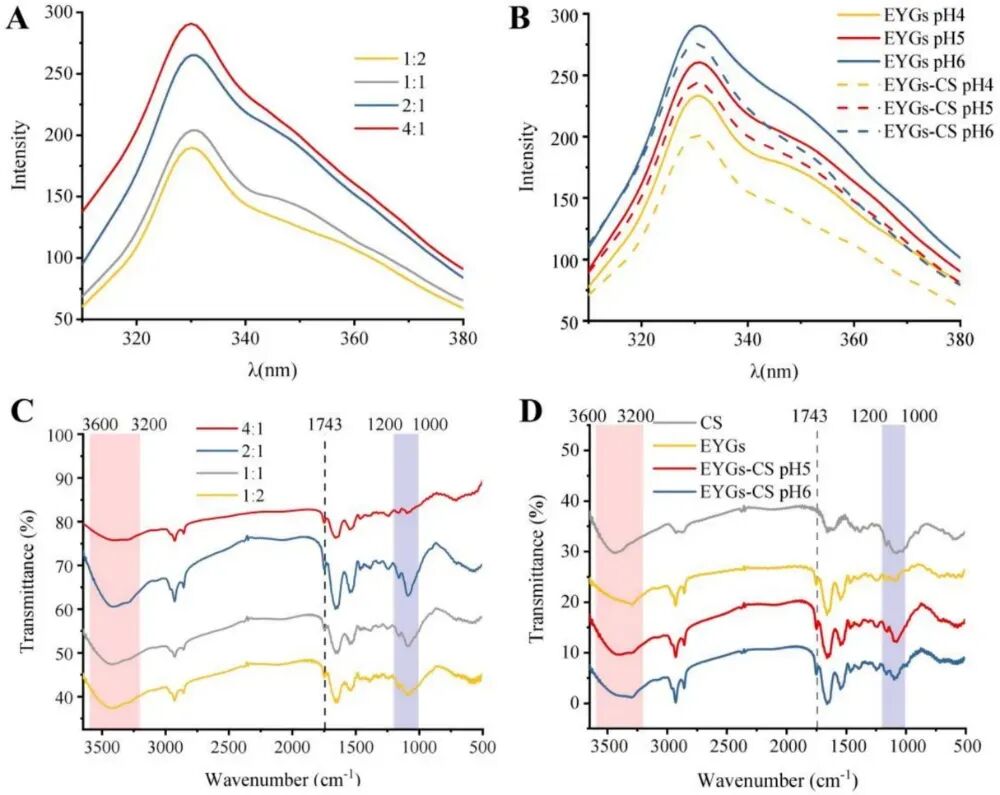
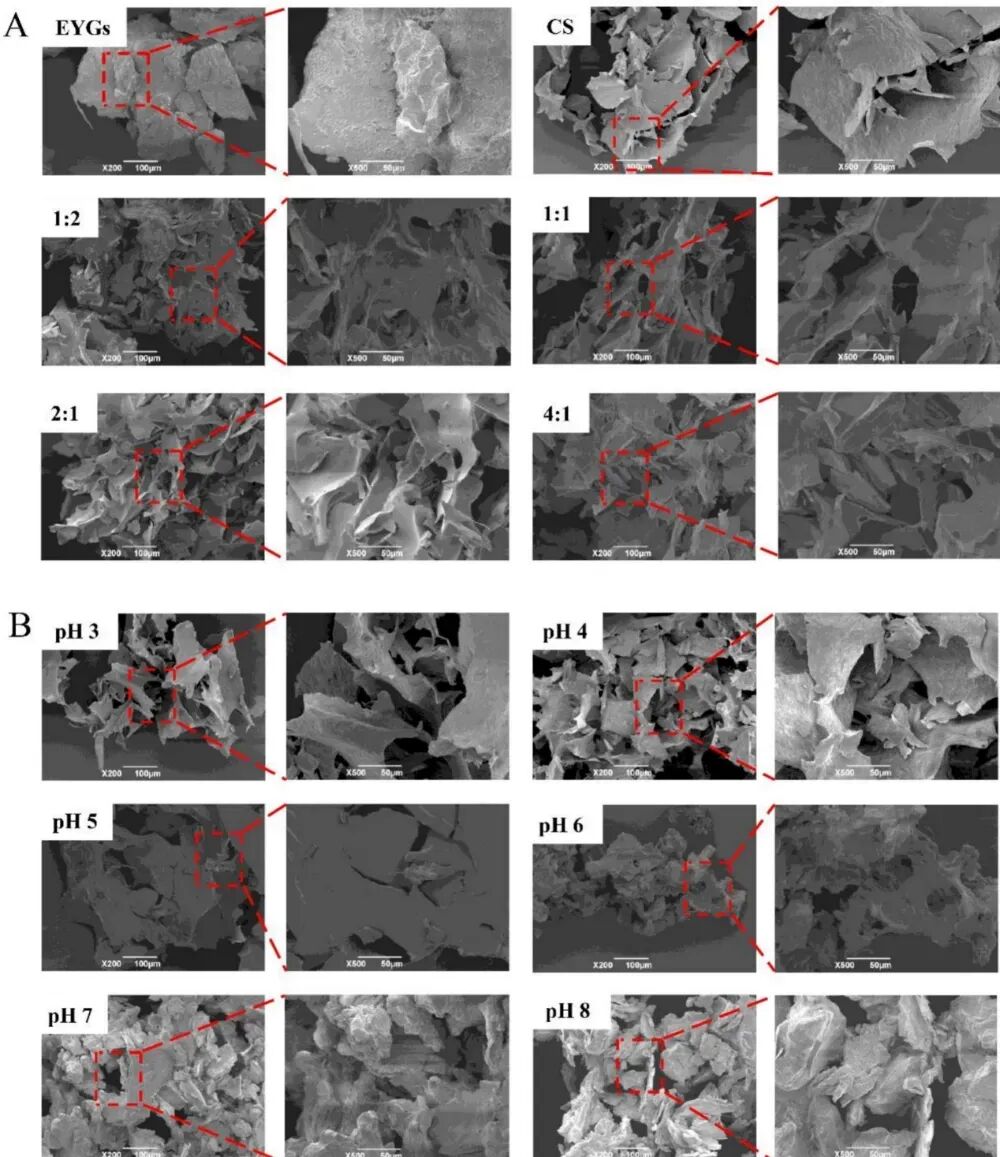
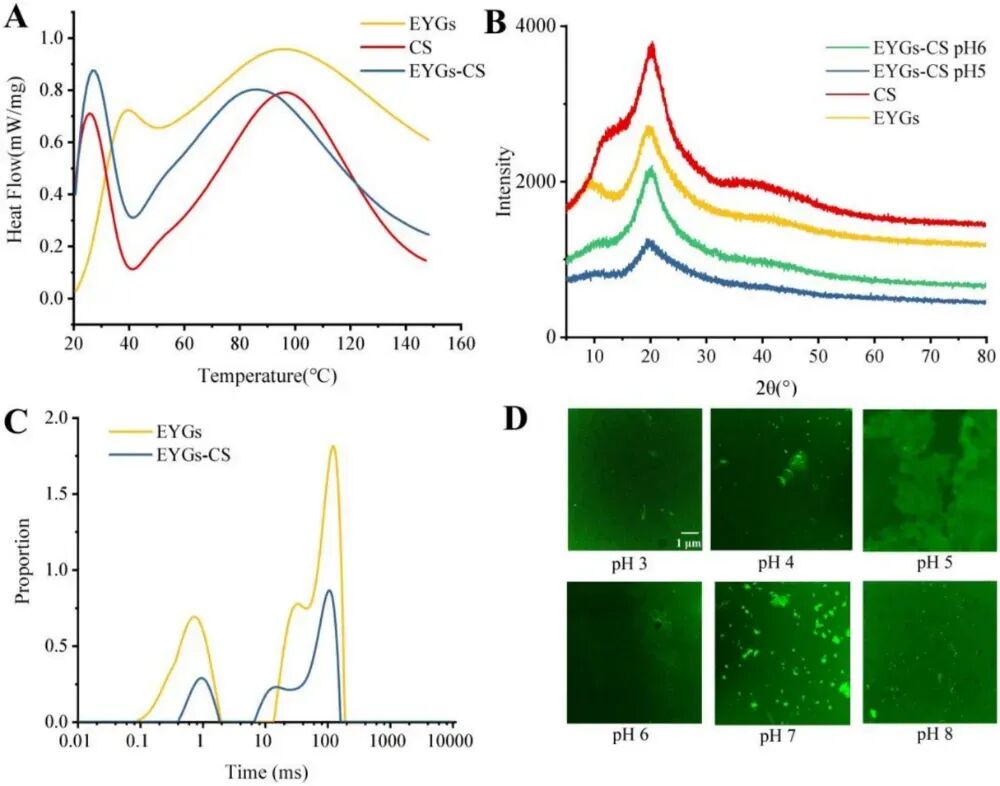
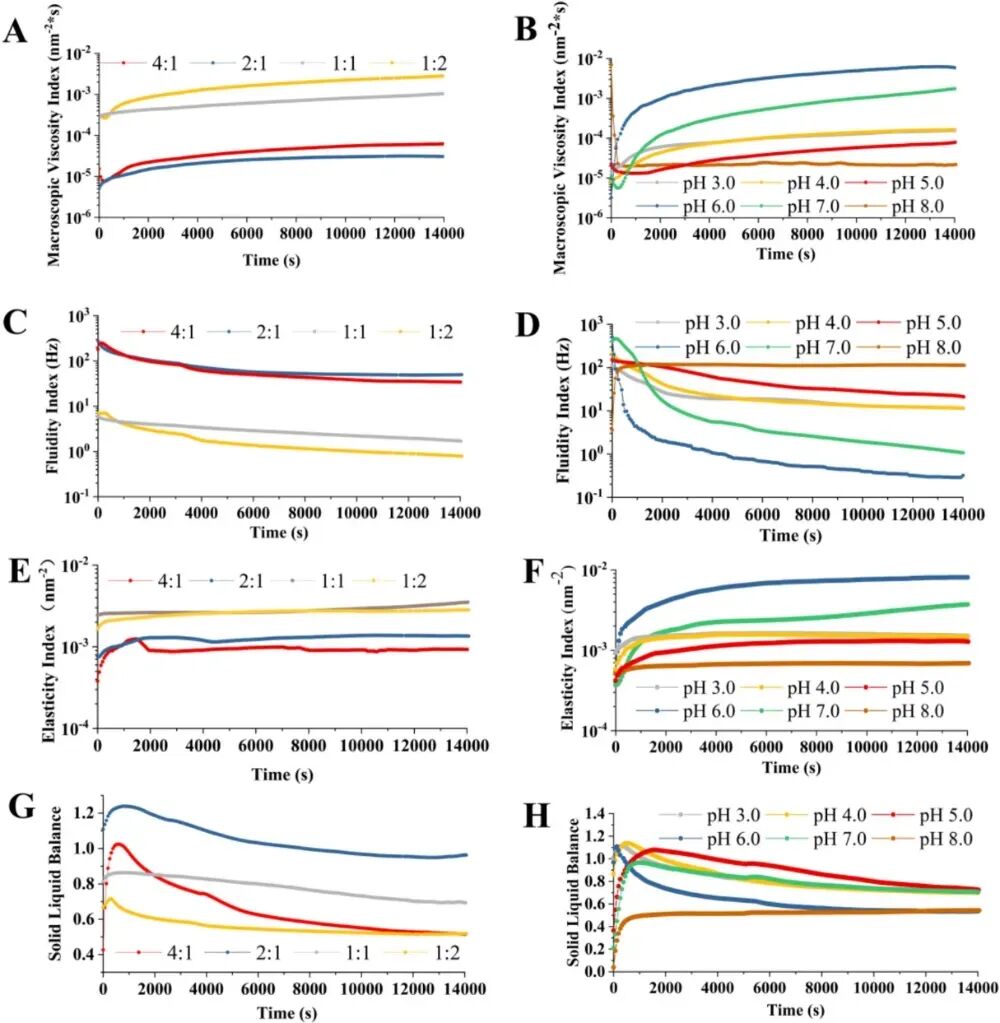
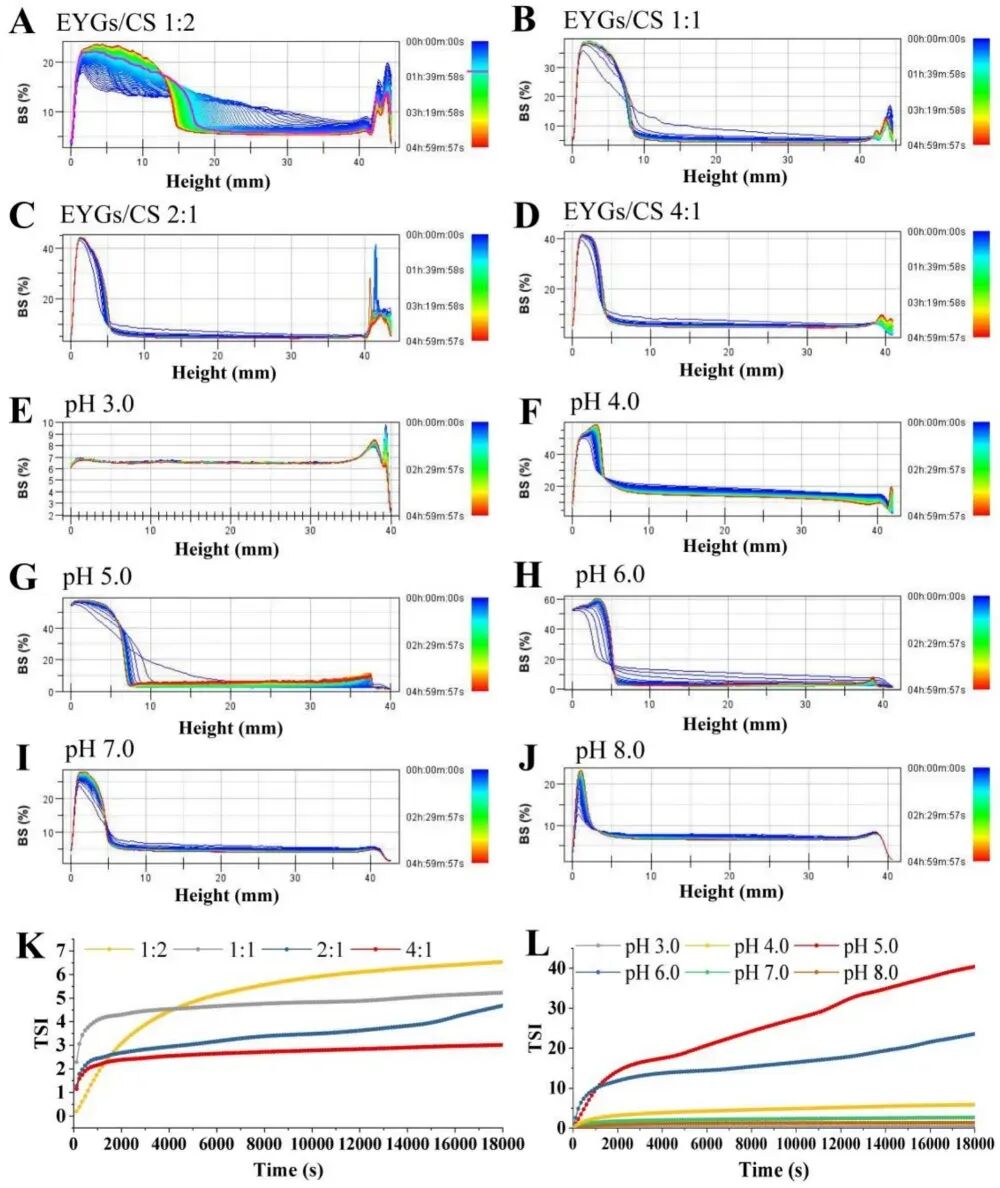
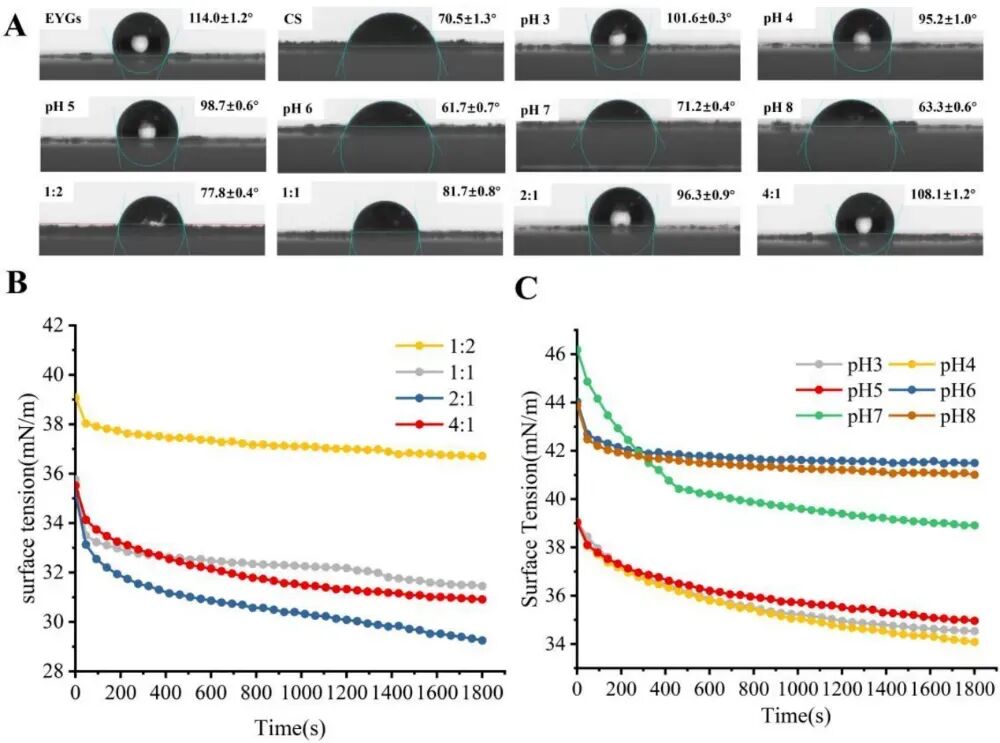
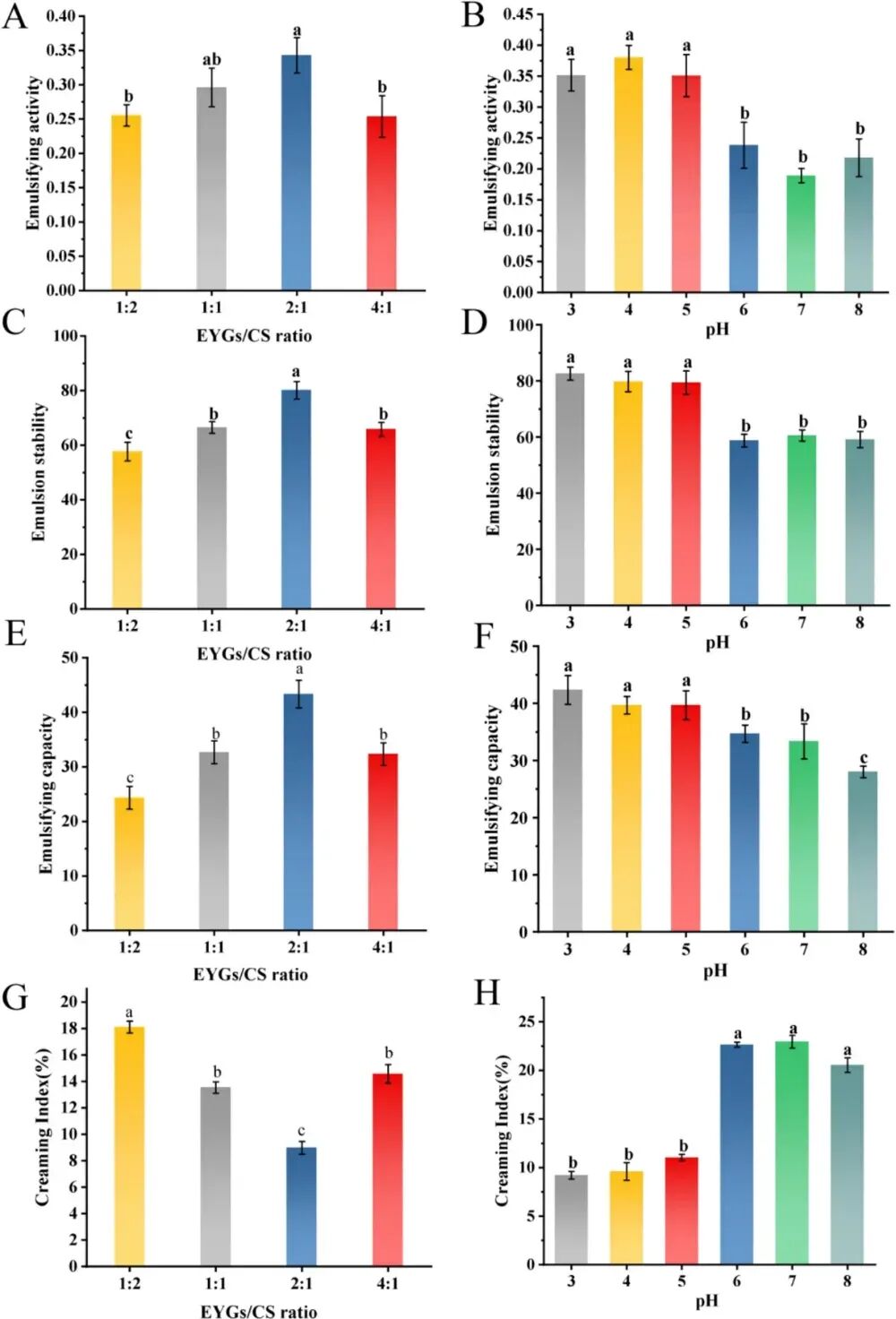
华中农业大学食品科技学院蔡朝霞教授团队在Food Chemistry发表题目为“Structural and chemical insights into egg yolk granule-chitosan complex system: How pH-modulation improve functional properties”研究论文(蛋黄颗粒-壳聚糖复合物体系的结构和化学特性研究:pH调节如何改善其功能特性)。蛋黄颗粒(EYGs)是免疫球蛋白提取过程中富含营养的副产物,其致密的结构限制了其在食品体系中的应用。本研究利用壳聚糖(CS)来调节EYGs的理化特性,并考察了不同EYGs-CS比例和pH值的影响。系统地研究了EYGs的形成机制、微观结构、界面性质和乳化性能。FTIR 和 XRD 结果证实静电相互作用和氢键是该反应的驱动力。这种络合作用破坏了 EYG 中的钙-磷酸盐桥,表现为变性温度降低和水分子流动性增强,从而形成更具柔性的两亲性结构。这种柔性络合物显著改善了界面性能,接触角接近 90°,界面张力降低。因此,在酸性条件(pH 3.0–5.0)下,当EYGs-CS比例为2:1时,可获得优异的乳化性能。本研究表明,pH响应型EYGs-CS复合物体系可通过调控微观结构和界面特性来增强功能特性。3.1. EYGs-CS复合物体系的zeta电位和粒径分布Fig. 1. Changes in zeta potential (A) and particle size distribution (B) of EYGs-CS complex system at different pH (EYGs/CS ratio 2:1). Turbidity of EYGs-CS complex system in different EYGs/CS ratios (1:2, 1:1, 2:1 and 4:1) at pH 5.5 (C) and of EYGs-CS complex system (EYGs/CS ratio 2:1) at different pH (3.0, 4.0, 5.0, 6.0, 7.0 and 8.0) (D).Fig. 2. Intrinsic fluorescence spectroscopy of EYGs-CS complex system as a function of different EYGs/CS mixing ratios (1:2, 1:1, 2:1 and 4:1) at pH 5.5 (A) and of EYGs-CS complex system (EYGs/CS ratio 2:1) at different pH (4.0, 5.0 and 6.0) (B). FTIR spectra of EYGs-CS complex system of different EYGs/CS ratios (1:2, 1:1, 2:1 and 4:1) at pH 5.5 (C) and of EYGs-CS complex system (EYGs/CS ratio 2:1) at different pH (5.0 and 6.0) (D).Fig. 3. SEM micrographs of EYGs-CS complex system with different EYGs/CS ratios (1:2, 1:1, 2:1 and 4:1) at pH 5.5 (A) and of EYGs-CS complex system (EYGs/CS ratio 2:1) at different pH (3.0, 4.0, 5.0, 6.0, 7.0 and 8.0) (B).Fig. 4. DSC thermograms of EYGs-CS complex system at pH 5.0 (EYGs/CS ratio 2:1) (A). XRD patterns of EYGs-CS complex system at pH 5.0 and 6.0 (EYGs/CS ratio 2:1) (B). T2 relaxation time of EYGs-CS complex system at pH 5.0 (EYGs/CS ratio 2:1) (C). CLSM of EYGs-CS complex system at different pH (3.0–8.0) with the EYGs/CS ratio of 2:1(D). The solution concentration was 1% w/v and the magnification was 40×.3.10. EYGs-CS复合物体系的微流变学分析Fig. 5. Macroscopic viscosity index (A), fluidity index (B), elasticity index (C) and solid liquid balance (D) of EYGs-CS complex system at different ratios (1:2, 1:1, 2:1 and 4:1) under pH 5.5. Macroscopic viscosity index (E), fluidity index (F), elasticity index (G) and solid liquid balance (H) of EYGs-CS complex system at ratios of 2:1 under different pH levels (3.0, 4.0, 5.0, 6.0, 7.0, and 8.0).3.11. EYGs-CS复合物体系的多重光散射分析Fig. 6. Backscattered light intensity of EYGs-CS complex system in different EYGs/CS ratios 1:2 (A), 1:1 (B), 2:1 (C), and 4:1 (D) at pH 5.5 and of EYGs-CS complex system (EYGs/CS ratio 2:1) at different pH 3.0 (E), 4.0 (F), 5.0 (G), 6.0 (H), 7.0 (I), and 8.0 (J). TSI value of EYGs-CS complex system in different EYGs/CS ratios (1:2, 1:1, 2:1, and 4:1) at pH 5.5 (K) and of EYGs-CS complex system (EYGs/CS ratio 2:1) at different pH (3.0–8.0) (L).Fig. 7. Contact angle of EYGs-CS complex system (EYGs/CS ratio 2:1) at different pH (3.0, 4.0, 5.0, 6.0, 7.0 and 8.0) and of EYGs-CS complex system in different EYGs/CS ratios (1:2, 1:1, 2:1 and 4:1) at pH 5.5 (A). Surface tension of EYGs-CS complex system in different EYGs/CS ratios (1:2, 1:1, 2:1 and 4:1) at pH 5.5 (B) and EYGs-CS complex system (EYGs/CS ratio 2:1) at different pH values (3.0, 4.0, 5.0, 6.0, 7.0 and 8.0) (C).Fig. 8. Emulsifying activity (A), emulsifying stability (C), emulsifying capacity (E) and creaming index (G) of EYGs-CS complex system at pH 5.5 with different EYGs/CS ratios (1:2, 1:1, 2:1 and 4:1). Emulsifying activity (B), emulsifying stability (D), emulsifying capacity (F) and creaming index (H) of EYGs-CS complex system at ratio of 2:1 under different pH levels (3.0, 4.0, 5.0, 6.0, 7.0, and 8.0).https://doi.org/10.1016/j.foodchem.2026.149398
在线投稿平台链接:https://www.wjx.cn/vm/rurx9OX.aspx原创内容仅代表原创编译,本平台不主张对原文的版权。本平台转载仅仅是出于学术交流和传播信息的需要,不存在任何商业性质,并不意味着代表本平台观点或证实其内容的真实性。转载文章版权归原作者所有,作者如果不希望被转载或有侵权行为,请私信本平台删除。小编水平有限,如有错误,请见谅。