Argentina Soybeans: Area Up but Yield Down Due to Insufficient Rainfall
USDA forecasts Argentina soybean production for marketing year 2025/26 at 48.0 million metric tons, down 1 percent from last month and 6 percent from last year. Yield is forecast at 2.86 tons per hectare, down 3 percent from last month and 2 percent from last year. Harvested area is forecast at 16.8 million hectares, up 2 percent from last month, but down 4 percent from last year.
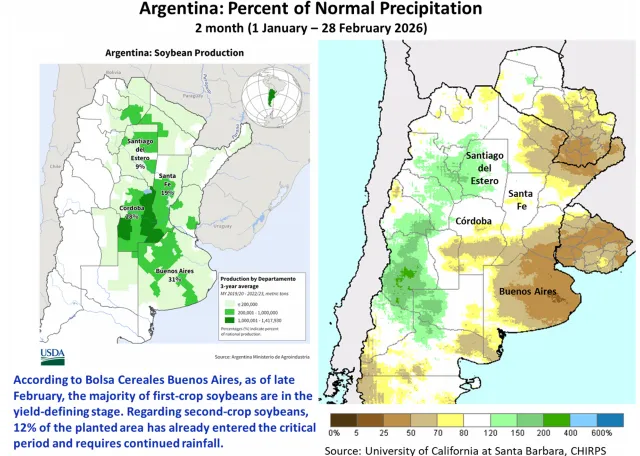
Soybeans in Argentina are grown as first-crop (75 percent) or second-crop (25 percent) soybeans. Planting for both crops is complete. Area is up this month guided by official data from the Argentina Ministry of Agriculture. Yield, on the other hand, is revised down month-to-month due to inadequate soil moisture reserves. Rainfall during the months of January and February was very heterogenous and limited in terms of total accumulation. As a result, the overall precipitation remained near to below average across the key soybean growing areas. Ministry reports indicate good crop status for the first crop, which is mostly in the flowering and grain-filling stages. The second crop, however, is showing varying degrees of stress and damage due to the existing water deficit.
Argentina Sunflowerseed: Production Revised Up Based on Official Data
USDA estimates Argentina sunflowerseed production for marketing year 2025/26 at 7.0 million metric tons (mmt), up 27 percent from last month and 25 percent from last year. Yield is estimated at 2.33 tons per hectare (t/ha), up 12 percent from last month and unchanged from last year. Harvested area is estimated at 3.0 million hectares (mha), up 13 percent from last month and 25 percent from last year.
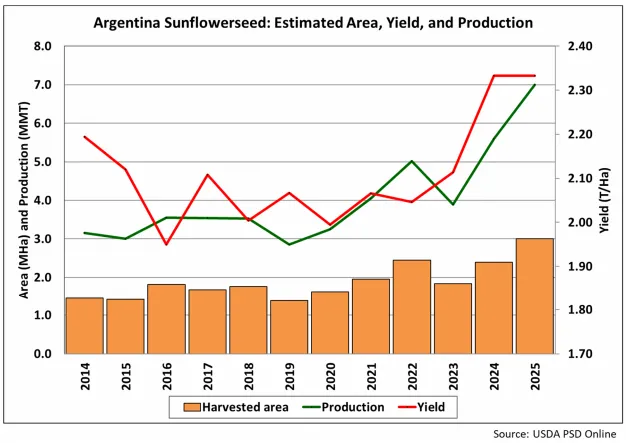
Sunflowers in Argentina are concentrated in three provinces: Buenos Aires (53 percent of production), Chaco (17 percent), and Santa Fe (13 percent). This year, sunflowerseed area has increased at the expense of cotton area, especially in the northern regions. Official data from the Argentina Ministry of Agriculture indicate that 3.1 mha have been planted this year. In addition, harvest is progressing and according to Bolsa Cereales Buenos Aires, yield is at 2.28 t/ha as of late February, and it has been stable at this level since the start of the harvest campaign. Generally, the Bolsa Cereales Buenos Aires yield is within 5 percent relative to the Ministry of Agriculture’s final yield. Harvest will continue until April.
Argentina Corn: Drop in Yield Due to Insufficient January and February Rainfall
USDA estimates Argentina corn production for marketing year 2025/26 at 52.0 million metric tons, down 2 percent from last month, but up 4 percent from last year. Corn yield is estimated at 6.93 tons per hectare, down 2 percent from last month and 4 percent from last year. Harvested area is estimated at 7.5 million hectares, unchanged from last month and up 9 percent from last year.
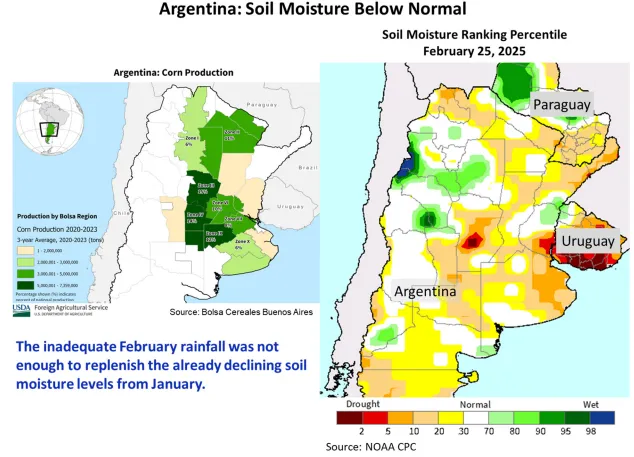
Argentina farmers plant both early-planted corn (corn planted prior to December 1st) and lateplanted corn (corn planted after December 1st). Over the last couple of weeks, rain has been recorded mostly in the central and northern agriculture areas of Argentina. Rain showers, however, have been unevenly distributed with limited intensity. Thus, the inadequate February rainfall was not enough to replenish the already declining soil moisture levels from January. Harvest of earlyplanted corn is underway.
Brazil Corn: Area and Production Increase on Larger First Crop
USDA estimates Brazil corn production for marketing year 2025/26 at 132.0 million metric tons (mmt), up 1 percent from last month, but down 3 percent from last year’s record crop, and yet 11 percent above the 5-year average. Harvested area is estimated at a record 22.8 million hectares, up 1 percent from last month, 2 percent from last year, and 6 percent above the 5-year average. Yield is estimated at 5.79 tons per hectare, down marginally from last month, 5 percent from last year, but 6 percent above the 5-year average. The corn yield estimate assumes a return to normal weather.
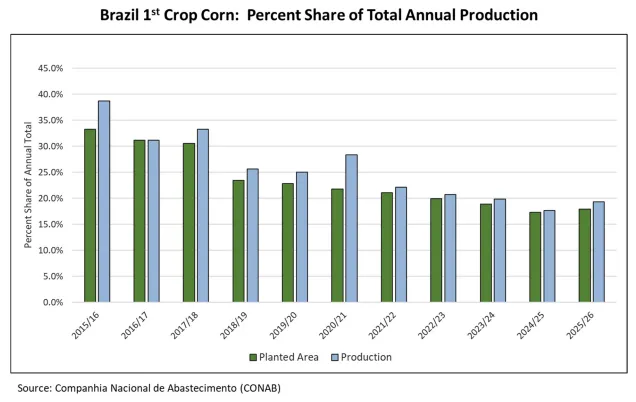
Brazil produces corn primarily as a second crop, following the soybean harvest in January and February. This second, or safrinha crop has grown in recent years to represent 75 percent or more of annual production. Conversely, first-crop corn, now a competing crop with soybeans (simultaneously planted in September through December), has seen its share of total national production diminish, with safrinha corn area expanding and first corn area falling. Planted area for first corn is now less than half of what it was 20 years ago.
This season, however, has seen a small rebound in first corn planting, with area rising year-to-year for the first time in four seasons. With planted area for safrinha corn also increasing, USDA has increased its record harvested area estimate further. With early returns indicating positive yields for first crop corn, USDA assumes normal weather and average yields for safrinha corn will elevate total annual corn production to a new estimate of 132.0 mmt.
Australia Barley: Production Reaches a New Record
USDA estimates Australia barley production for marketing year (MY) 2025/26 at a record 16.3 million metric tons, up 5 percent from last month, 23 percent from last year and 21 percent above the 5-year average. Harvested area is estimated at 4.8 million hectares, down 1 percent from last month, but up 3 percent from last year and 1 percent above the 5-year average. Yield is estimated at 3.42 metric tons per hectare, up 6 percent from last month, 19 percent from last year and 19 percent above the 5-year average.
The year-over-year increase in production is supported by a higher official forecast released on March 2, 2026 by the Australian Bureau of Agricultural and Resource Economics and Sciences (ABARES), as well as exceptional growing conditions through the critical crop development stages this year. Barley is grown in the winter in Australia with planting beginning in April. Harvest typically commences in October and continues through January, thus, the MY 2025/26 barley harvest is complete.
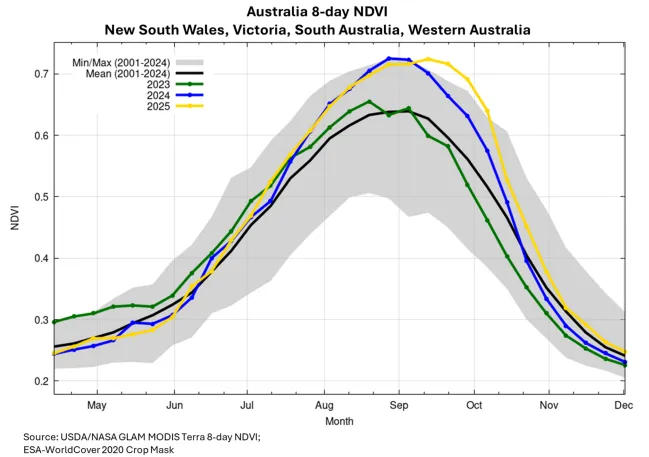
From the beginning of the barley season, April through mid-June, the growing conditions were below normal, indicating dryness during the start of the season. Fortunately, timely precipitation came throughout the remainder of the season, thus boosting the barley crop when it needed it most. Analysis of the satellite-derived Normalized Difference Vegetation Index (NDVI) depicts aboveaverage conditions and crop vigor in the barley producing areas across Australia. This provides evidence to support the increase in production for MY 2025/26 to a new record.
Australia Wheat: Production is Third Highest on Record
USDA forecasts Australia wheat production for marketing year 2025/26 at 36.0 million metric tons, down 3 percent from last month, but up 6 percent from last year and 7 percent above the 5-year average. Harvested area is estimated at 12.4 million hectares, down 2 percent from last month, 5 percent from last year and 3 percent below the 5-year average. Yield is forecast at 2.90 metric tons per hectare, down less than 1 percent from last month, but up 11 percent from last year and 10 percent above the 5-year average.
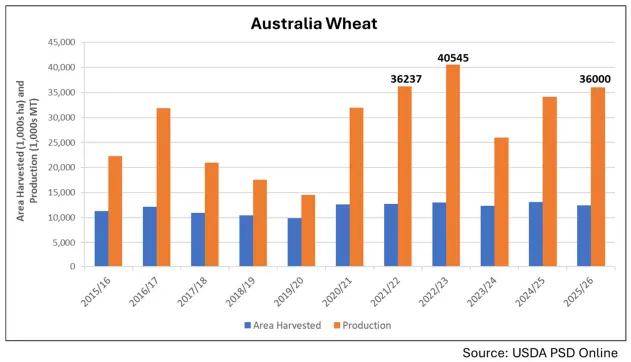
The revised estimate is based on the latest official crop report that was released on March 2, 2026 by the Australian Bureau of Agricultural and Resource Economics and Sciences (ABARES). The crop report described mixed conditions throughout the winter cropping regions, and specifically a new record production in Western Australia due to favorable conditions. A Commodity Intelligence Report (CIR) published on September 24, 2025 detailed excellent conditions during crop travel in Western Australia, available at https://www.fas.usda.gov/sites/default/files/2026-02/09-2025-Australia.pdf.
Brazil Cotton: Record Production on Higher Area and Record Yield
USDA estimates Brazil soybean production for marketing year (MY) 2025/26 at a record 19.5 million 480-pound bales, up 4 percent from last month, 15 percent from last year and 44 percent above the 5-year average. Harvested area is estimated at 2.2 million hectares, up 3 percent from last month, 12 percent from last year and 32 percent above the 5-year average. Yield is estimated at a record 1,957 kilograms per hectare, up 1 percent from last month, 3 percent from last year, and 10 percent above the 5-year average.
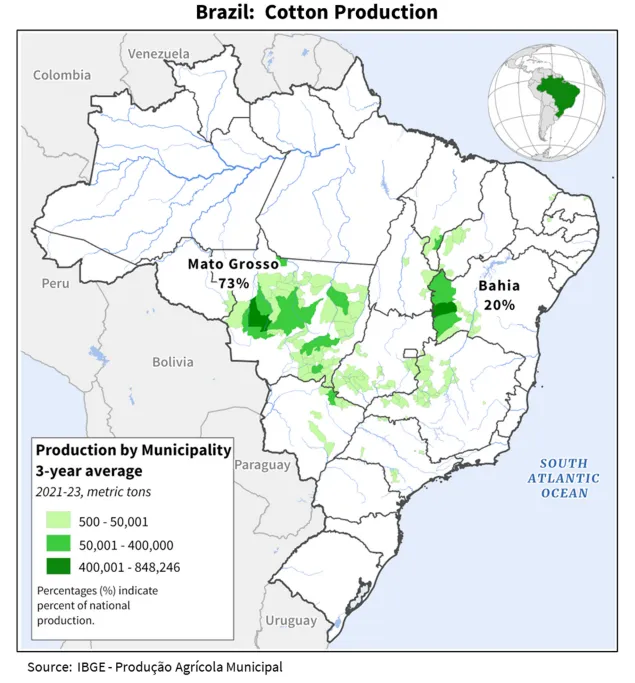
Cotton production continues to expand in Brazil, which has become the world’s largest cotton exporter. The Mato Grosso Institute for Agricultural Economics (IMEA) and the Associação Matogrossense dos Produtores de Algodão (AMPA) estimate cotton area in the state at over 1.5 mha, a 6 percent increase over the previous season. In Bahia, sources indicate that area is up 19 percent, year-over-year.
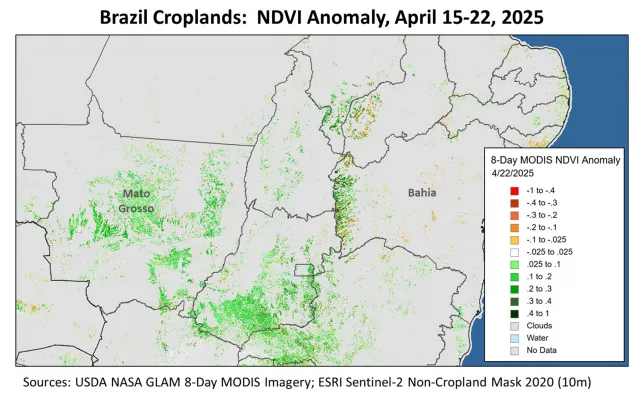
The MY 2025/26 cotton season follows the MY 2024/25 soybean season in Brazil. Despite planting delays in Mato Grosso in early 2025, seasonal rainfall resulted in healthy crop vigor, as indicated by satellite-derived Normalized Difference Vegetation Index (NDVI) analysis. These ideal conditions for the 2025 cotton cropping season boosted yields to an all-time high. Record yields, coupled with the additional area, further boosted production to a new record.