Food Hydrocolloids| 油脂不饱和度对双凝胶线性 / 非线性流变行为及稳定性的影响
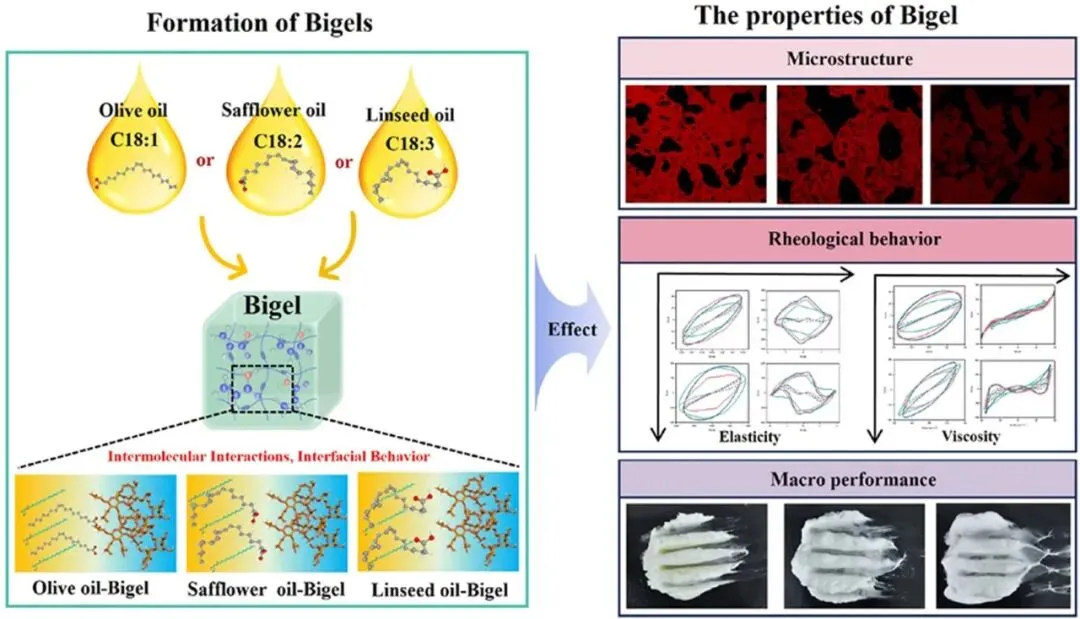
近日,东北农业大学团队在《Food Hydrocolloids》期刊上发表了题为《The unsaturation degree of oils effects the linear/non-linear rheological behavior and stability of bigel》的研究性论文(一区,IF:12.4)。该研究以橄榄油、红花油、亚麻籽油为模型油,制备单甘酯基 oleogel 与羟丙基甲基纤维素水凝胶复合双凝胶(bigel),系统探究了油脂不饱和度对 bigel 微观结构、热稳定性及线性 / 非线性流变行为的影响,揭示了低不饱和度油脂(橄榄油)因脂肪酸链线性结构促进凝胶因子有序堆积,强化界面作用与网络强度,而高不饱和度油脂因链结构弯曲破坏组装稳定性的机制,为健康脂肪替代品的配方优化提供了理论支撑。
双凝胶(bigel)是通过可控混合条件将油凝胶(oleogel)与水凝胶(hydrogel)复合形成的半固体双相体系,整合了两类凝胶网络的结构优势,能抑制液滴迁移、提升体系稳定性,同时实现塑性流动与弹性恢复的优化平衡,其润滑性和流变学特性与动物脂肪相似,因此常作为高脂食品(如蛋黄酱、沙拉酱、奶油)的部分或完全替代品,在保持相似口感和加工性能的同时降低热量摄入,具有重要的健康食品应用价值。
双凝胶的优良结构与宏观性能由配方和加工参数共同调控,包括油凝胶与水凝胶比例、相结构与浓度、添加剂、混合温度及储存条件等。油凝胶作为核心结构单元,其油相占比通常超过 90%,其物理化学性质会显著影响油凝胶的微观结构与稳定性,进而决定双凝胶的质地、流变学特性及整体性能。脂肪酸不饱和度作为油脂的关键属性,会从根本上塑造油脂的物理化学性质,进而调控油凝胶及其他含油体系的微观结构与宏观性能,但这种影响具有显著的体系依赖性:在动物蜡基油凝胶中,高不饱和度油脂可增强凝胶因子堆积与相互作用,提升网络密度和机械强度;而在植物蜡和硬脂酸体系中,高不饱和度油脂会干扰晶体成核并破坏网络形成;在复合体系中,油脂不饱和度还可通过调控油水界面行为影响体系稳定性,但改性与未改性的界面活性物质(如蛋白质)对油脂不饱和度的响应存在差异,导致相关研究结论不一致。
目前,关于油脂对双凝胶影响的研究较为有限,已有研究表明高饱和油(如椰子油)会限制单甘酯基油凝胶网络形成,而不饱和油(如橄榄油)可与单甘酯形成稳定的 β- 晶体网络并提升双凝胶硬度;同时,油脂分子与水凝胶因子的相互作用也不可忽视,如高极性大豆油可增强与明胶的结合,富含二酰甘油的大豆油能与羟丙基甲基纤维素(HPMC)更高效相互作用,进而改善双凝胶性能。这些研究表明,油脂会通过油凝胶特性及与水凝胶的相互作用,影响双凝胶的质地、机械稳定性、保油性和加工耐受性,这对涂抹酱、人造黄油替代品等结构化脂肪体系的性能至关重要。然而,现有研究多基于小振幅振荡剪切条件开展,对大变形下油脂不饱和度影响双凝胶稳定性的机制尚未明确,而这一机制对双凝胶基材料的实际应用至关重要。因此,系统阐明油脂不饱和度对双凝胶结构与性能的调控作用,不仅是理解其构效关系的核心,也能为双凝胶配方中油脂的合理选择提供理论依据,成为本论文开展的核心背景。
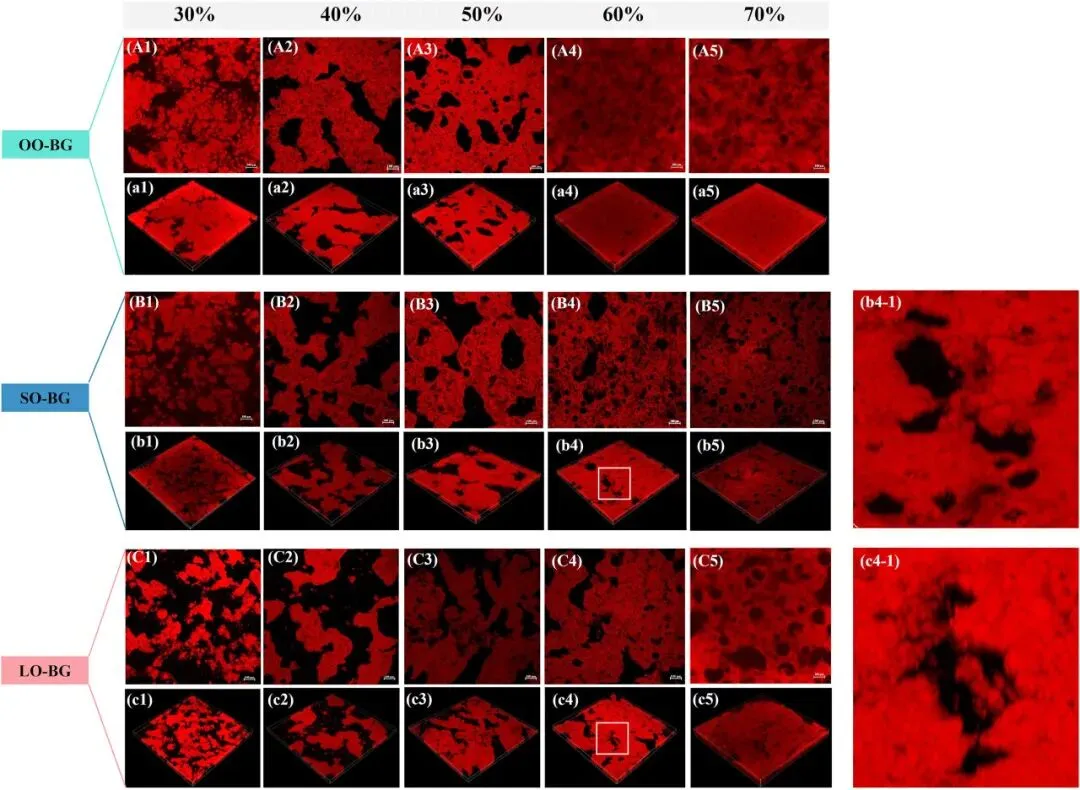
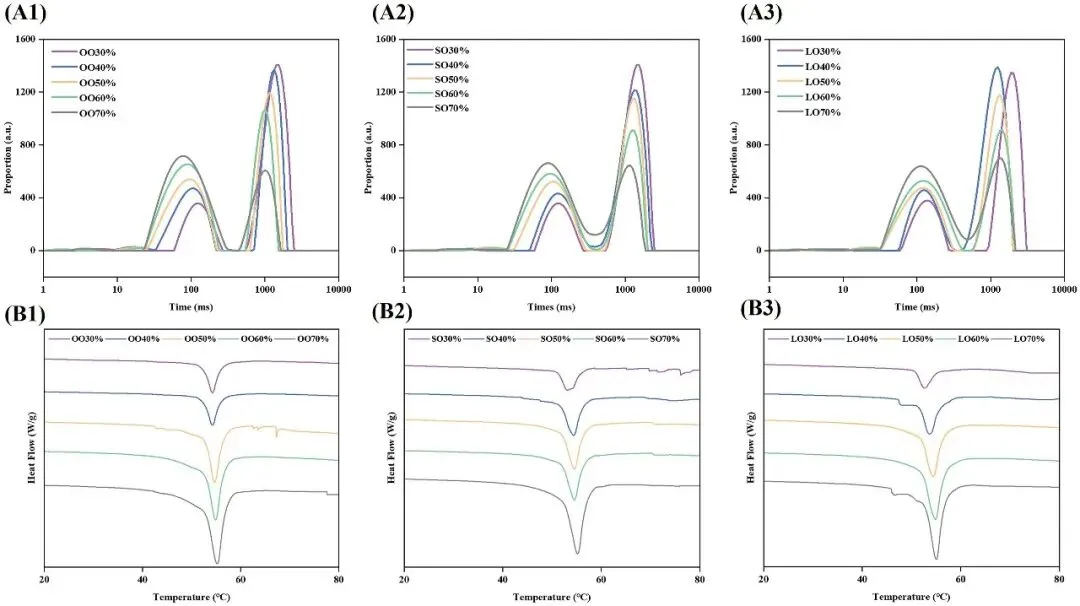
油脂不饱和度显著影响双凝胶(bigel)的微观结构与稳定性,且强度随油脂不饱和度升高而降低。低不饱和度的橄榄油(C18:1)形成的双凝胶(OO-BGs)具有最致密均匀的网络结构、最窄的粒径分布及最低的分子迁移率,其横向弛豫时间范围最窄、热焓值最高,热稳定性最优;而高不饱和度的红花油(C18:2)和亚麻籽油(C18:3)形成的双凝胶(SO-BGs、LO-BGs)结构松散,存在明显空隙与分层现象,分子约束力弱,稳定性较差,其中亚麻籽油双凝胶的结构完整性与稳定性最弱。
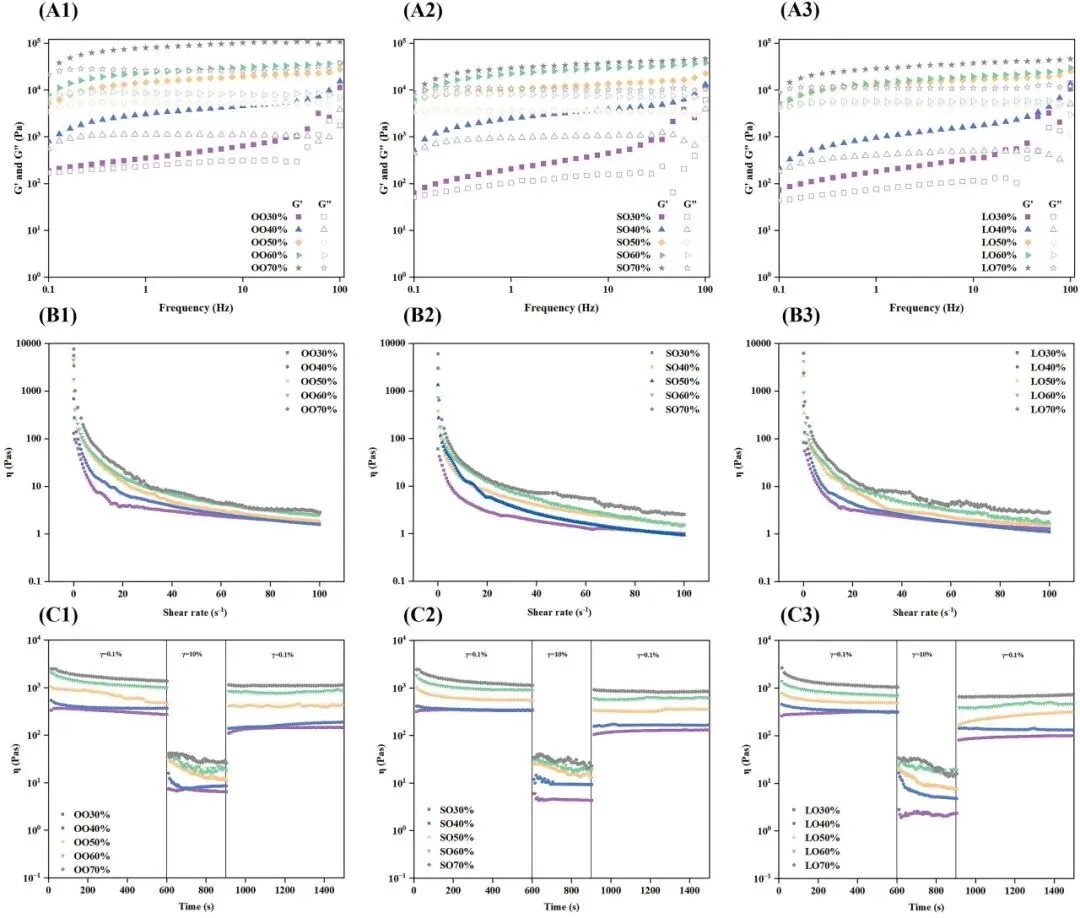
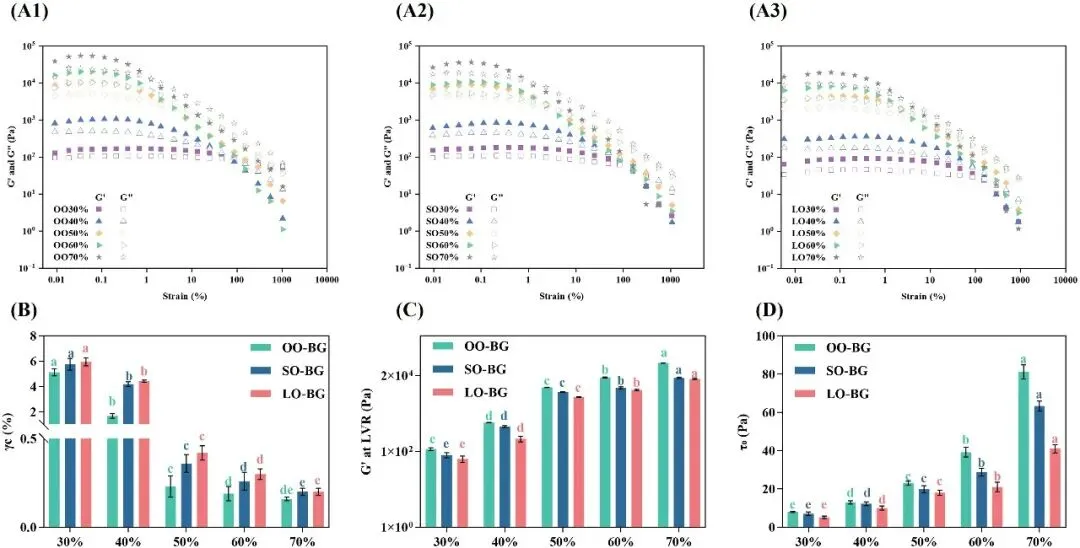
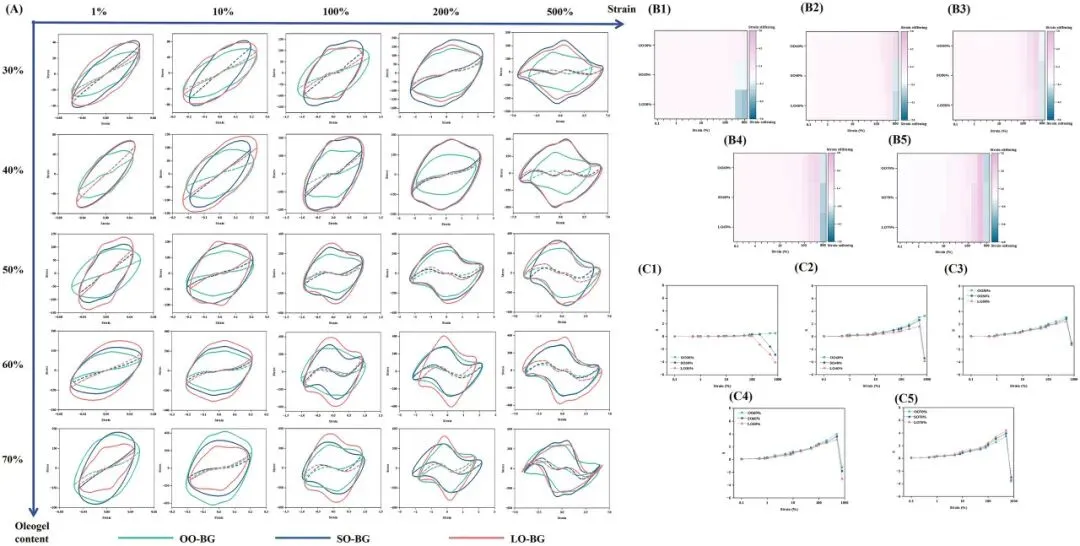
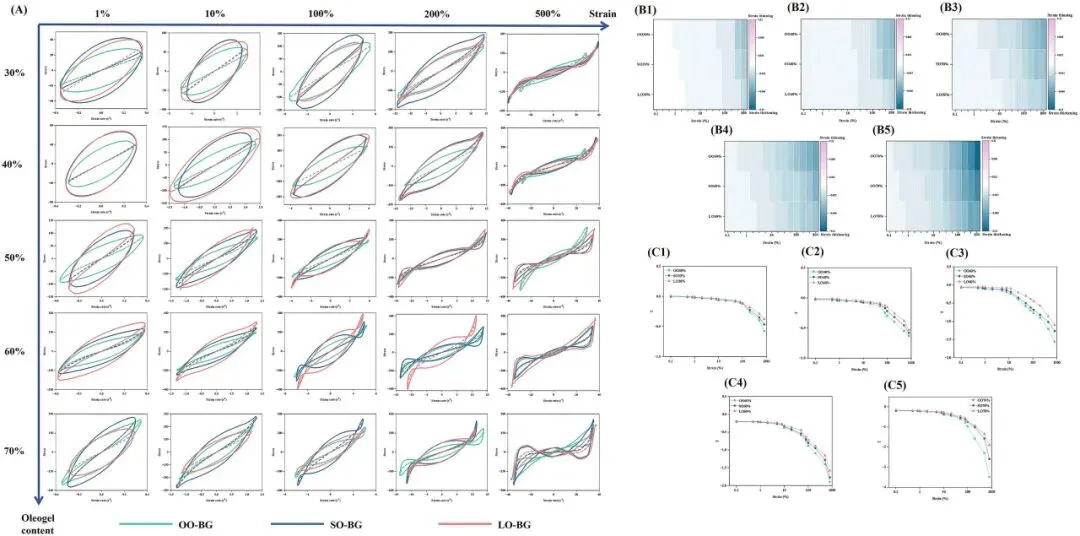
油脂不饱和度主导双凝胶的线性与非线性流变行为。OO-BGs 表现出最高的弹性模量、屈服应力与稠度系数,频率依赖性最低,剪切变稀行为显著,且在触变性测试中结构恢复度最优,展现出极强的抗变形能力;在大振幅振荡剪切下,其弹性 Lissajous-Bowditch(LB)曲线面积最小,应变硬化程度最高,粘性 LB 曲线收缩最早,剪切 thinning 效应最显著,加工适应性最优。相比之下,SO-BGs 与 LO-BGs 的弹性与屈服应力更低,结构易在剪切作用下发生不可逆破坏,其中 LO-BGs 的流变性能最差,大变形下易软化坍塌,成型性不佳。
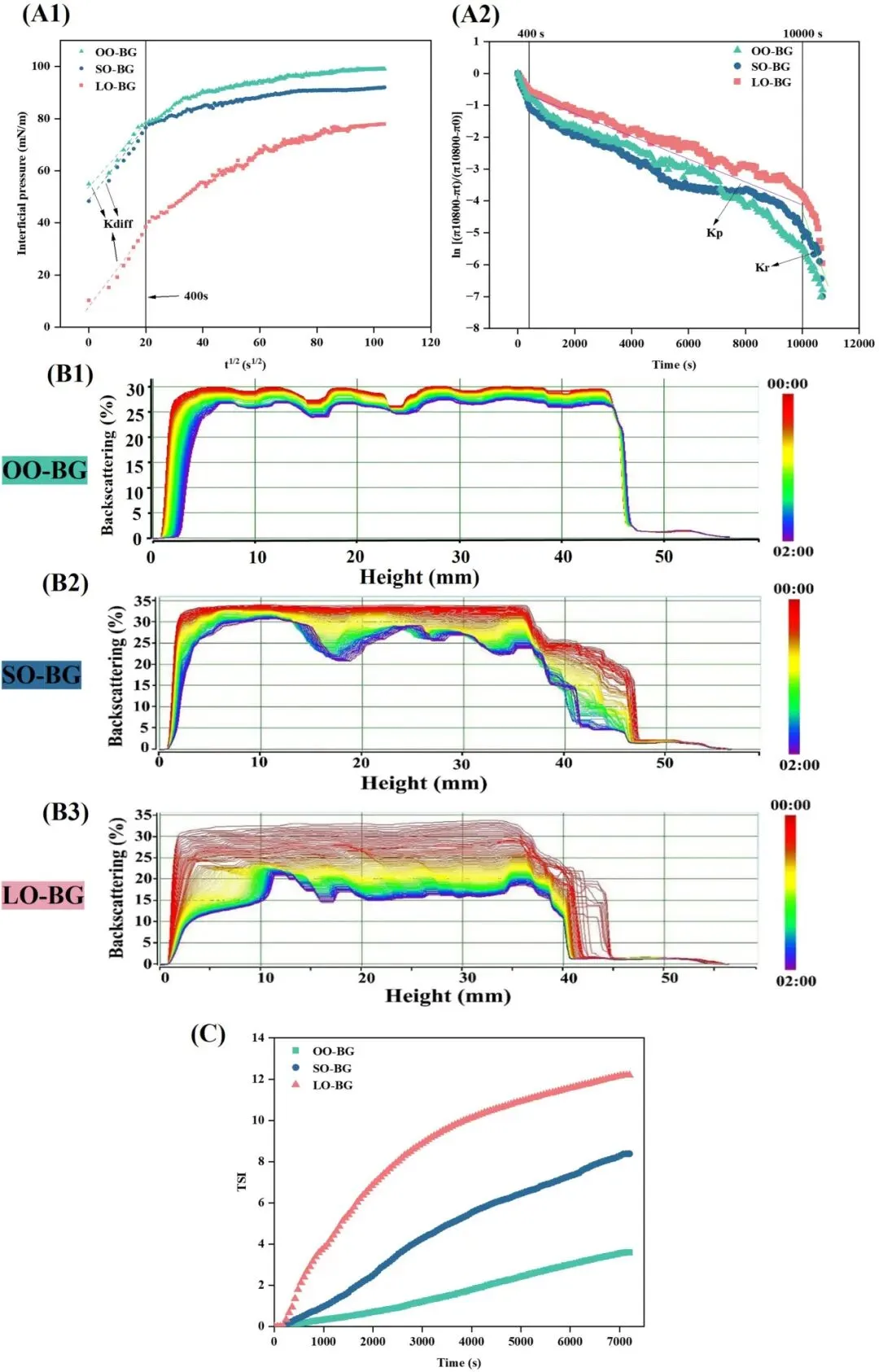
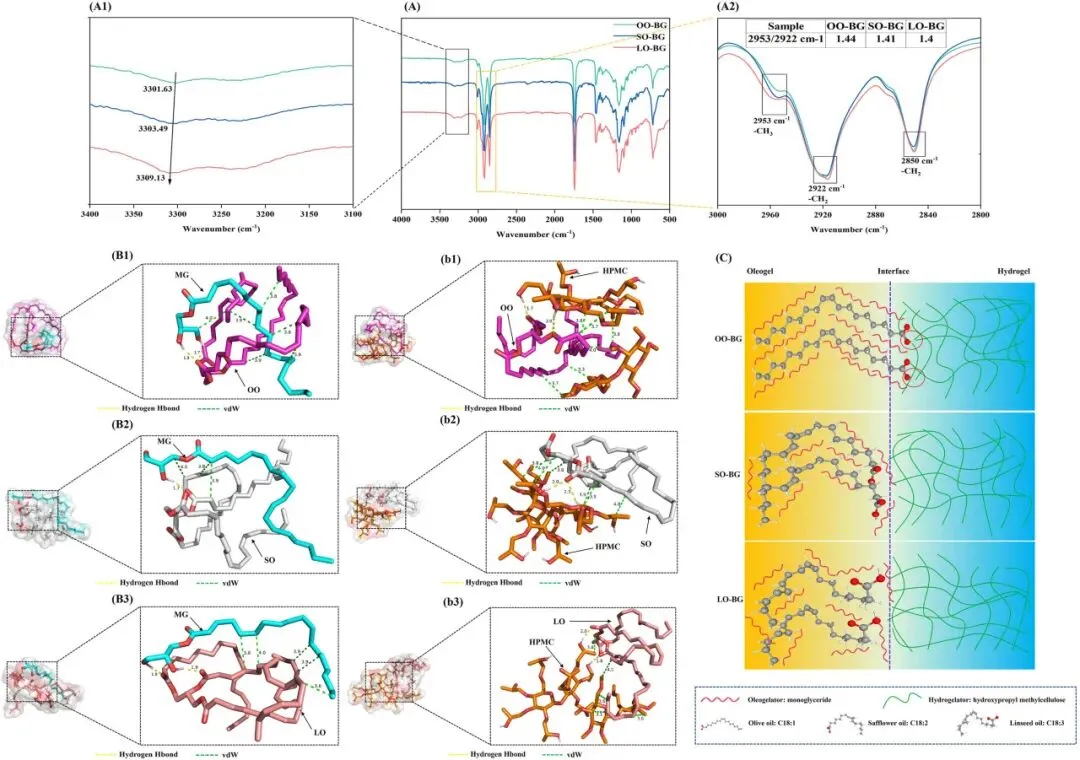
油脂不饱和度通过分子结构与界面作用调控双凝胶性能。橄榄油的单不饱和脂肪酸(C18:1)具有线性分子结构,能促进单甘酯(MG)的有序堆积,强化 oleogel 网络强度,同时其羧基易延伸至水相,与羟丙基甲基纤维素(HPMC)形成更强的氢键与范德华力,提升界面膜致密性;且橄榄油体系中凝胶因子的扩散、渗透与重排速率最快,界面压力最高,进一步稳固双凝胶结构。而高不饱和度油脂的脂肪酸链因多双键呈现弯曲构型,破坏凝胶因子有序组装,削弱分子间作用力与界面相互作用,导致双凝胶结构松散、性能劣化。
Fig. 1. Schematic diagram of the micro-structure of bigels. (A1∼A5, B1∼B5, C1∼C5) CLSM images; (a1∼a5, b1∼b5, c1∼c5) 3D-CLSM images; A, B, and C represent OO-BGs, SO-BGs, and LO-BGs, respectively; b4-1 and c4-1 are magnified images of the regions within the white boxes in b4 and c4, respectively; the scale bar is 100 μm. 1∼5 indicates a gradual increase in oleogel content.
Fig. 2. Microstructural stability of bigels. (A1∼A3) Distribution of transverse relaxation times of OO-BGs, SO-BGs, and LO-BGs, respectively; (B1∼B3) DSC thermograms of OO-BGs, SO-BGs, and LO-BGs, respectively.
Fig. 3. Rheological properties of bigels. (A1∼A3) Frequency scanning of OO-BGs, SO-BGs, and LO-BGs, respectively; (B1∼B3) Viscosity of OO-BGs, SO-BGs, and LO-BGs, respectively; (C1∼C3) Thixotropic recovery of OO-BGs, SO-BGs, and LO-BGs, respectively.
Fig. 4. Strain scanning of bigel in linear and nonlinear regions. (A1∼A3) Strain scanning of OO-BGs, SO-BGs, and LO-BGs, respectively; (B) Critical strain (γc); (C) G′ value at the endpoint of LVR; (D) Yield stress (τ0).
Fig. 5. The strain elastic characteristics of bigels. (A) Elastic LB curve at an oscillation frequency of 1.0 Hz, showing strain amplitudes ranging from 1% to 500%; (B1∼B5) Heat maps of the normalized e3/e1 values, illustrating the different regions of strain stiffening/softening of bigels. (C1∼C5) Stiffening index S values. 1∼5 indicates a gradual increase in oleogel content.
Fig. 6. The strain viscosity characteristics of bigels. (A) Viscosity LB curve at an oscillation frequency of 1.0 Hz, showing strain amplitudes ranging from 1% to 500%; (B1∼B5) Heat maps of the normalized v3/v1 values, illustrating the different regions of strain stiffening/softening of bigels. (C1∼C5) Stiffening index T values. 1∼5 indicates a gradual increase in oleogel content.
Fig. 7. The adsorption dynamics of the gelator at different oil-water interfaces and the multiple light scattering results of different bigel systems: (A1) The π versus root time (t1/2); (A2) The ln [(π10800-πt)/(π10800-π0)] versus time plot. The slopes of Kdiff, Kp and Kr represent the diffusion rate, the penetration, and the structural rearrangement rate, respectively. (B1∼B3) The backscattering light (ΔBS) intensity changes and (C) The Turbiscan Stability Index (TSI) of different bigel systems during 2 h.
Fig. 8. Schematic diagram of intermolecular interactions in the bigel. (A) FT-IR spectra of three bigel systems; (A1) enlarged view of the peak vibration at 3300 cm−1; (A2) enlarged view of the peak vibration in the range of 2850-2950 cm−1. (B1-B3) Schematic representation of the binding of OO, SO, and LO with MG; (b1-b3) Schematic representation of the binding of OO, SO, and LO with HPMC. (C) Schematic illustrating the interfacial behaviour mechanisms of fatty acids with varying degrees of unsaturation.
https://doi.org/10.1016/j.foodhyd.2026.112532
免责声明:「原创」仅代表原创编译,水平有限,仅供学术交流,本平台不主张原文的版权,如有侵权,请联系删除。文献解读或作者简历如有疏漏之处,我们深表歉意,请作者团队及时联系《食探未来》主编(微信号:shitanweilai8077),我们会在第一时间进行修改或撤稿重发,感谢您的谅解!



 10个月宝宝每天需要喝多少奶粉?