本文的核心语法应用在于非谓语动词中现在分词(V-ing)的用法。文中多次使用现在分词引导短语作定语或状语,用以精炼地表达伴随状况、结果或对前文的补充说明,展现了环境变化与经济影响间的因果链条。 |
The International Year of Glaciers’ Preservation in 2025 was a timely reminder that the stability of Mongolia’s economy rests on fragile mountain systems that are melting faster than ever recorded.
2025年国际冰川保护年是一个及时的提醒,即蒙古国经济的稳定性取决于正以有记录以来最快速度消融的脆弱山地系统。
The loss reverberates across the country’s energy and agricultural systems, two development pillars that draw from the same finite resource: water.
这种损失在国家的能源和农业系统中引起共振,这两个发展支柱都源于同一种有限的资源:水。
Warming and glacial retreat
气候变暖与冰川退缩
Mongolia’s average surface air temperature is already 2.3°C higher than the pre-industrial baseline, about 1.3°C above the global average.
蒙古国的平均地表气温已比工业化前基准高出2.3摄氏度,比全球平均水平高出约1.3摄氏度。
The most fossil fuel-intensive climate scenario (SSP5) indicates nearly 8°C of warming by the end of the century with the steepest increases expected in the northern and western provinces; home to the country’s glaciers.
化石燃料密集度最高的气候情景(SSP5)表明,到本世纪末气温将上升近8摄氏度,预计增幅最大的是该国冰川所在地——北部和西部省份。
These glaciers contribute more than 70 per cent of Mongolia’s freshwater, sustaining agriculture, hydropower, and domestic use.
这些冰川贡献了蒙古国70%以上的淡水,支撑着农业、水力发电和生活用水。
Since 1940, glacier volume has declined by about 28 per cent, and total glacier area has decreased by 35 per cent between 1990 and 2016, leaving only 627 glaciers covering 334 km².
自1940年以来,冰川体积减少了约28%,1990年至2016年间,冰川总面积减少了35%,仅剩下覆盖334平方公里的627条冰川。
Between the 1980s and 2010, Mongolia lost 63 lakes larger than 0.1 km² and about 683 rivers, many in the foothills of the Altai ranges with the highest concentration of glaciers.
20世纪80年代至2010年间,蒙古国失去了63个面积大于0.1平方公里的湖泊和约683条河流,其中许多位于冰川最集中的阿尔泰山脉山麓。
Groundwater storage on the Mongolian Plateau is also decreasing at nearly 3 mm per year, linked partly to reduced glacial input.
蒙古高原的地下水储量也正以每年近3毫米的速度减少,这在一定程度上与冰川补给减少有关。
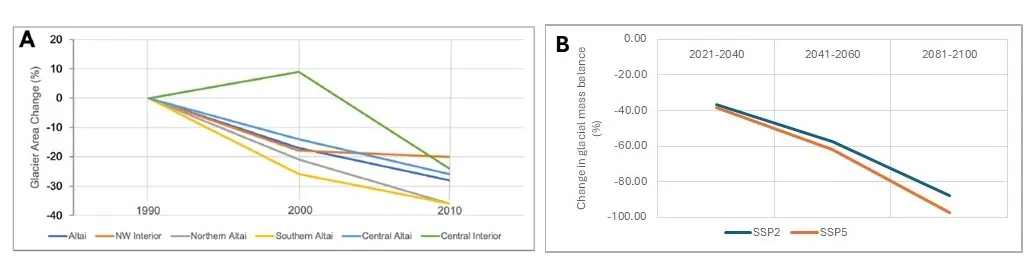
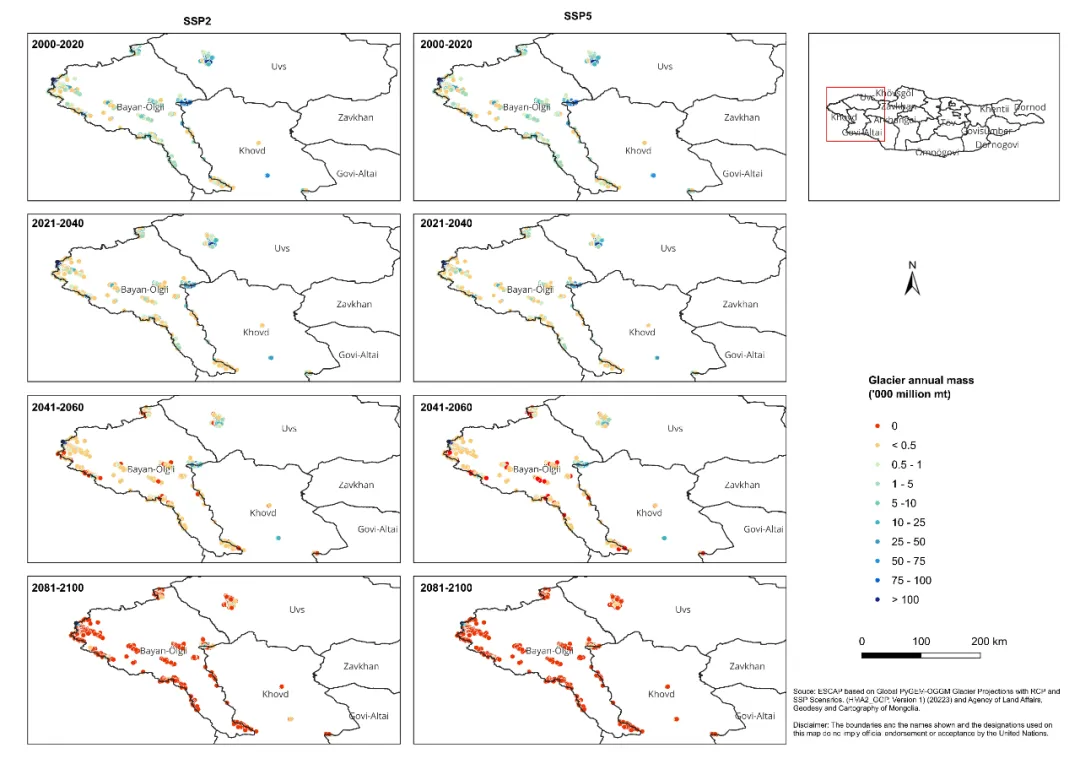
Analysis using downscaled IPCC climate projections available on ESCAP’s Risk and Resilience Portal suggests that this trend is likely to continue in the coming decades and by 2,100 many western Altai glaciers may disappear entirely (Figures 1A and 1B).
利用亚太经社会风险与复原力门户网站提供的降尺度政府间气候变化专门委员会气候预测进行的分析表明,这一趋势在未来几十年可能会持续,到2100年,许多阿尔泰西部冰川可能会完全消失(图1A和1B)。
Figure 1(A and B) Change in glacier area during 1990-2010 and (B) projected change in glacier mass balance (2021-2100) in Mongolia under climate change scenarios
图1(A和B)1990-2010年间冰川面积的变化以及(B)气候变化情景下蒙古国冰川物质平衡的预测变化(2021-2100年)
Figure 2 Change in glacial mass balance in the Altai Mountain region under existing and climate change scenarios
图2 现有及气候变化情景下阿尔泰山地区的冰川物质平衡变化
Water, energy and agriculture: A tightening nexus
水、能源与农业:日益紧密的纽带
Mongolia’s semi-arid climate has always made water a strategic asset for development.
蒙古国的半干旱气候一直使水资源成为发展的战略资产。
Agriculture remains the largest water consumer, accounting for roughly two-thirds of total use.
农业仍然是最大的用水户,约占总用水量的三分之二。
Since 2008, more than 1,000 hectares of irrigated land have been added annually, driven by food and livestock-security goals.
在粮食和畜牧业安全目标的推动下,自2008年以来,每年新增灌溉土地1000多公顷。
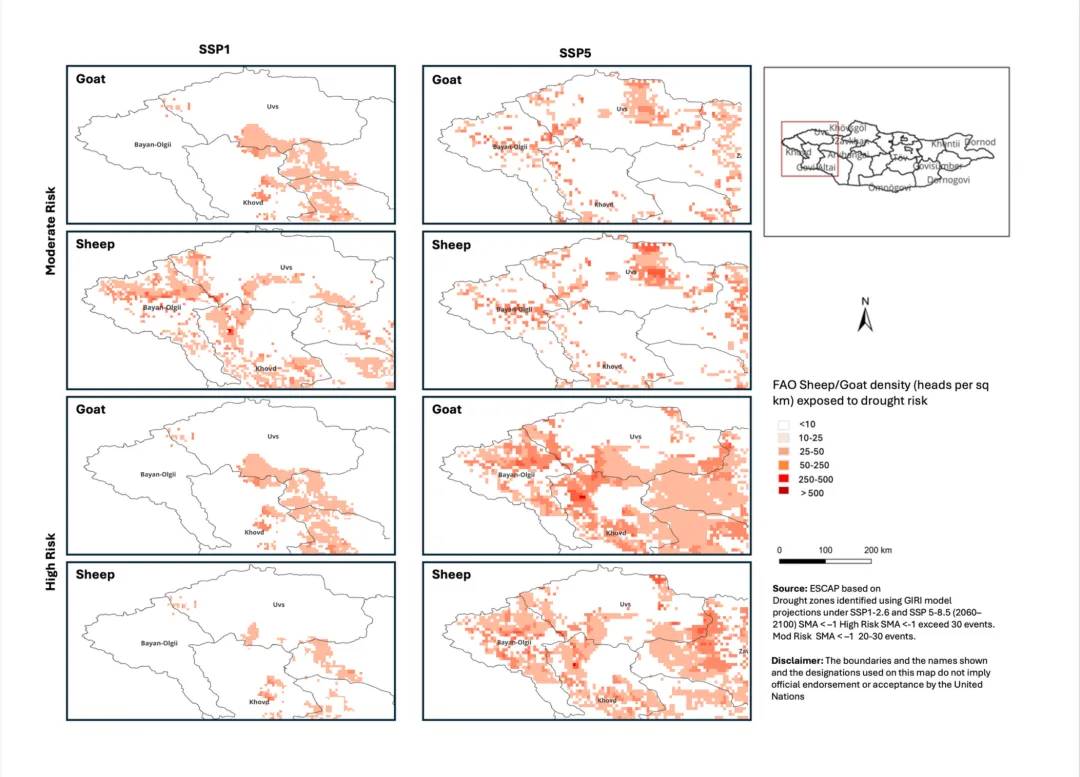
With prolonged dry conditions (Figure 3), farmers in western and northern provinces report increasing reliance on shallow wells and groundwater pumping, while pastures dry earlier in the season.
随着干旱条件的延长(图3),西部和北部省份的农民报告称,他们越来越依赖浅水井和地下水抽取,而牧场在季节初期就已干枯。
These demands coincide with a growing push to expand hydropower for domestic energy security.
这些需求恰逢为保障国内能源安全而日益推动的水电扩张。
Figure 3 Exposure of livestock (sheep and goats) to soil moisture drought under climate change conditions
图3 气候变化条件下家畜(绵羊和山羊)暴露于土壤水分干旱的情况
Hydropower in transition
转型中的水电
Hydropower accounts for nearly one-fifth of Mongolia’s electricity generation, but its viability depends on stable water flow.
水电占蒙古国发电量的近五分之一,但其可行性取决于稳定的水流。
In the western region, hydropower provides 93 per cent of locally produced energy.
在西部地区,水电提供了当地生产能源的93%。
The Durgun Hydropower Plant (HPP) in Khovd Province, for example, provides over 28 per cent of regional power but operates in one of the driest parts of the country.
例如,科布多省的德尔根水电站提供了该地区28%以上的电力,但其运行地点却是该国最干旱的地区之一。
With glacier retreat and declining summer precipitation, inflows have become less predictable.
随着冰川退缩和夏季降水减少,入流量变得越来越难以预测。
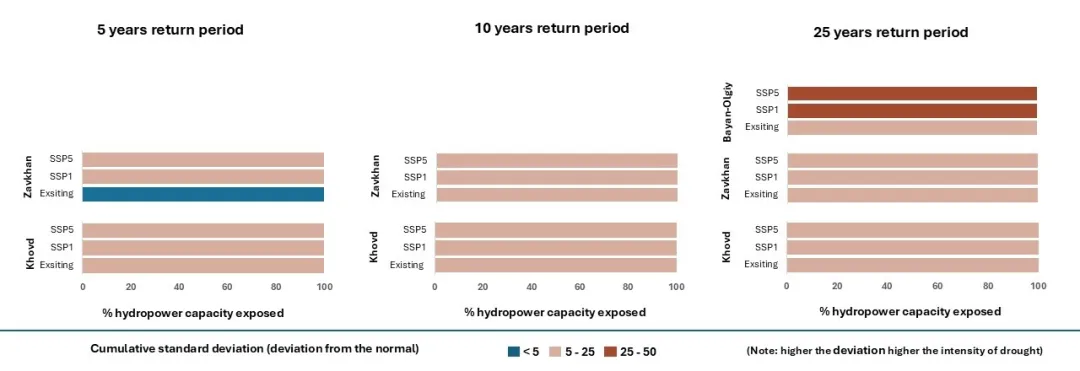
ESCAP drought-exposure modelling shows that the western provinces already face chronic low-to-medium drought intensity, with worsening conditions under future scenarios (Figure 3).
亚太经社会的干旱暴露建模显示,西部省份已经面临长期的中低强度干旱,在未来情景下情况将进一步恶化(图3)。
Figure 4 Exposure of hydropower plants to drought (Standardized streamflow index) under climate change scenarios in the western region (Source: ESCAP Authors)
图4 西部地区气候变化情景下水电站暴露于干旱(标准化径流指数)的情况(来源:亚太经社会作者)
When summer river levels fall, reservoir storage drops, hydropower generation declines and diesel generation must fill the gap raising both costs and emissions.
当夏季河流流量下降,水库蓄水量减少,水电发电量下降,必须用柴油发电填补缺口,这增加了成本和排放。
Meanwhile, agricultural water withdrawals upstream further constrain available flows for power generation.
与此同时,上游的农业取水进一步限制了可用于发电的流量。
The result is a feedback loop: limited water cuts hydropower output, leading to higher reliance on fossil energy, which in turn intensifies warming and glacier melt.
其结果是一个反馈回路:有限的水资源削减了水电产出,导致对化石能源的依赖增加,这反过来又加剧了变暖和冰川消融。
Competing pressures in a semi-arid economy
半干旱经济中的竞争压力
In the Western Energy Systems, consisting of provinces closest to the glaciers, rising demand compounds these stresses.
在由最靠近冰川的省份组成的西部能源系统中,不断增长的需求加剧了这些压力。
Between 2018 and 2019, electricity consumption in the region rose 5.6 per cent, driven by population growth and mining expansion.
2018年至2019年间,受人口增长和矿业扩张驱动,该地区的用电量上升了5.6%。
In summer months, when electricity demand peaks for irrigation pumping and cooling, river discharge often reaches its lowest levels.
在用电需求因灌溉抽水和制冷而达到顶峰的夏季月份,河流流量往往达到最低水平。
This mismatch between energy demand and hydrological supply poses a systemic risk.
能源需求与水文供应之间的这种错位构成了系统性风险。
Climate projections show that long-term discharge in key basins will decline, reducing the economic lifespan of existing hydropower assets.
气候预测显示,关键流域的长期流量将下降,从而缩短现有水电资产的经济寿命。
Addressing this challenge requires coordinated planning across water, energy, and agriculture.
应对这一挑战需要水、能源和农业领域的协调规划。
Three areas stand out:
三个领域尤为突出:
Water-efficient agriculture.
节水型农业。
Expanding drip irrigation, adopting drought-resilient crop varieties, and improving on-farm water storage can reduce demand during low-flow periods.
扩大滴灌、采用耐旱作物品种以及改善农田蓄水,可以减少低流量期间的需求。
Aligning irrigation schedules with projected runoff cycles would ease pressure on hydropower reservoirs.
使灌溉时间表与预测的径流周期保持一致,将减轻水电水库的压力。
Diversified renewables.
多样化的可再生能源。
Mongolia’s wind and solar resources can complement hydropower seasonality.
蒙古国的风能和太阳能资源可以弥补水电的季节性不足。
Integrating hybrid systems with storage or pumped hydro can maintain grid stability during drought years.
将混合系统与储能或抽水蓄能相结合,可以在干旱年份维持电网稳定性。
Data-driven basin management.
数据驱动的流域管理。
Glacier monitoring and real-time hydrological data should inform both irrigation allocation and hydropower operation.
冰川监测和实时水文数据应为灌溉分配和水电运行提供参考。
This shared evidence-based approach can prevent conflicts between sectors during dry spells.
这种基于证据的共享方法可以防止干旱期间各部门之间的冲突。
Mongolia already emphasizes renewable diversification.
蒙古国已经强调可再生能源的多样化。
By embedding glacier and river monitoring within sector planning, the policy can better anticipate seasonal stress rather than react to it.
通过将冰川和河流监测纳入部门规划,政策可以更好地预测季节性压力,而不是被动反应。
From vulnerability to transformative adaptation
从脆弱性到变革性适应
Glacier retreat, once viewed as an environmental concern, is now an economic one.
冰川退缩曾被视为环境问题,现在则是经济问题。
For Mongolia, without adaptation and foresight, the combined stress of reduced meltwater, erratic rainfall, and rising temperatures could destabilize both food production and energy security.
对于蒙古国而言,如果没有适应措施和远见,融水减少、降雨不稳定和气温上升的共同压力可能会破坏粮食生产和能源安全。
Protecting these frozen reserves and managing the water they release means securing not only the country’s rivers but its power and food systems as well.
保护这些冰冻储备并管理它们释放的水资源,意味着不仅要保障国家的河流,还要保障其电力和粮食系统。
Resilience begins where risk meets foresight.
韧性始于风险与远见的结合。