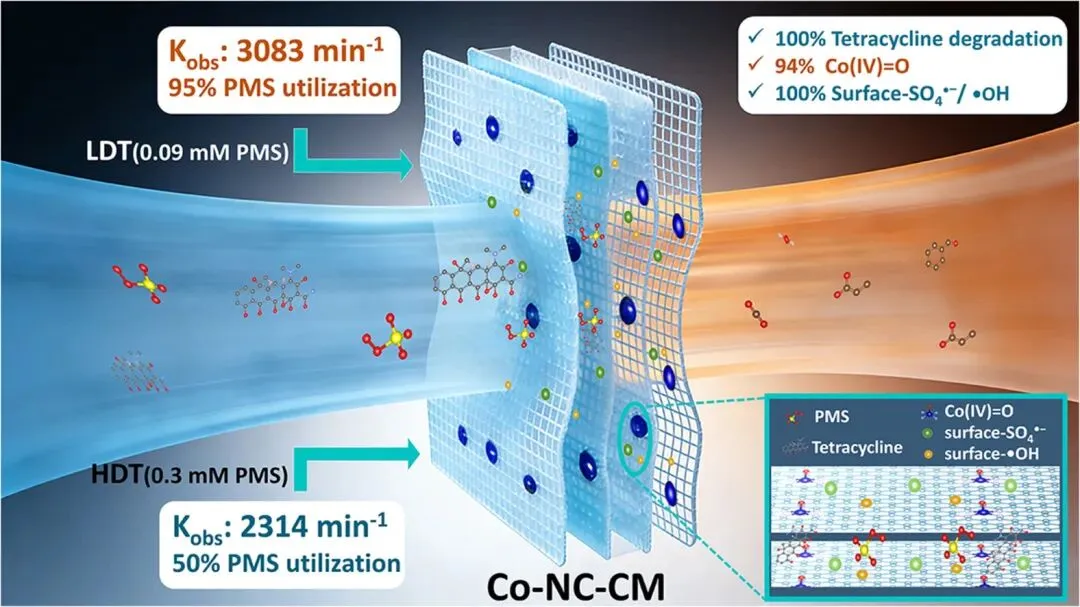
在本研究中,我们合成了具有Co(III)位点的新型超薄煅烧钴掺杂MOF纳米棒(Co-NC),并构建了基于Co-NC的纳米限制型CM(Co-NC-CM)。已有研究表明,Co(III)和Co(II)位点均可分别通过单电子或双电子转移途径生成Co(IV)=O物种。而从热力学角度来看,Co(III)位点更倾向于通过单电子转移形成Co(IV)=O物种(Wan等,2025)。据此,推断所制备的Co-NC能够生成Co(IV)=O。我们评估了Co-NC-CM对PMS的利用率及其对四环素的连续降解性能。Co-NC-CM的降解性能显著优于已报道的二维Co-MOF衍生物和CMs,表现出超快的动力学速率(kobs为2314 min−1)。我们首次识别出该连续降解过程包含两个截然不同的阶段:活化阶段和稳定阶段。通过优化稳定阶段的PMS投加量,PMS输入量可减少70%,PMS利用率可达95%,同时四环素的降解率仍保持在100%。此外,较低的PMS投加量(0.09 mM)通过产生高浓度的Co(IV)=O及等量的表面结合自由基,促使PMS利用率更高,其kobs值甚至达到3083 min−1,这表明在稳定阶段存在一种与PMS剂量相关的机理转变。该研究为纳米限制型CM技术在低氧化剂条件下的应用提供了根本性突破,将推动高级氧化工艺领域的绿色转型。
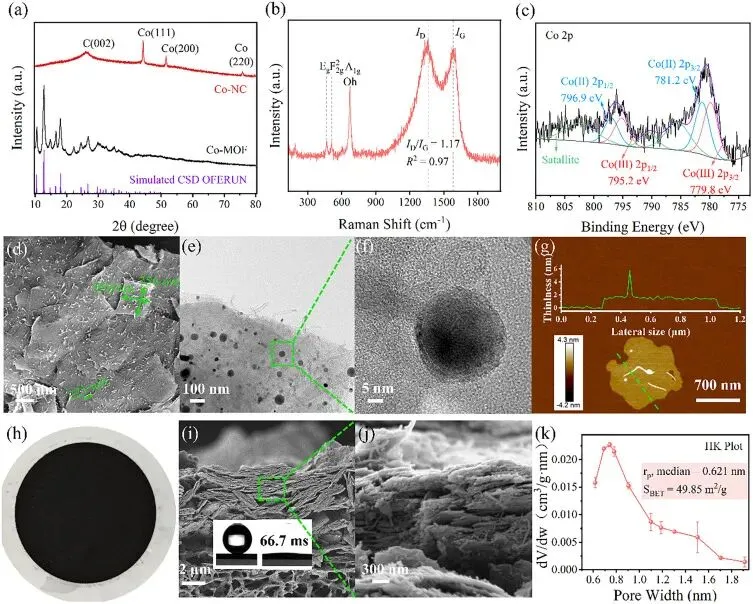
Fig. 1. (a) XRD patterns, (b) Raman spectrum, (c) Co 2p XPS spectrum, (d) SEM image, (e, f) TEM images, and (g) AFM image and thickness of Co-NC. (h) The photo graph, (i, j) cross-section images (inset: the corresponding contact angle), and (k) the pore size distribution of Co-NC-CM-0.5.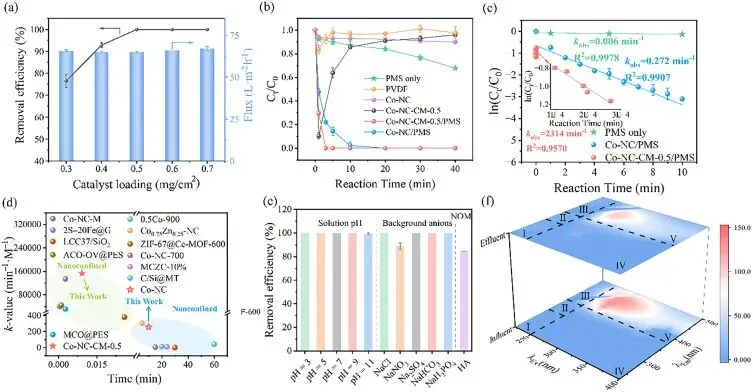
Fig. 2. (a) The influence of catalyst loading amount on the removal efficiency of tetracycline and pure water flux. (b) Effects of different catalytic systems on tetracycline removal. (c) The corresponding pseudo-first-order kinetic model simulation. (d) Comparison of k of advanced catalytic materials for tetracycline removal. (e) Tetracycline removal in solutions containing different pH, coexisting anions, and NOM. (f) The fluorescence EEM spectra of HA. (Reaction conditions: [PMS]0 = 0.3 mM, [tetracycline]0 = 10 mg·L−1, initial pH = 7.0 ± 0.1, flow rate = 1.5 mL min−1, [coexisting anions]0 = 10 mM, [HA]0 = 20 mg·L−1).
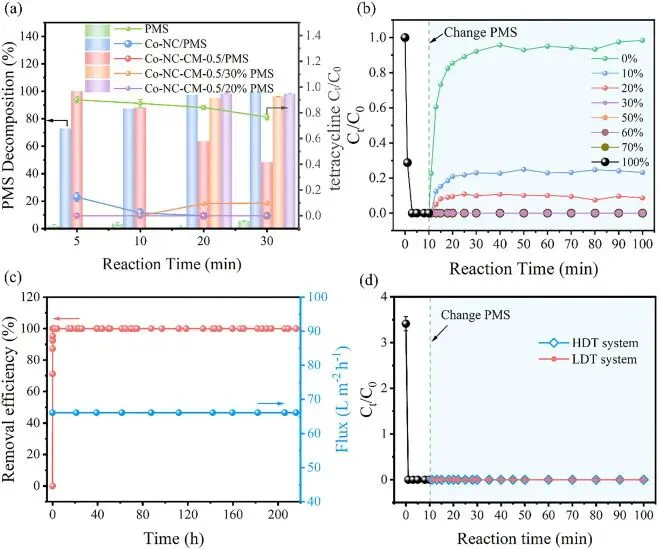
Fig. 3. (a) The PMS decomposition and tetracycline removal under different PMS doses in the whole degradation processes. (b) Tetracycline removal under different PMS doses during the stable stage. (c) Long-term performance of LDT system. (d) Tetracycline removal efficiency in real aquaculture wastewater by HDT/LDT systems. (Reaction conditions: [PMS]0 = [PMS]HDT = 0.3 mM, [PMS]LDT = 0.09 mM, [tetracycline]0 = 10 mg·L−1, initial pH = 7.0 ± 0.1, flow rate = 1.5 mL min−1).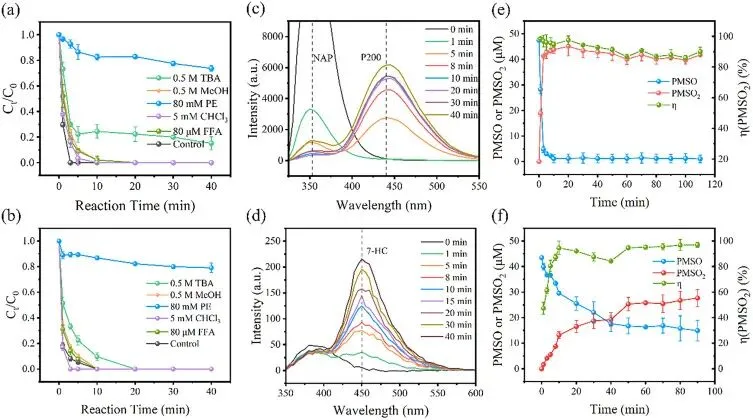
Fig. 4. Tetracycline removal under different quenching conditions in (a) Co-NC-CM-0.5/PMS system and (b) Co-NC/PMS system. (c) FL spectra of NAP in Co-NC-CM-0.5/PMS system. (d) FL spectra of coumarin in CM-0.5/PMS system. PMSO loss and PMSO2 production in (e) Co-NC-CM-0.5/PMS and (f) Co-NC/PMS system. (Reaction conditions: [PMS]0 = 0.3 mM, [tetracycline]0 = 10 mg·L−1, [NAP]0 = 50 μM, [coumarin]0 = 50 μM, [PMSO]0 = 50 μM, initial pH = 7.0 ± 0.1, flow rate = 1.5 mL min−1).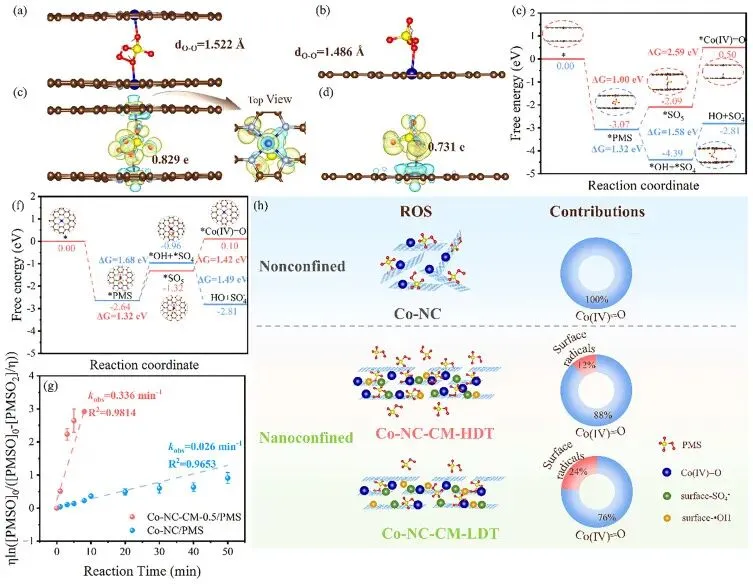
Fig. 5. The adsorption configuration of PMS on (a) Co-NC-CM-0.5 and (b) Co-NC. EDD of PMS adsorption on (c) Co-NC-CM-0.5 and (d) Co-NC. Energy profile during the dissociation of PMS within the (e) Co-NC-CM-0.5 and (f) Co-NC. (g) PMSO pseudo-first-order kinetic model simulation in Co-NC-CM-0.5/PMS and Co-NC/PMS system. (h) The ROS and relative contributions in different systems. (Reaction conditions: [PMS]0 = [PMS]HDT = 0.3 mM, [PMS]LDT = 0.09 mM, [tetracycline]0 = 10 mg·L−1, [PMSO]0 = 50 μM, initial pH = 7.0 ± 0.1, flow rate = 1.5 mL min−1).纳米限制型碳材料(CMs)对抗生素进行快速、高效且连续的催化去除,对水安全和人类健康具有重要意义。然而,在连续降解过程中,该方法仍面临氧化剂用量大、活化效率低等关键挑战。在本研究中,我们报道了一种基于新型Co-NC-CM纳米限制系统的LDT策略,用于高效活化PMS,从而实现四环素的有效降解。该系统表现优于此前报道的纳米限制型CM,展现出高达3083 min−1的kobs值。通过评估PMS利用率,将动态降解过程划分为活化阶段和稳定阶段。在稳定阶段,LDT系统在长期运行下实现了100%的四环素降解率、95%的PMS活化率,并使PMS投加量减少了70%。重要的是,该 LDT 系统在实际水产养殖废水中仍能保持 100% 的四环素降解率。密度泛函理论(DFT)计算和实验结果表明,得益于 PMS 的富集及有效的碰撞效应,LDT 系统成功维持了 1.98 × 10⁻⁹ μM 的 Co(IV)=O 含量、恒定的表面结合自由基产率以及超快动力学。本研究为在低PMS用量条件下连续降解四环素提供了一种高效且稳定的催化材料。连续降解过程中“活化阶段”与“稳定阶段”的概念,有望为未来更高效、低耗料的纳米限制型催化金属(CM)技术的合理设计提供启示。
Jinsong He, Keyu Long, Fan Ni, Yongjia Lei, Wei Qu, Wei Shi, Yifeng Zhang, Fei Shen, Ultrafast kinetics and efficient PMS activation using a 2D calcined Co-MOF nanoconfined catalytic membrane for continuous tetracycline degradation, Water Research, 2026, https://doi.org/10.1016/j.watres.2026.126340
声明:本公众号仅分享前沿学术成果,无商业用途。如涉及侵权,请立刻联系公众号后台或发送邮件,我们将及时修改或删除!
邮箱:Environ2022@163.com