Plant Physiology, kiag374 14 June 2026
CAMTA5 suppresses blossom-end rot in tomato by regulating the expression of the functional CBP60A variant
Author
Xuemei Hou , Zhuohui Zhang , Aiyin Cui , Yuanyuan Kong , Tong Wang , Chen Liang , Yihua Li , Yali Zhu , Weibiao Liao
*: College of Horticulture, Gansu AgriculturalUniversity, Lanzhou 730070, PR China
Abstract
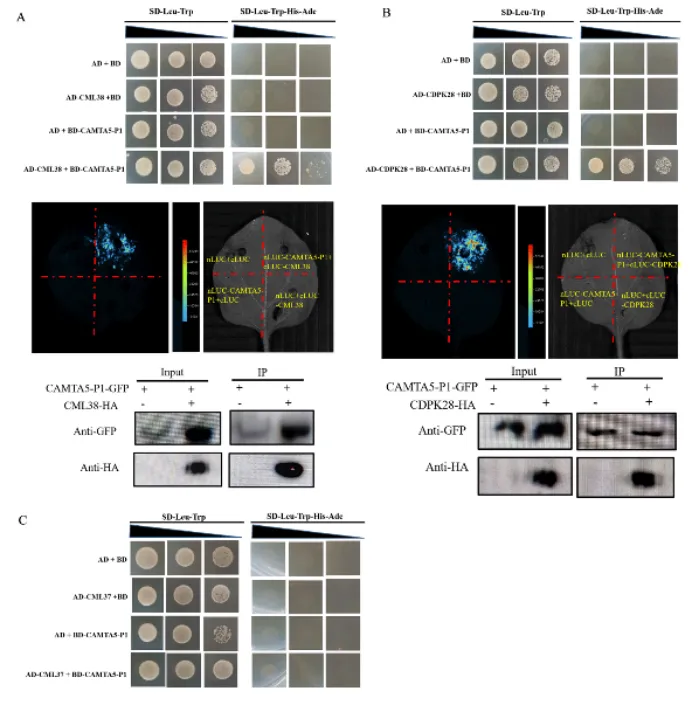
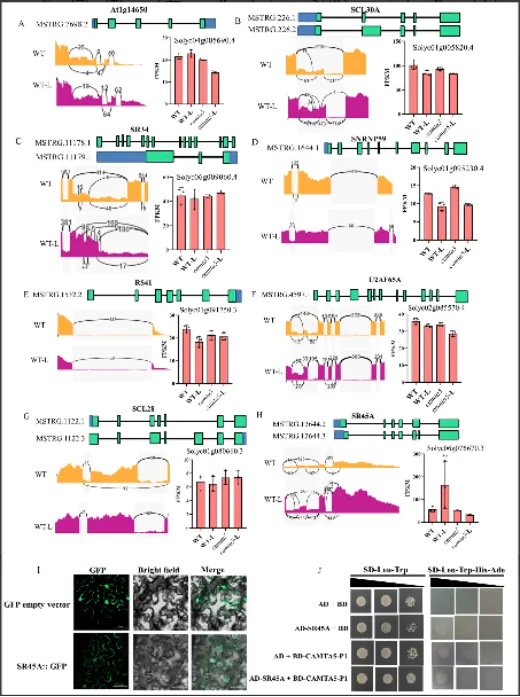
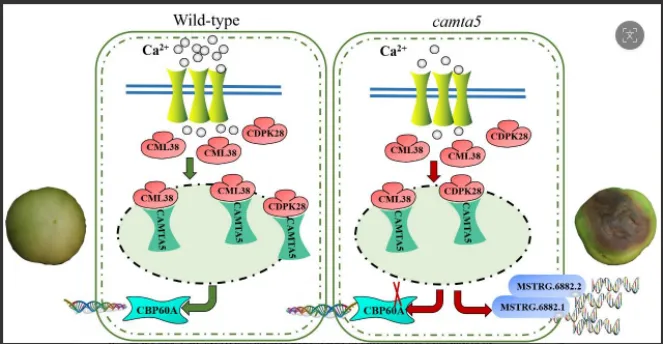
Low-calcium (Ca) stress induces blossom-end rot (BER), a physiological disorder that seriously reduces the yield and quality of tomato (Solanum lycopersicum L.). However, the mechanisms underlying low-Ca-induced BER remain insufficiently understood. Calmodulin-binding Transcriptional Activators (CAMTAs) are evolutionarily conserved CaM-binding proteins that play crucial roles in plant responses to Ca deficiency. In this study, we found that the expression of SlCAMTA5 increases in tomato under Ca-deficient conditions. Knockout of SlCAMTA5 markedly elevates BER incidence, accompanied by reactive oxygen species (ROS) accumulation and reduced Ca uptake capacity in the fruit peel under low Ca conditions, whereas SlCAMTA5 overexpression results in the opposite phenotypes, demonstrating its function in suppressing BER. Transcriptome analysis showed that the expression of calcium ion (Ca2+) transport–related genes (CML37, CML38, and CDPK28) is upregulated in wild-type (WT) plants but downregulated in camta5 mutants under low-Ca stress. Further assays revealed that CAMTA5 interacts with CML38 and CDPK28 via its P1 region containing ankyrin (ANK) repeats, several IQ motifs, and a calmodulin binding (CAMBD) domains. Moreover, the Ca2+ transport-related gene calmodulin-binding protein 60 A (CBP60A) was identified as a gene undergoing differential alternative splicing in WT under low-Ca stress. It was also confirmed as differentially expressed in camta5 mutants. Under Ca deficiency, new nonfunctional variants of CBP60A are generated from its pre-mRNA. CAMTA5 directly binds to the promoter of the functional CBP60A transcript, activating its expression. Moreover, the interaction between CAMTA5 and CML38/CDPK28 enhances this transcriptional activation. Collectively, our findings demonstrated that the CML38/CDPK28–CAMTA5 module suppresses BER occurrence by regulating the functional alternatively spliced variant of CBP60A.







 10个月宝宝每天需要喝多少奶粉?