Food Packaging ang Shelf Life| 负载柠檬醛的 PVA-PVP 水凝胶垫:制备、理化性质、表征及在蓝莓保鲜中的应用
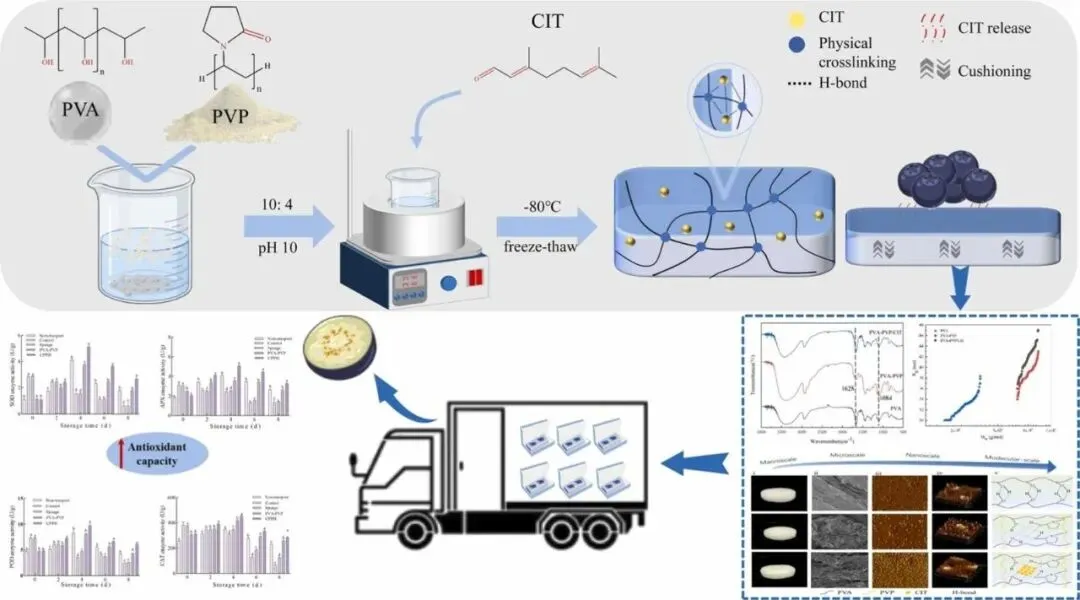
近日,沈阳农业大学团队在《Food Packaging and Shelf Life》期刊上发表了题为Citral-loaded PVA-PVP hydrogel pad: Preparation, physicochemical properties, characterization, and application for blueberry preservation的研究性论文(一区,IF:10.6)。该研究以 PVA 与 PVP 为基材制备水凝胶垫,优化了 PVA/PVP 配比与 pH 条件,负载柠檬醛构建兼具缓冲与保鲜功能的活性水凝胶(CPPHP),系统表征其结构与理化特性,并验证其在蓝莓模拟运输中的保鲜效果。结果表明,PVA/PVP=10:4、pH=10 的水凝胶弹性、持水性与缓释性能最优,CPPHP 可显著降低蓝莓腐烂率、维持硬度与花青素含量,提升抗氧化酶活性。这一成果为易损浆果在运输过程中的品质保持提供了新型缓冲保鲜方案。
蓝莓富含花青素等多种生物活性物质,具备抗氧化、护眼等多种健康功效,是经济价值与营养价值兼备的浆果。但蓝莓成熟期多处于高温高湿环境,果皮薄、果肉柔软,在采后贮藏与物流运输过程中极易因机械损伤、微生物侵染发生腐烂变质,每年采后损耗率超过 50%,已成为制约蓝莓产业发展的关键问题。
当前蓝莓运输主要采用瓦楞纸板、发泡聚乙烯、海绵等缓冲材料,虽能减轻机械损伤,但功能单一,不具备抗菌保鲜能力,无法有效抑制蓝莓腐烂与品质劣变。开发同时具备缓冲防护与活性保鲜功能的新型包装材料,成为蓝莓采后物流减损的迫切需求。
水凝胶因高弹性、高持水性、结构可调等优势,在食品缓冲包装领域具有良好应用前景。聚乙烯醇(PVA)生物相容性好、成膜与交联性能优异,是制备缓冲水凝胶的理想基材,但单一 PVA 水凝胶存在抗压强度不足、抗蠕变性能差等缺陷,限制其应用。与聚乙烯吡咯烷酮(PVP)共聚可在无有毒交联剂条件下增强水凝胶网络结构,提升力学强度与持水性,是绿色安全的改性路径。
柠檬醛作为香茅精油的主要成分,具有广谱抗菌活性,可有效抑制果蔬采后致病菌生长,延长货架期,但其挥发性强、稳定性差,直接使用难以实现长效保鲜。将柠檬醛负载于 PVA-PVP 水凝胶中,可实现活性成分的控释,同时赋予水凝胶缓冲防护与抗菌保鲜双重功能。
目前,关于 PVA-PVP 复合水凝胶的配比、pH 对其力学性能、持水性及活性物质缓释行为的系统研究较少,且该复合水凝胶在蓝莓运输保鲜中的实际应用效果尚未得到充分验证。基于此,本研究制备负载柠檬醛的 PVA-PVP 水凝胶缓冲垫,优化制备工艺,系统表征其结构与理化性能,并探究其在模拟运输条件下对蓝莓品质的维持效果,为易损浆果的绿色、高效、一体化物流保鲜包装提供理论依据与技术支撑。
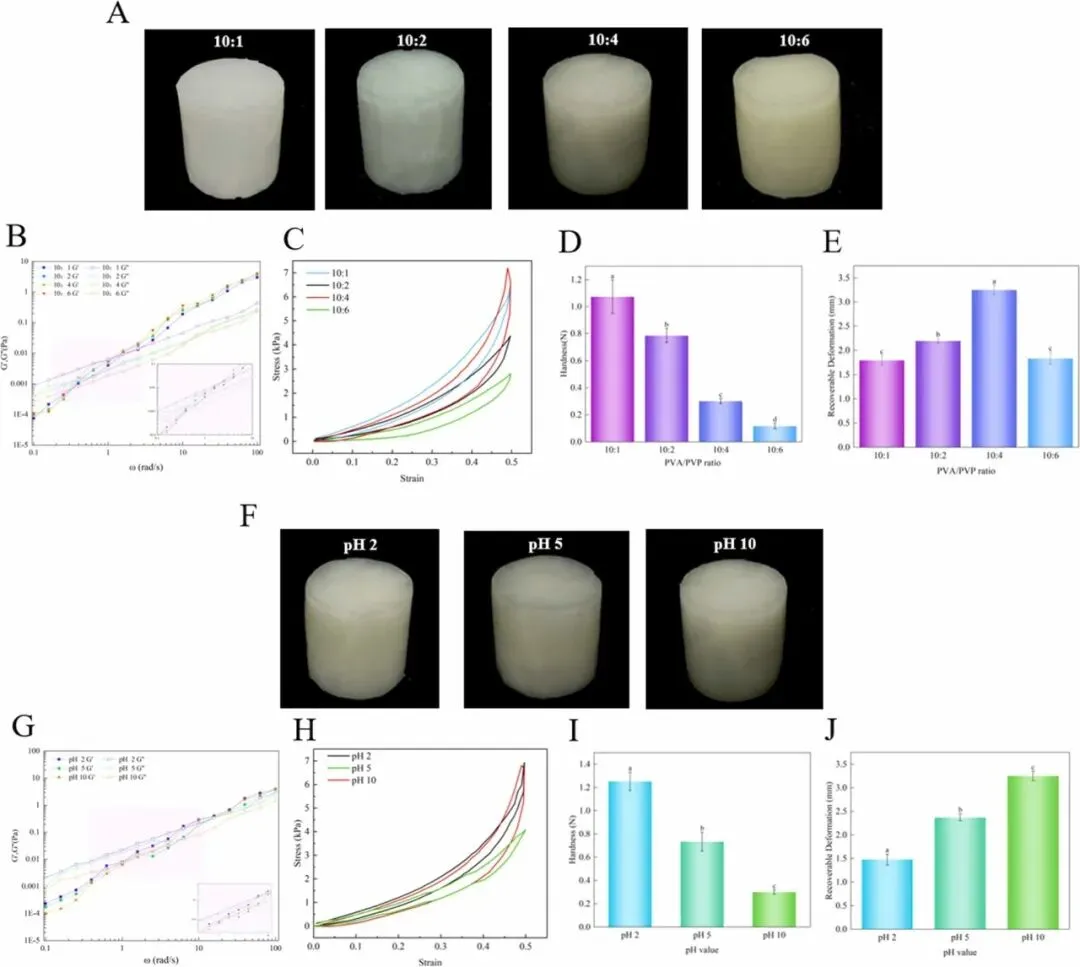
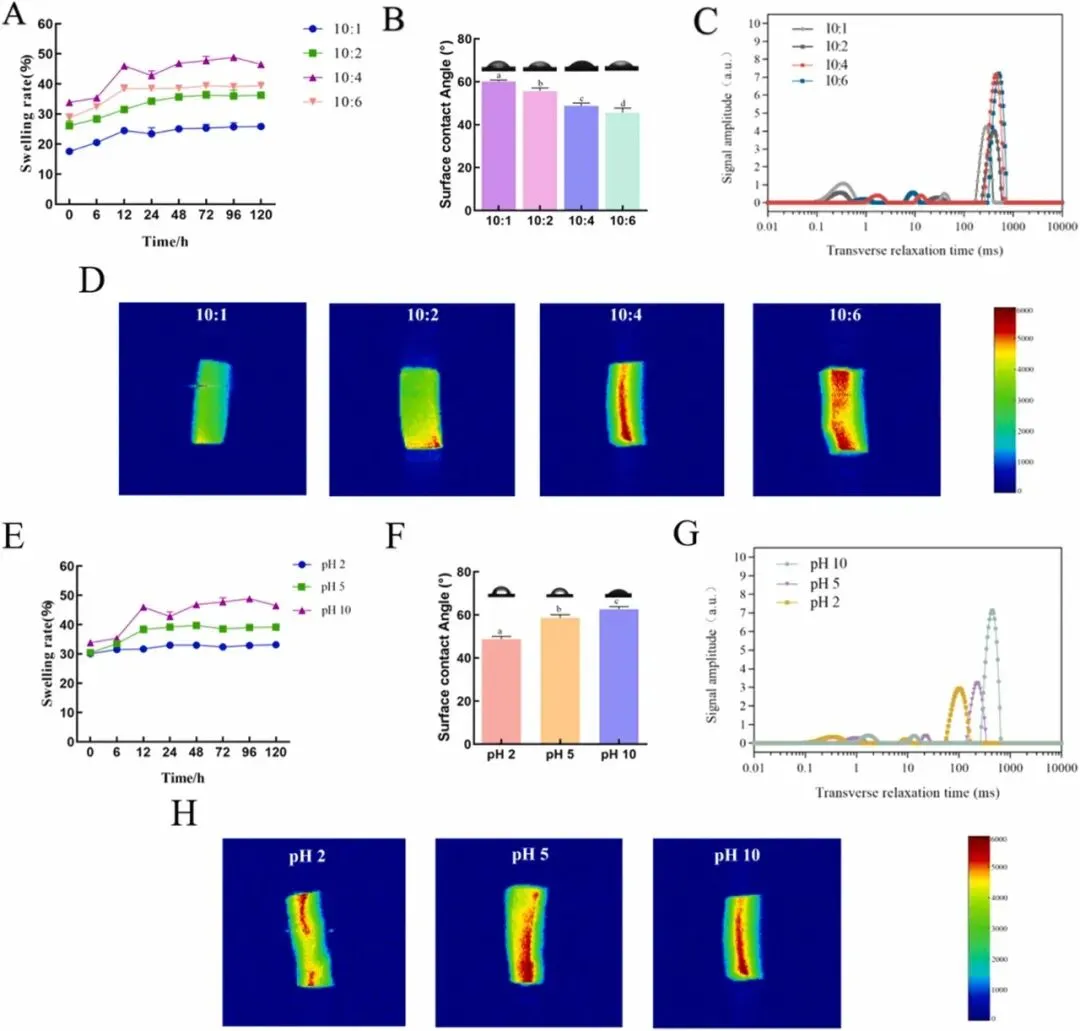
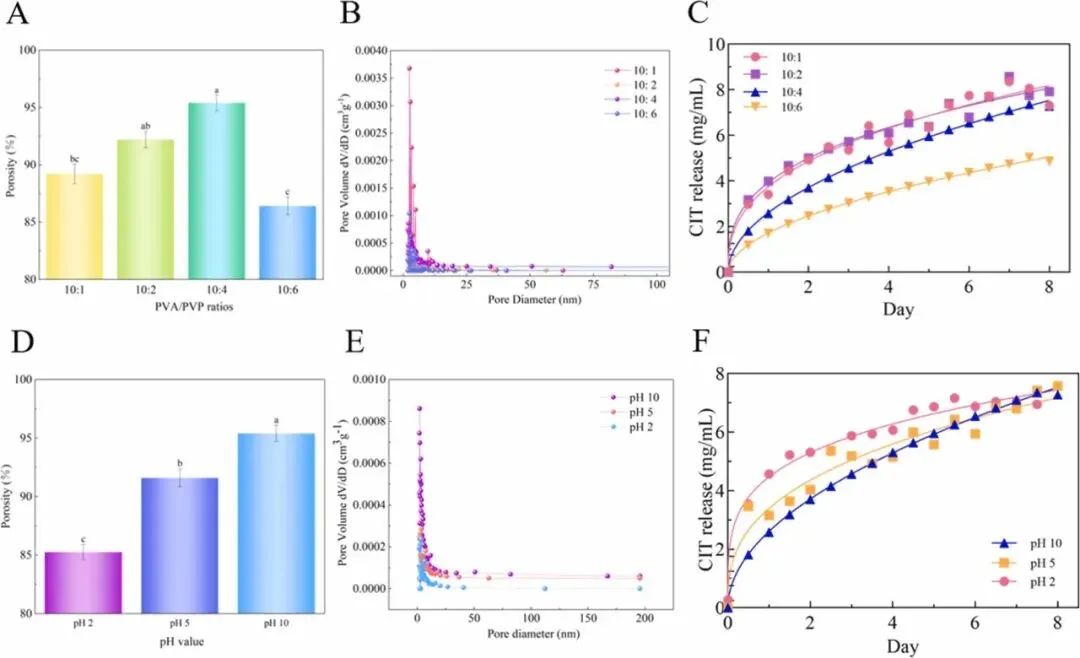
PVA 与 PVP 共混制备的水凝胶可通过调控配比和 pH 显著改变力学、持水及缓释特性,当 PVA/PVP 比例为 10:4、体系 pH 为 10 时,水凝胶综合性能最优,表现出良好的弹性、能量耗散能力、可回复形变与适宜硬度,同时具备最高的溶胀率、亲水性与均匀水分分布,孔隙结构与扩散行为更符合菲克扩散规律,可实现柠檬醛的稳定控释。
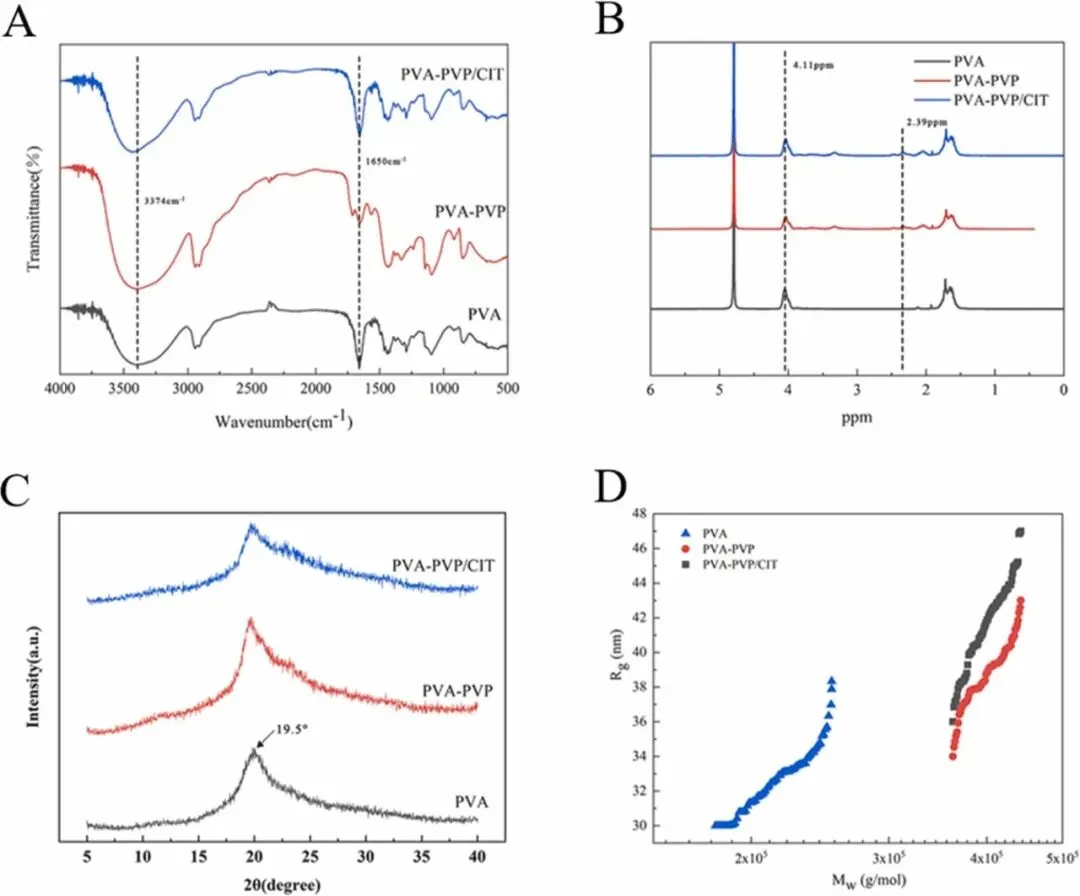
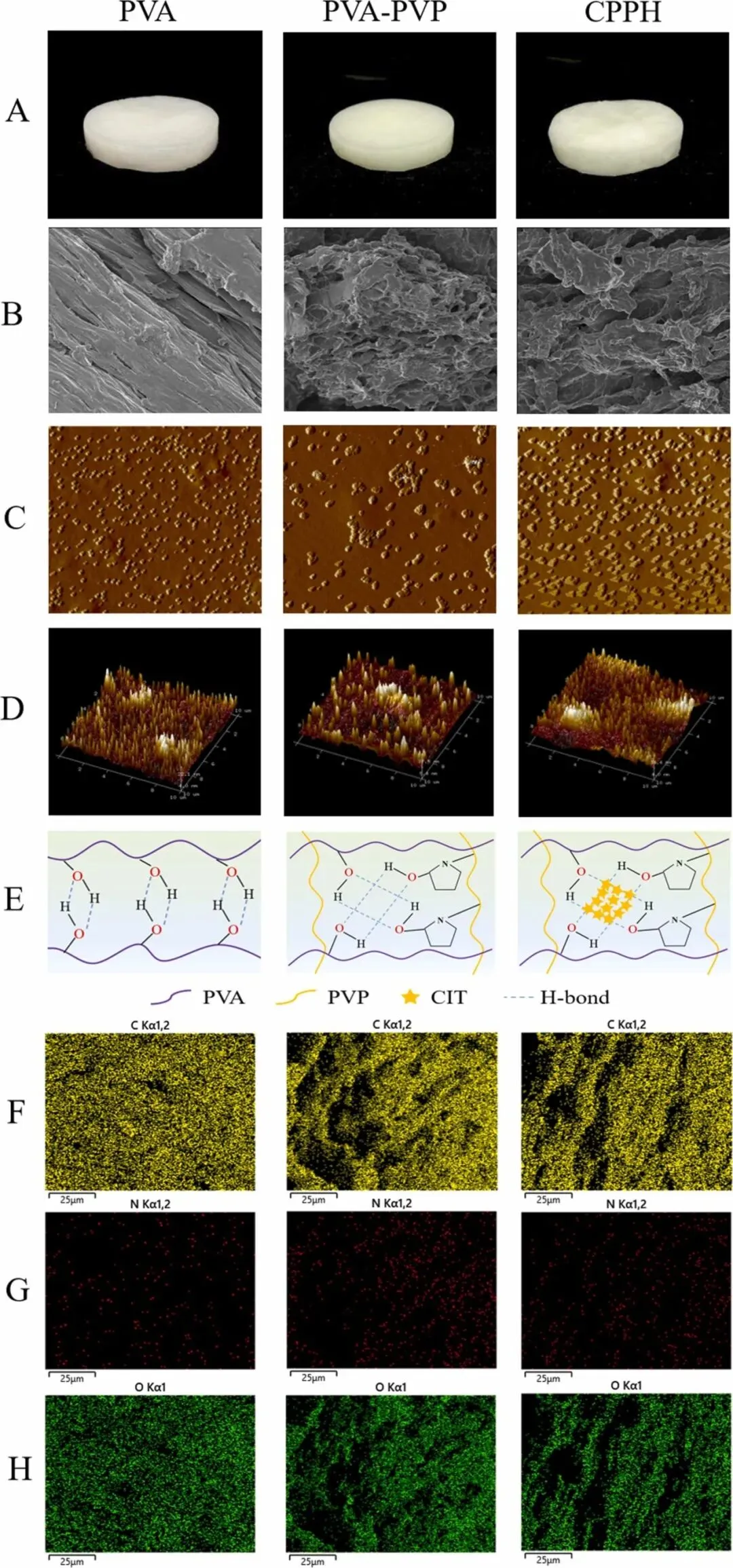
CPPHP 通过氢键作用实现 PVA、PVP 与柠檬醛的稳定复合,红外、核磁与 XRD 等表征证实柠檬醛成功载入并增强了分子间相互作用,使水凝胶分子链构象更为紧密、交联密度更高,微观结构更均匀有序,元素分布结果进一步验证了复合网络的稳定形成,结构优化直接提升了水凝胶的物理稳定性与功能持久性。
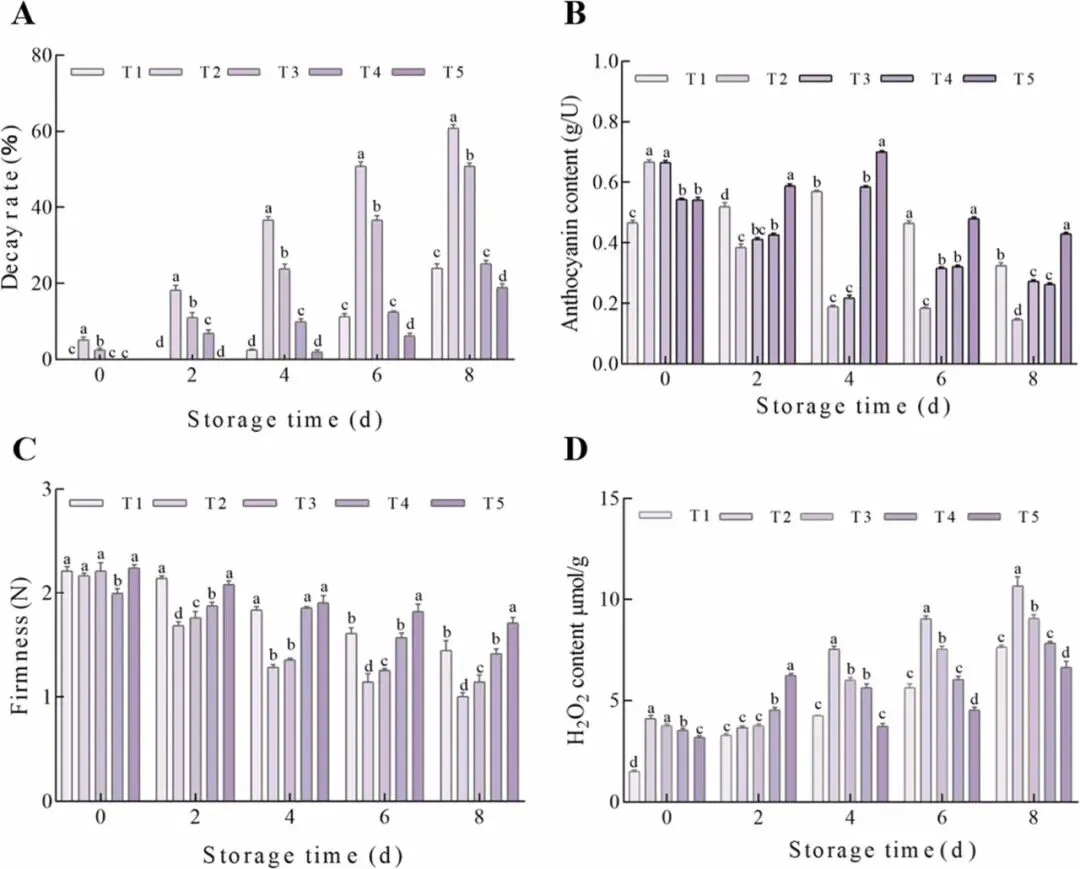
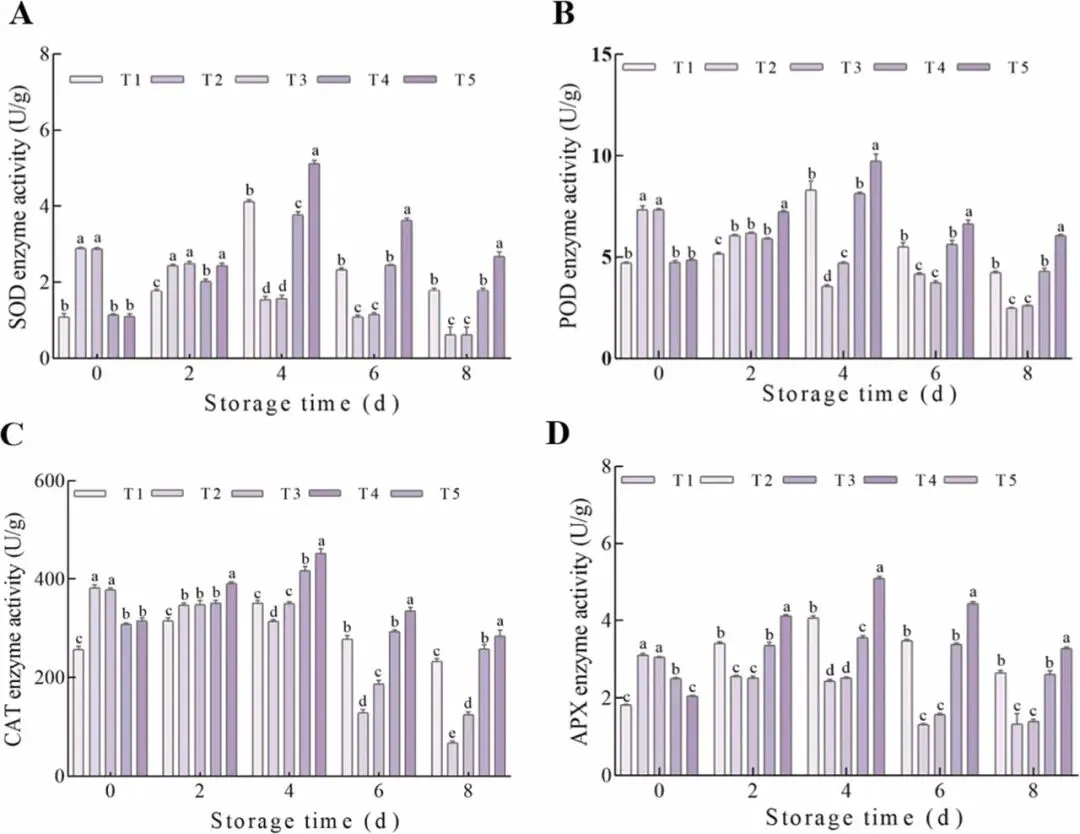
CPPHP 可同时发挥缓冲防护与抗菌保鲜双重作用,在模拟运输试验中能显著降低蓝莓腐烂率,延缓果实硬度下降,维持更高的花青素含量,有效调控过氧化氢水平并提升 SOD、POD、APX、CAT 等抗氧化酶活性,整体保鲜效果显著优于无衬垫、普通海绵及未载药水凝胶组,可使蓝莓在运输后保持更优的品质与更长的货架期。
Fig. 1. The effect of PVA/PVP ratios and pH value on the mechanical properties of hydrogels. Ratios: appearance morphology of hydrogel (A), dynamic rheology (B), compression cyclic stress-strain curves (C), hardness (D), recoverable deformation (E); pH value: appearance morphology of hydrogel (F); dynamic rheology (G); compression cyclic stress-strain curves (H), hardness (I) and recoverable deformation (J).
Fig. 2. The effect of PVA/PVP ratios and pH value on the water holding properties. Ratio: swelling rate (A), surface contact angle (B), low-field nuclear magnetic resonance (C), MRI images (D); pH value: swelling rate (E), surface contact angle (F), low-field nuclear magnetic resonance (G) and MRI images (H).
Fig. 3. The effect of PVA/PVP ratios and pH value on the sustained release performance. Ratio: porosity (A), pore size distribution (B), and release kinetics of CIT in hydrogels (C); pH value: porosity (D), pore size distribution (E), and release kinetics of CIT in hydrogels (F).
Fig. 4. The structural characterization of PVA, PVA-PVP, and PVA-PVP/CIT hydrogels: (A) FTIR, (B) 1H NMR, (C) XRD, (D) Plot of Mw versus Rg.
Fig. 5. (A)Hierarchical structures of the hydrogel: (A) Macroscopic view of hydroge. (B) Scanning electron microscopy (SEM) image of the Micro-structure. (C and D) 2D/3D Atomic Force Microscopy (AFM) Nano-Images of the Hydrogel (E) Illustration of the interactions of polymer chains. (F) The C distribution of PVA 、PVA-PVP、PVA-PVP/CIT hydrogels. (G) The N distribution. (H) The O distribution.
Fig. 6. Blueberry quality: decay rate (A), anthocyanin content (B), firmness (C), hydrogen peroxide (H2O2) content (D). Blueberries were divided to five groups: (T1) without simulated transportation; (T2) transportation without cushioning pads (the control group); (T3) transportation with only sponge pads; (T4) transportation with sponge and PVA-PVP hydrogel pads; (T5) transportation with sponge and PVA-PVP/CIT hydrogel pads. Statistical significance among groups was assessed using Duncan's multiple comparison test, with different lowercase letters indicating significant differences (p < 0.05). Error bars represent standard deviations.
Fig. 7. Blueberry antioxidant enzyme activity: SOD (A), POD (B), APX (C), and CAT (D). Blueberries were divided to five groups: (T1) without simulated transportation; (T2) transportation without cushioning pads (the control group); (T3) transportation with only sponge pads; (T4) transportation with sponge and PVA-PVP hydrogel pads; (T5) transportation with sponge and PVA-PVP/CIT hydrogel pads. Statistical significance among groups was assessed using Duncan's multiple comparison test, with different lowercase letters indicating significant differences (p < 0.05). Error bars represent standard deviations.
https://doi.org/10.1016/j.fpsl.2026.101746
免责声明:「原创」仅代表原创编译,水平有限,仅供学术交流,本平台不主张原文的版权,如有侵权,请联系删除。文献解读或作者简历如有疏漏之处,我们深表歉意,请作者团队及时联系《食探未来》主编(微信号:shitanweilai8077),我们会在第一时间进行修改或撤稿重发,感谢您的谅解!