Journal of Integrative Plant Biology 23 Mar 2026
FcMAPK4‐phosphorylated FcNOR activates FcERF5 to promote fig fruit softening through activation of FcPG12 expression
Author
Wang Y, Fan Z, Wang Y, Qiu Y, Sun Y, Ma H*
*: College of Horticulture, China Agricultural University, Beijing 100193, China
Abstract
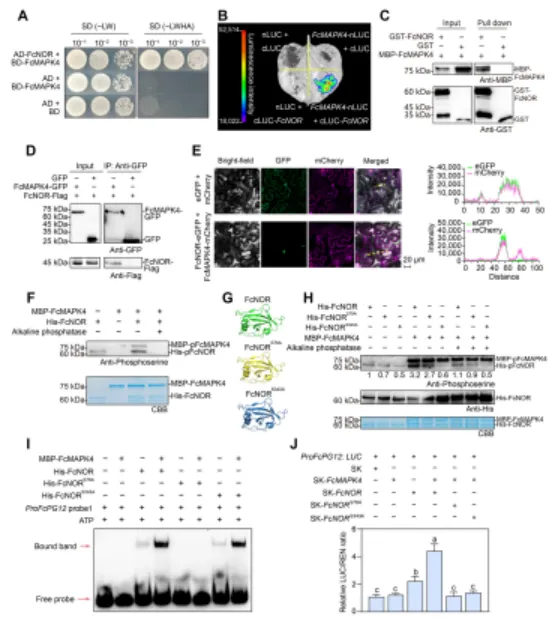
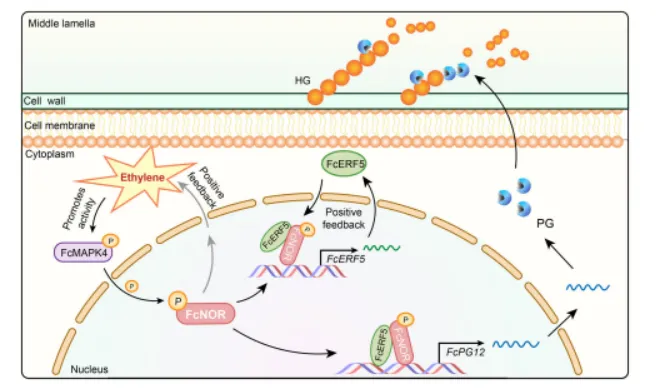
Rapid softening of fig (Ficus carica L.) fruit during ripening leads to extremely short shelf life; the regulatory mechanisms underlying this process remain largely unknown. Fig softening during ripening is largely attributed to pectin degradation, and we identified FcPG12 as the crucial polygalacturonase gene involved in the process. We then identified a NAM (ATAF1/2-CUC2) transcription factor, termed FcNOR and sharing 53.09% amino acid identity with Solanum lycopersicum NOR, which binds directly to the promoter ofFcPG12 to activate its transcription. The activity of FcNOR increased robustly following FcMAPK4 phosphorylation of Ser-78 and Ser-343, which are essential for FcNOR DNA binding and transcriptional activity, respectively. Ethylene also enhanced FcMAPK4 kinase activity and promoted FcNOR phosphorylation, leading to the latter's elevated activity. APETALA2/Ethylene Response Factor 5 (FcERF5) functioned as a transcriptional activator of FcPG12 expression, which was synergistically enhanced by interaction between FcNOR and FcERF5. Moreover, FcNOR binds to the promoter of FcERF5, increasing the latter's transcription and forming a FcNOR–FcERF5 positive-feedback loop. Collectively, integration of ethylene signaling with MAPK-mediated phosphorylation by the FcMAPK4–FcNOR–FcERF5 regulatory module, leading to transcriptional regulation of FcPG12 expression to drive pectin degradation, reveals new insights into the mechanism of fruit softening.






 10个月宝宝每天需要喝多少奶粉?