Plant Biotechnology Journal. 18 February 2026
Hydrogen Gas Enhances Salinity Tolerance in Tomato Seedlings by Regulating the S-Nitrosylation of MEK1
Author
Hua Fang, Xuetong Wu, Dengjing Huang, Xinfang Chen, Zhiya Liu, Xuejuan Pan, Huan Chen, Dandan Zheng, Caicai Ma, Xuemei Hou, Shuya Wang, Chunlei Wang, Weibiao Liao*.
*: College of Horticulture, Gansu Agricultural University, Lanzhou, China
Abstract
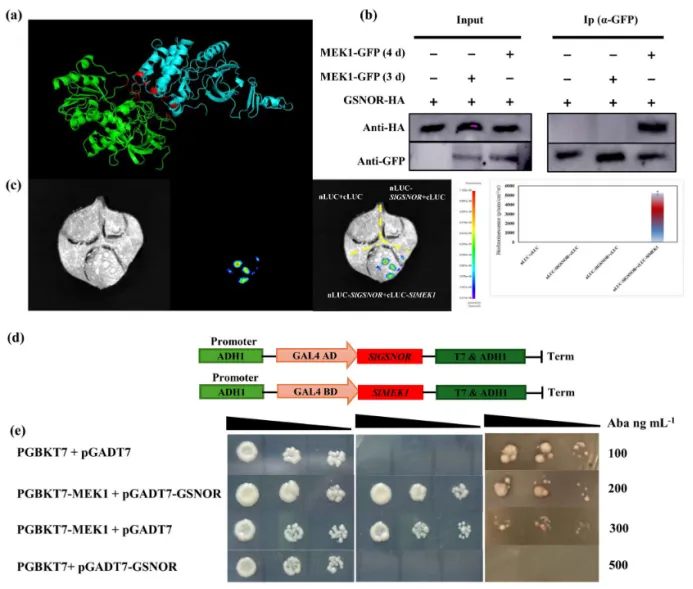
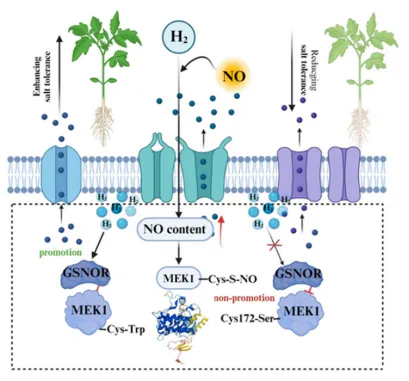
Hydrogen gas (H2) effectively alleviates abiotic stress in horticultural plants. Protein S-nitrosylation, a key post-translational modification, serves as a critical mechanism for nitric oxide (NO) to exert its biological function under adverse conditions. However, the relationship among H2, NO and S-nitrosylation in response to salt stress remains poorly understood. In this study, we demonstrate that NO participated in H2-enhanced salt tolerance in tomato seedlings (Solanum lycopersicum cv. Micro-Tom). H2 triggered an increase in NO levels and S-nitrosothiol (SNO) content under salt stress, enhancing the enrichment of S-nitrosylated proteins. S-nitrosoproteomic analysis revealed that MEK1, a conserved MAPK component, was notably induced and S-nitrosylated by NO and H2 under salt stress. Furthermore, SlMEK1-overexpressing tomato lines exhibited enhanced salt stress tolerance, while knockout lines showed reduced tolerance, indicating the positive regulatory role of SlMEK1 in salt tolerance. Additionally, SlMEK1 may contribute to H2-enhanced salt tolerance. Meanwhile, MEK1 was shown to undergo S-nitrosylation at Cys 172, and this modification was involved in H2-enhanced salinity tolerance. Moreover, site-specific mutation analysis at Cys 172 confirmed that MEK1 S-nitrosylation positively contributed to both intrinsic and H2-facilitated salt tolerance. Finally, S-nitrosylation of MEK1 increased its interaction with GSNOR, and H2 further promoted this interaction under salt stress. Collectively, our findings indicate that H2 may enhance the salinity tolerance in tomato seedlings by orchestrating the interplay between S-nitrosylated MEK1 and GSNOR.