What is SARAS?
Sustainable and Resilient Agrifood System可持续与韧性农业食品系统
It refers to agrifood system that can deliver healthy and affordable food for all while protecting ecosystems, ecsuring economic viability, promoting social equity, and remaininig resilient to shocks such as climate change, pandemics, and market disrujptions.
SARAS views agriculture not as isolated sector, but as a shole system, encompassing:
Production_ processing_distribution_consumption_waste and recycling.
它覆盖从生产—加工—流通—消费—废弃回收的完整链条,不只是“农业”,而是系统工程。
��sustainable means meeting today’s need without undermining future generration
可持续(Sustainable)=不透支自然与社会未来
��resilient means maintaining functonality under stress and uncertainty.
韧性(Resilient)=面对气候、疫情、市场波动仍能稳定供给
Why is SARAS importan today?
Current global agrifood system are facing multible overlapping crises:
_climate change threatening food security
_boldivwersity loss
_rural livelyhood vulnerrability
_coextistence of undernutruition and obestiy
Growing social inequlity within food system.
Because of this, international organizations such as the food and agriculture organization of the unitednations emphasize the urgent need to move beyond productivitiy-centered models toward systemic transformation-this if the core ratianal behind SARAS.
Four core dimensions of SARAS?
_ECOLOGICAL DIMENSION
Goal: Produce food while regenerating nature.
生产粮食,同时修复自然。
_ECONOMIC DIMENSION
Goal: Make agriculture economically viable for producers.
让农业“养得活人”。
_SOCAIL DIMENTION
Goal: Treat food as a matter of social justice.
让吃饭成为一种社会正义。
_GOVERNANCE AND POLITICAL DIMENSION
Goal: Shift from fragmented management to integrated governance.
从“碎片化管理”走向“整体治理”。
Three Key Transformation prompted by SARAS
_From “maximizing yield”to “optimazing systems”
从“单一增产” → “系统优化”
Not only productivity,but also nutriton, environment, and livelihoods matters.
_From “one-size -fits-all solutions”to”place-based-approaches”
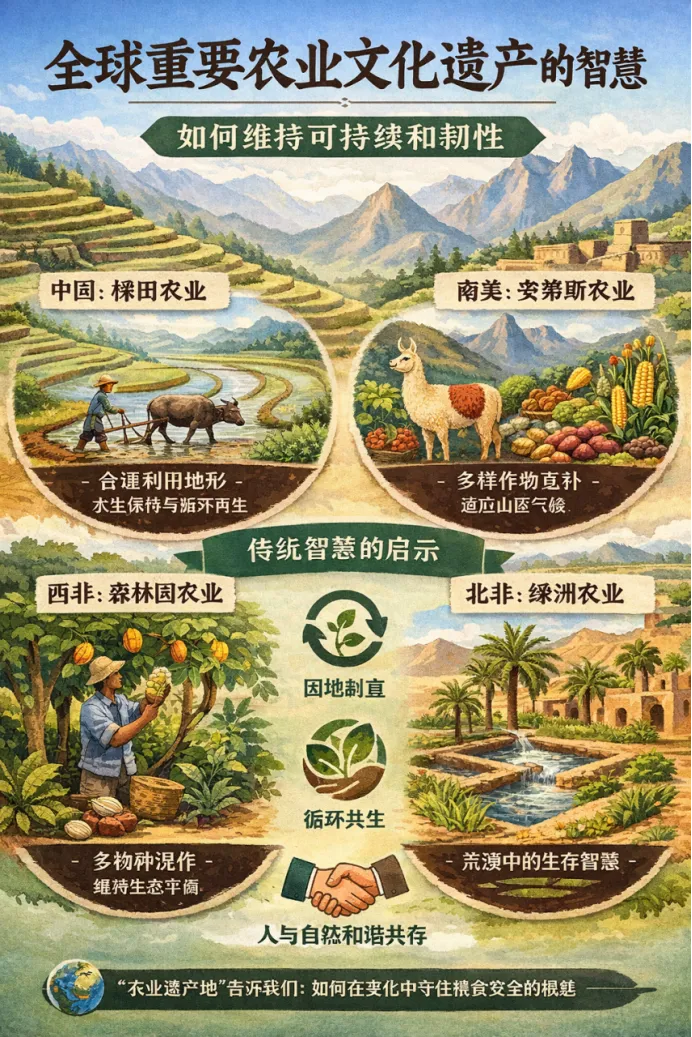
从“全球统一方案” → “因地制宜”
Each region should design pathways suited to its own ecological and cultural conditions
_From “linear chains”to “circular systems”
从“线性链条” → “循环体系”
A central prniciple: the whole- system approache
ARAS emphysizes that:
_production, consumpution, environment, and education are interconnected
_urban and rural areas are mutually dependent
_local action have global consequences
Therefore, transformation must:
_balance global franmeworks with local practices
_minmize trade-offs and maximize synergies
_aboid unintended impacts on other counties and vulnuerable groups.
和你研究/教学的关系(特别重要)
Rrlevance to Education and Cultural Research
In the context of agrarian education, youth food culture, and traditonal farming knowlege, SARAS offers a powerful framwork:
_Agrarian educaiton, socail and cutural dimentions of SARAS
耕读教育→ SARAS 的社会与文化维度
_Youth dietary practices, consumption transfourmation
青年饮食→ SARAS 的消费转型
_Farming heritage, place-based knowlege systems
农耕文化→ SARAS 的地方知识体系
_labor education, practical foundation of system change
劳动教育→ SARAS 的实践基础
You could frame this in teaching materials as:
SARAS jprovides the global theoretical context for contmporary agrarian education, while chinese farming civilization offers deep cultural resources for realizing SARAS locally.
定位:
SARAS 为当代耕读教育提供了国际理论背景,而中国农耕文明则为 SARAS 提供了深厚的文化土壤。
 10个月宝宝每天需要喝多少奶粉?