Food Hydrocolloids| 玉米醇溶蛋白纳米粒与仙草多糖纳米涂层增强益生菌 MC1 稳定性及酸奶质构
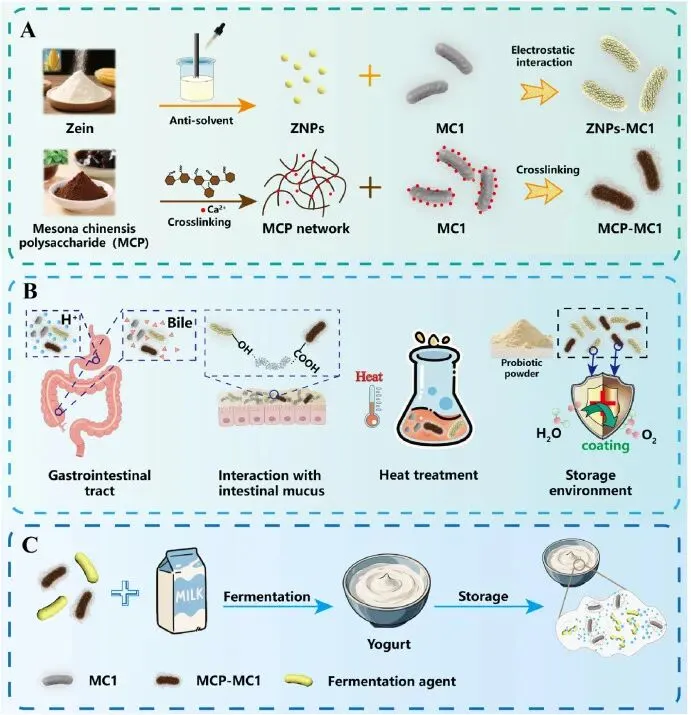
近日,中国农业大学团队在《Food Hydrocolloids》期刊上发表了题为《Zein nanoparticles and Mesona chinensis polysaccharide nanocoatings enhance probiotic MC1 stability and yogurt texture》的研究性论文(一区,IF:12.4)。该研究针对益生菌在加工、储存及胃肠道转运过程中存活率低的行业瓶颈,分别通过静电自组装和 Ca²⁺- 羧基配位策略,构建了玉米醇溶蛋白纳米粒(ZNPs)和仙草多糖(MCP)两种食品级益生菌纳米涂层,用于修饰具有降尿酸活性的副干酪乳杆菌 MC1。研究发现,ZNPs 涂层凭借疏水特性显著提升了 MC1 的热稳定性和储存存活率,MCP 涂层则通过羧基的 H⁺缓冲作用增强了菌株的耐酸和耐胆盐能力,且两种涂层均能通过氢键作用强化益生菌的肠道黏液粘附性。将 MCP 包被的 MC1 作为辅助发酵剂与商业菌株共发酵酸奶,产品 28 天储存后活菌数仍达 10⁸・⁷² CFU/mL,稳定性指数低至 0.82±0.03,流变学性能显著优于单菌株发酵酸奶,为益生菌功能食品的品质提升提供了可行技术方案。
益生菌可通过调节肠道稳态、增强免疫等发挥健康益处,是功能食品领域的核心原料,但在加工、储存及口服转运过程中,需经受高温、机械应力、胃酸、胆盐等多重胁迫,导致其存活率大幅下降,生理功能难以充分发挥。食品级生物大分子表面包被是提升益生菌稳定性的有效策略,其中玉米醇溶蛋白(zein)可制备为疏水纳米粒,具有优异的屏障性能,但其在益生菌单菌表面涂层中的应用仍较少;仙草多糖(MCP)是兼具抗氧化、肠道调节活性的阴离子多糖,可通过金属离子配位形成凝胶网络,前期研究证实其微凝胶能保护益生菌,但尚未开发直接作用于菌体表面的纳米涂层技术。因此,本研究以具有降尿酸活性的副干酪乳杆菌 MC1 为对象,分别构建玉米醇溶蛋白纳米粒(ZNPs)和仙草多糖(MCP)两种纳米涂层,系统评价其对益生菌稳定性的提升效果,并验证其在发酵乳中的应用价值,为益生菌功能食品的品质升级提供技术支撑。
1. 成功制备两种生物相容性良好的益生菌纳米涂层
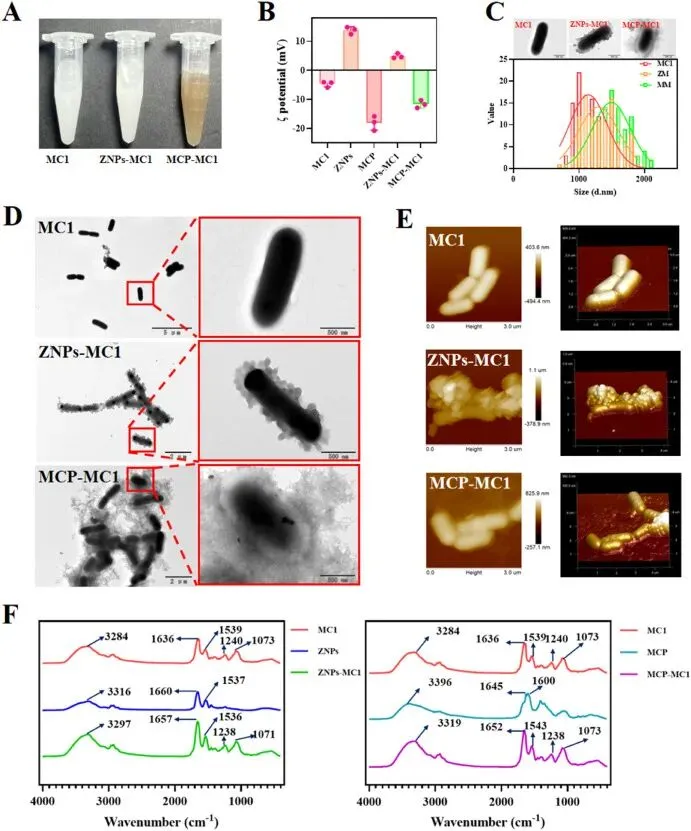
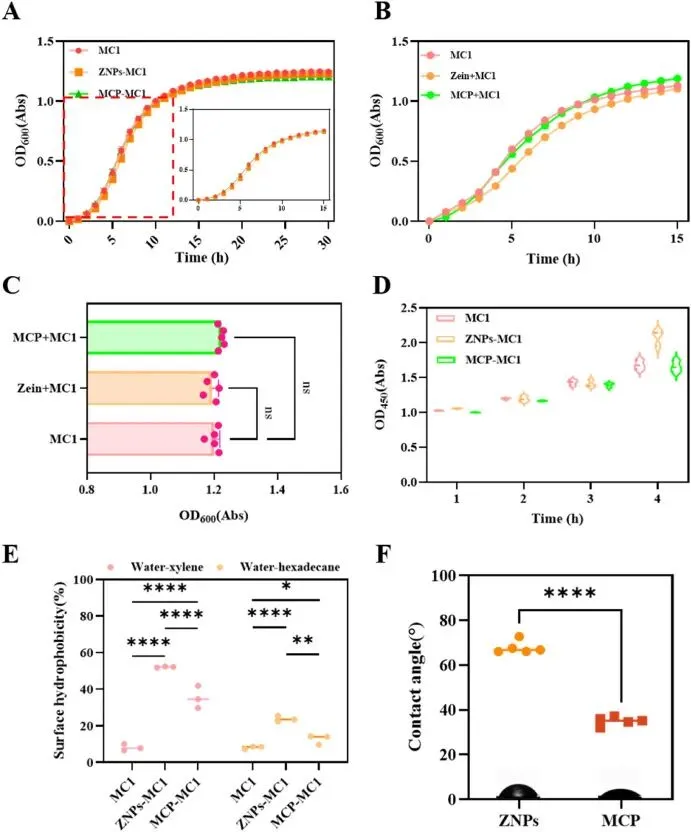
通过静电自组装和 Ca²⁺- 羧基配位策略,分别在 MC1 表面构建了致密的 ZNPs 纳米颗粒层和网状 MCP 涂层,两种涂层均能牢固附着于菌体表面,使益生菌粒径从 1223.29 nm 分别增至 1326.32 nm 和 1488.62 nm,表面电位也发生相应转变。生长曲线和 CCK-8 实验证实,ZNPs 和 MCP 对 MC1 无细胞毒性,不会抑制其代谢活性,甚至可轻微促进菌株增殖。此外,涂层显著提升了 MC1 的表面疏水性,其中 ZNPs 涂层的疏水增强效果更优,为其储存稳定性提升奠定了基础。
2. 两种涂层差异化提升益生菌的多重环境胁迫耐受性
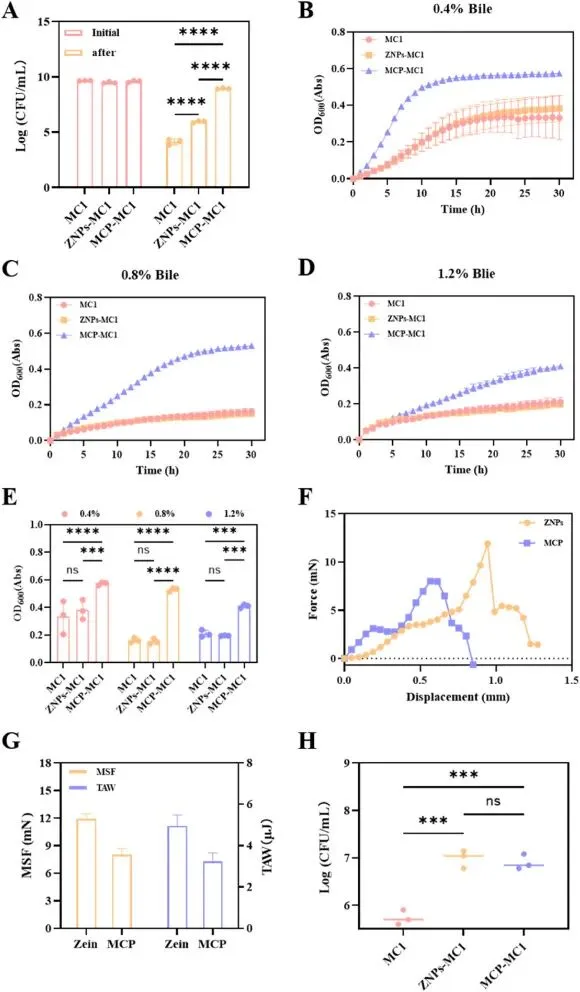
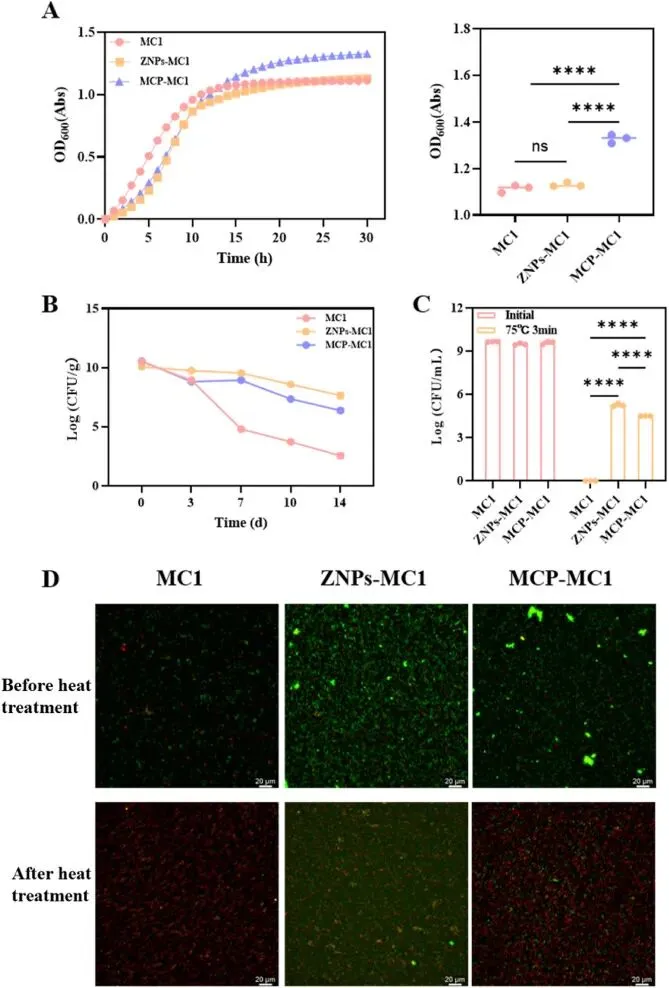
ZNPs 涂层凭借疏水屏障特性,显著增强了 MC1 的热稳定性和储存稳定性:75℃热处理 3 min 后,ZNPs-MC1 活菌数达 10⁵・²⁶ CFU/mL,而未包被 MC1 完全失活;37℃、55% 相对湿度储存 14 天后,ZNPs-MC1 活菌数仍保持 10⁷・⁶³ CFU/g,较未包被组提升 5 个数量级。MCP 涂层则通过羧基的 H⁺缓冲作用和物理屏障效应,大幅提升了 MC1 的耐酸和耐胆盐能力:模拟胃液处理 2 h 后,MCP-MC1 活菌数达 10⁸・⁹⁴ CFU/mL,显著高于 ZNPs-MC1 和未包被组;在 1.2% 胆盐浓度下仍能维持良好生长。同时,两种涂层均通过氢键作用增强了 MC1 与肠道黏液的粘附能力,粘附量较未包被组提升约 10 倍。
3. MCP 包被益生菌作为辅助发酵剂显著优化酸奶品质
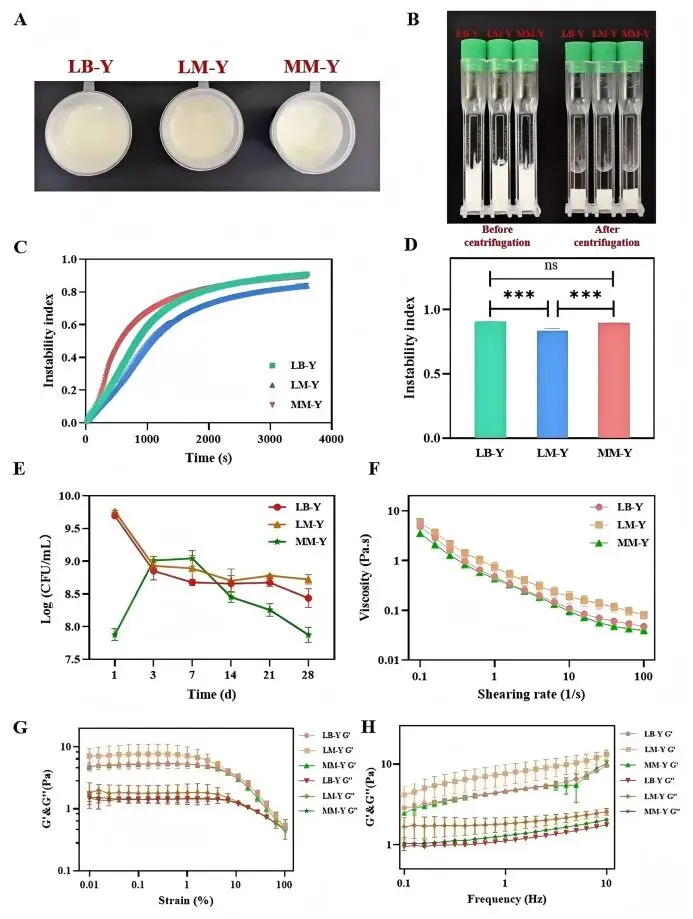
将 MCP-MC1 与商业保加利亚乳杆菌按 2:1 比例共发酵制备酸奶,产品在 28 天储存期内活菌数始终维持在 10⁸・⁷² CFU/mL 以上,显著高于单菌株发酵组。稳定性分析显示,共发酵酸奶的不稳定指数仅为 0.82±0.03,远低于商业菌株单发酵组(0.95±0.02)和 MCP-MC1 单发酵组(0.93±0.04)。流变学测试表明,共发酵酸奶具有更高的表观粘度、储能模量和损耗模量,呈现更优异的剪切变稀行为和类固体特性。机制分析发现,MCP 与菌株分泌的胞外多糖、酪蛋白通过氢键和静电相互作用形成致密的 “MCP-EPS - 酪蛋白” 三维网络,增强了凝胶的持水性和结构稳定性。
4. 阐明了两种纳米涂层的益生菌保护作用机制
ZNPs 涂层的保护机制主要源于其疏水核心形成的水分阻隔层,减少了储存过程中水分对菌体的渗透损伤,同时玉米醇溶蛋白可维持细胞膜脂质流动性,降低热胁迫对细胞膜的破坏。MCP 涂层则通过双重机制发挥作用:一方面,分子链上的大量羧基可缓冲胃酸中的 H⁺,减少质子对菌体的攻击;另一方面,三维网状结构可物理阻挡胆盐和消化酶与菌体的直接接触。此外,两种涂层表面的活性基团均可与肠道黏液中的糖蛋白形成氢键,增强益生菌的肠道定植能力,为其发挥健康功效提供保障。
Fig. 1. Schematic diagram of preparation and application of the probiotic coatings. (A) Schematic diagram of preparation of the ZNPs and the MCP coatings; (B) Protective effect of probiotic coatings in different environments; (C) Schematic diagram of yogurt fermented by MCP-coated probiotics.
Fig. 2. Characterization of probiotic coatings. (A) Homogeneous aqueous suspensions of the MC1, ZNPs-MC1, and MCP-MC1; (B) Changes in zeta potential of probiotics before and after coating; (C) Changes in hydrodynamic diameter of probiotics before and after coating; (D-E) TEM and AFM images of coated probiotics; (F) FTIR spectra of free MC1 and coated MC1.
Fig. 3. Changes in probiotic activity and surface hydrophobicity before and after coating. (A) Growth curves of MC1, ZNPs-MC1, and MCP-MC1; (B) Effects of ZNPs and MCP on the growth activity of MC1; (C) Growth inhibition values of MC1, ZNPs-MC1, and MCP-MC1 at 24 h; (D) Cell viability of MC1, ZNPs-MC1, and MCP-MC1; (E) Surface hydrophobicity of MC1, ZNPs-MC1, and MCP-MC1; (F) Contact angles of ZNPs and MC1.
Fig. 4. Interaction between probiotics and simulated gastrointestinal environment. (A) Survival rates of MC1, ZNPs-MC1, and MCP-MC1 after in vitro simulated gastric fluid treatment; (B-E) Growth curves and 30-h growth comparison of MC1, ZNPs-MC1, and MCP-MC1 under gradient bile salt concentrations; (F) Mucoadhesive curves of ZNPs and MCP on rat intestinal mucosa; (G) Maximum separation force (MSF) and total adhesion work (TAW) of ZNPs and MCP to rat intestinal mucosa; (H) Count of intestinal mucin-adhering bacteria by MC1, ZNPs-MC1 and MCP-MC1.
Fig. 5. Stability of probiotics before and after coating under various conditions. (A) Growth curves and 30-h growth comparison of MC1, ZNPs-MC1, and MCP-MC1 at pH4.5; (B-C) Changes in viable bacterial counts of MC1, ZNPs-MC1 and MCP-MC1 during storage and after heat treatment; (D) Fluorescence microscopy images of MC1, ZNPs-MC1, and MCP-MC1 before and after heat treatment.
Fig. 6. Application and quality evaluation of coated probiotics in yogurt (LB-Y: yogurt fermented with commercial Lactobacillus bulgaricus; LM-Y: co-fermented yogurt with Lactobacillus bulgaricus and MC1; MM-Y: yogurt fermented with MCP-MC1). (A) Appearance of the LB-Y, LM-Y, and MM-Y yogurts; (B) Stratification of the LB-Y, LM-Y, and MM-Y yogurts before and after centrifugation; (C) Dynamic curves of instability index of three yogurts over time; (D) Quantitative comparison of instability index of three yogurts at stable period; (E) Viable count changes of lactic acid bacteria in three yogurts during storage; (F) Apparent viscosity of three yogurts as a function of shearing rate; (H-G) Storage modulus (G′) and loss modulus (G″) of three yogurts as a function of strain and frequency, respectively.
https://doi.org/10.1016/j.foodhyd.2026.112873
免责声明:「原创」仅代表原创编译,水平有限,仅供学术交流,本平台不主张原文的版权,如有侵权,请联系删除。文献解读或作者简历如有疏漏之处,我们深表歉意,请作者团队及时联系《食探未来》主编(微信号:shitanweilai8077),我们会在第一时间进行修改或撤稿重发,感谢您的谅解!