Plant Biotechnology Journal., 03 Apr 2026
Regulatory Mechanism of CsMYB1-CsMYB82/CsbHLH48-CsCAD4 Model for Resistance Against Colletotrichum gloeosporioides in Camellia sinensis
Author
Han R, Wang Y, Xue Z…Ma S, Huang Q, Li X*.
*:College of Horticulture, Nanjing Agricultural University, Nanjing, China.
Abstract
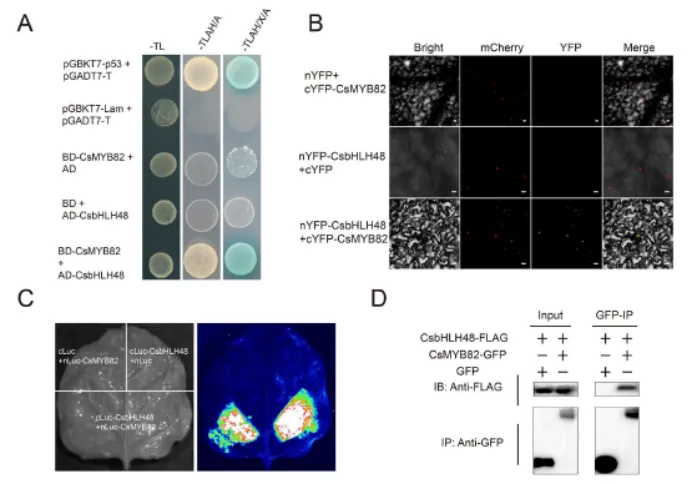
Anthracnose caused by Colletotrichum gloeosporioides is a major threat to tea cultivation; however, the molecular mechanism underlying different resistance among tea cultivars remains unclear. We identified distinct expression patterns of CsMYB82 between anthracnose-resistant and susceptible varieties after infection with anthracnose from previous RNA-seq data. We further investigated the role of CsMYB82 within a lignin-associated regulatory network during anthracnose responses. We found that CsMYB1 negatively regulates CsMYB82 expression by Y1H screen. Additionally, we identified the interaction between CsMYB82 and CsbHLH48 both in vitro and in vivo. DNA-affinity purification sequencing (DAP-seq) revealed that CsMYB82 directly binds to the promoter of CsCAD4, and this binding activity is enhanced in the presence of CsbHLH48. Functional analyses indicated that overexpression of CsMYB82 or CsCAD4 in tobacco and tea leaves was associated with increased susceptibility to anthracnose, whereas transient silencing of CsMYB82 or CsCAD4 via virus-induced gene silencing (VIGS) in tea leaves resulted in reduced disease symptoms accompanied by elevated lignin accumulation. The functional analysis of CsMYB1 showed the opposite phenotype. Collectively, these results suggest that CsMYB82 participates in a transcriptional regulatory module involving CsMYB1, CsbHLH48, and CsCAD4, which modulates lignin biosynthesis and influences anthracnose responses in tea plants. This study provides mechanistic insights into the transcriptional regulation of lignin-associated defence responses and contributes to a better understanding of anthracnose resistance in tea.