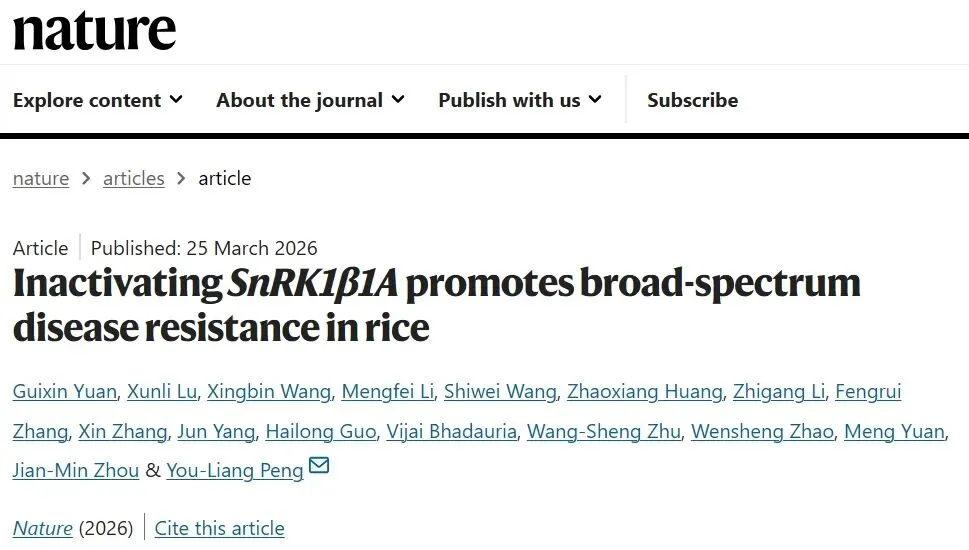
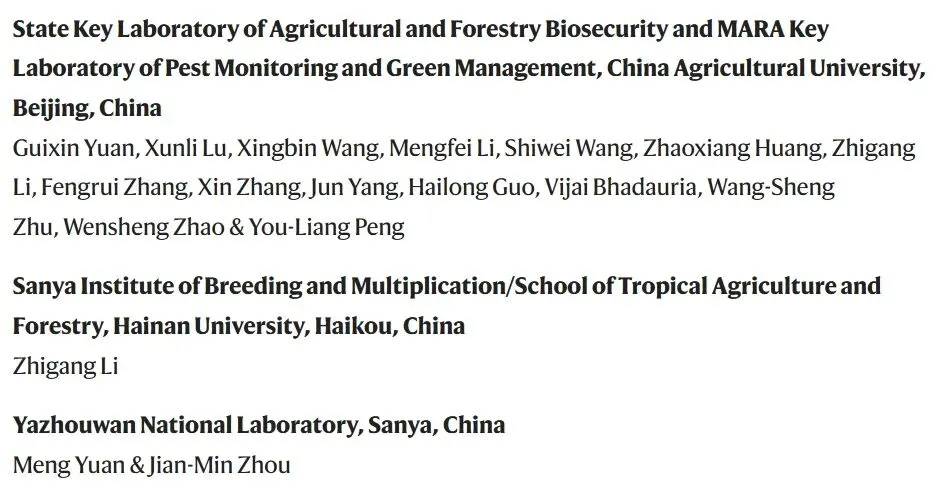
近日,国际顶级期刊《自然》(Nature)刊发了由中国农业大学、海南大学及其相关科研研究所、实验室等17位学者联合发表的论文:Inactivating SnRK1β1A promotes broad-spectrum disease resistance in rice.
来源
标题
Inactivating SnRK1β1A promotes broad-spectrum disease resistance in rice
作者
摘要
Rice is a staple crop for more than half of the world’s population, and its sustainable production is vital to ensure global food security. However, rice is susceptible to several devastating fungal diseases, including blast disease caused by Magnaporthe oryzae, sheath blight by Rhizoctonia solani, false smut by Ustilaginoidea virens, brown spot by Bipolaris oryzae, bakanae by Fusarium fujikuroi and head blight by Fusarium graminearum. The mechanisms underlying the susceptibility to these fungal diseases remain unclear. Here we report that the β subunit of SnRK1, SnRK1β1A, confers broad-spectrum susceptibility to these fungal diseases. Our findings show that diverse rice fungal pathogens have convergently evolved an effector-like protein, Gas2, which interacts with SnRK1β1A to prevent its ubiquitination-mediated degradation and promotes its nuclear translocation. SnRK1β1A is markedly induced on fungal infection, promoting susceptibility by inhibiting SnRK1α1, an α subunit of SnRK1 known to positively regulate broad-spectrum resistance in rice. Notably, rice lines with disrupted SnRK1β1A are resistant to several fungal diseases without compromising growth and yield in the field under normal farming conditions. This study demonstrates that broad-spectrum disease resistance in crops can be achieved by disrupting inducible susceptibility genes whose encoded proteins are targeted by effectors conserved across several pathogens.
连接万千学者,让学术更简单
学国平台小程序
更多前沿文章请登陆:www.xsbg.com



 10个月宝宝每天需要喝多少奶粉?