Anxi Tieguanyin Tea Culture System, China
Tea production in Anxi was first born in the 18th century in southeastern Fujian where the most famous tea is Tieguanyin. Local farmers’ unique traditional practices guarantee the production of exceptional quality tea leaves. These legacies have ensured the long-term stability and sustainability of the ecological systems and communities´ livelihoods.Global importance
As the place of origin of Oolong tea craftsmanship, and as the place where the variety of Tieguanyin tea tree was discovered, Anxi Tieguanyin Tea Culture System is of an evident global importance. Contributions made by Anxi people to the world’s tea industry, include the discovery of famous Tieguanyin, the invention of tea tree short scion cutting techniques, the creation and transmission of Oolong tea-making techniques.
作为乌龙茶制作技艺的发源地,同时也是铁观音茶树品种的发现地,安溪铁观音茶文化系统具有显著的全球意义。安溪人民对世界茶产业的重要贡献包括:发现名茶铁观音、发明茶树短穗扦插繁殖技术,以及乌龙茶制作工艺的创造与传承。
Since Song Dynasty (960~1279 A.D.) and Yuan Dynasty (1206~1368 A.D.), Anxi tea culture has been spread to the world via the Maritime Silk Road. It belongs to and is the symbol of the Oolong Tea—one of the six major categories of Chinese Tea. As a type of semi-fermented tea, Tieguanyin Oolong falls in between the green tea and the black tea. Currently, there are more than 100 varieties of tea trees in Anxi, mainly varieties suitable for Oolong tea making. The richness of tea tree varieties is one of the uniqueness Anxi.
自宋代(公元960—1279年)和元代(公元1206—1368年)起,安溪茶文化便通过海上丝绸之路传播至世界各地。铁观音属于中国六大茶类之一——乌龙茶体系的代表性茶品。作为半发酵茶,铁观音介于绿茶与红茶之间。目前,安溪拥有100多个茶树品种,主要为适宜制作乌龙茶的类型。丰富的茶树品种资源构成了安溪茶产业的重要特色之一。
Around the thirteenth year of the Emperor Chongzhen’s reign (1640 A.D.), Anxi tea farmers were inspired by the fact that the tea tree branches buried accidentally could take root and sprout, therefore they created the Tea Tree Whole-plant Layering Propagation Method. Successively, other multiplication methods were experimented and improved such as the Tea Tree Long-scion Cutting Propagation Method and the Short-scion Cutting Propagation Method. These changes overcame various shortcomings of generative propagation methods that depend on seeds, and the disadvantages of vegetative propagation methods like layering.
大约在明崇祯十三年(公元1640年)前后,安溪茶农受到偶然埋入土中的茶树枝条能够生根发芽这一现象的启发,创造了“茶树全株压条繁殖法”。随后,又相继试验并改进了茶树长穗扦插繁殖法和短穗扦插繁殖法。这些技术创新克服了依赖种子繁殖所带来的不稳定性,也弥补了传统压条等无性繁殖方式的诸多局限,为茶树优良品种的规模化推广奠定了基础。
Food and livelihood security
The most important products of “Anxi Tieguanyin Tea Culture System” are Tieguanyin fresh leaves and the finished tea made of fresh leaves. Over the past few years, Anxi County has actively promoted the development of extended industries of Tieguanyin tea industry with tea-related food products. In 2017, about 66.4% of Anxi population were receiving benefits from tea industry and it accounted for over 90 percent of total per capita income. In addition, the development of tea industry also drives the development of other relevant activities, such as food processing, e-commerce, machinery manufacturing, cultural tourism, and accommodation & catering, etc.
Planted around the Anxi Tieguanyin tea gardens, or intercropped between tea trees, crops (like maize and paddy), tubers (like potato and sweet potato), and oil-yielding crops (like soybean, peanut, and oilseed rape) are providing food and edible oil for locals. Meanwhile, straw and vine of these food crops can serve as not only fodder for livestock and poultry raised by local people, for example, hog, chicken, duck and goose, etc., but also as organic fertilizers under tea trees.
Agrobiodiversity
With a remarkable richness of tea tree varieties, Anxi County is well known as a prominent “treasure house of improved varieties of tea trees”. Currently, there are more than 100 varieties of tea tree, among which 81 local ones. Principal tea varieties in Anxi are Tieguanyin, Huangdan, Benshan, Maoxie, Meizhan and Daye Oolong. Tieguanyin, in particular, is the most representative one accounting for 64 percent of Anxi’s total area of tea gardens.
In addition, Anxi County has a rich agro-biodiversity that consists of crops, animals and microorganisms. In addition to tea trees, food crops, oil crops, vegetables, sugar-yielding crops, green manure crops, and fiber crops and fruit trees are grown. In addition, on Tea Mountains and in Anxi Tieguanyin tea gardens, dozens of edible fungi grow and livestock such as poultry are living. Lastly, freshwater aquatic products, like carp, grass carp, silver carp and white shrimp, are cultured in the ponds and around Anxi Tieguanyin tea gardens.
As a result, these green gardens form a stable ecosystem with strong regulation and control capabilities. Intercropping and relay-cropping approaches, such as tea-fruit symbiosis and tea-grass symbiosis, maintain rich habitat diversity within the tea gardens, turning them into important habitats for plants, animals and microorganisms. It comes along with a biodiversity network with stable structure and rich diversity that can better sustain and protect the biodiversity of the tea gardens.
Local and traditional knowledge systems
Anxi tea traditional knowledge mainly consists of tea trees cultivation, multiplication and tea leaves transformation. Tea cultivation starts with Tea Garden Site Selection and Construction.
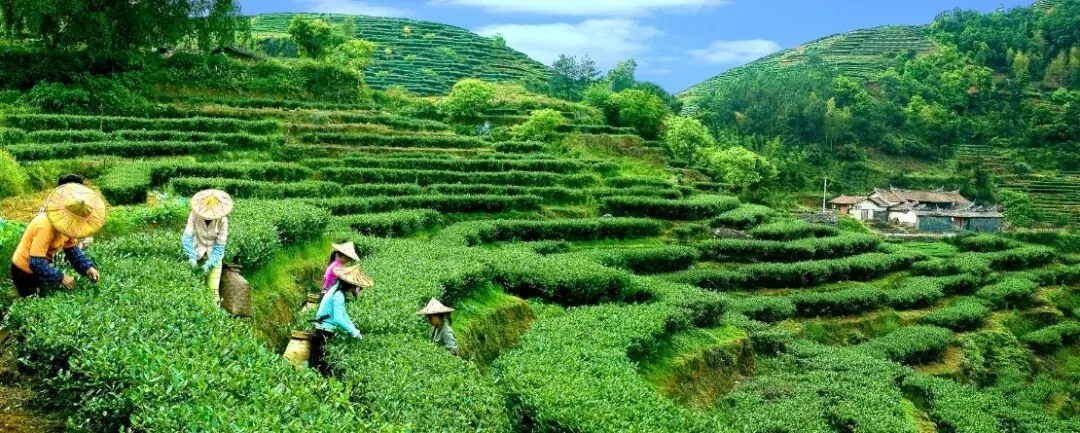
Indeed, site selection of tea gardens has immediate impact on the quality and output capacity of Tieguanyin tea. Usually, tea gardens should be located in mountainous areas with specific soil conditions and water availability. Anxi tea farmers have created water drainage and conservancy systems. Flood control and water drainage system consists of isolated canals on upward side of tea gardens, and drainage ditches surrounding tea gardens. After garden land preparation, shelter forest and alley trees are planted on hilltop, in upwind inlet areas, or alongside roads. At the same time, tea gardens are divided, according to terrains and topography, into several plots surrounded by planted shelter forests.
Anxi County is the birthplace of tea tree vegetative propagation techniques in China. “Tea tree whole-branch layering propagation method” was first developed. Lately, tea farmers progressively created “Tea tree long-scion cutting propagation method”, based on “Tea tree whole-branch layering propagation method” and “Tea tree short-scion cuttage techniques”.
In Anxi, tea farmers have created, according to tea-making principles of completely-fermented black tea and non-fermented green tea, a complete set of process for “semi-fermented” Oolong Tea making. Taking factors like season, climate, variety, and maturity of fresh leaves into consideration, this process seeks to have the optimal quality of tealeaves. It consists of two processing stages: primary processing and refinement processing.
Culture, local values and social organizations
Anxi Tieguanyin tea culture has exerted significant influence on the evolution of the agricultural society in Anxi region, and further on the Fujian Business Culture, regional culture, religious belief, living custom, literature, and art. It has contributed to shaping cultural customs and the spirit of chadao (literally The Tao of Tea, or Tea-ism, referring to an artistic, ceremonial way of tea making, tea drinking, and relevant rituals) that are continuously evolving.
Tea Battle, also known as mingzhan, diǎncha, diǎnshi in ancient time, date back to late Tang Dynasty (618~907 AD). Emergence of Tea Battle implied that the custom of tea drinking was refined and purified artistically. In Anxi, with the development of Oolong tea and the creation of Tieguanyin Tea, tea farmers needed a way to communicate with, learn, and even compete with each other about tea-making techniques. Thereby, Tea Battle has gradually evolved into the form of tealeaves quality competition, a prototype of Anxi Tieguanyin Tea King Contest.
Landscapes features
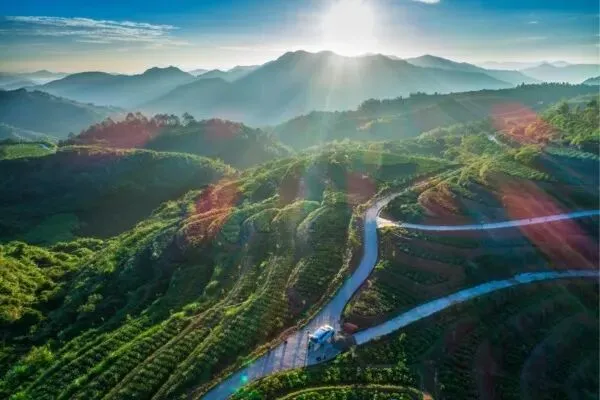
Based on the climate type and the microclimate conditions in the mountain area, Anxi people plant hilltop head-water forests, construct villages and tea gardens on hillside, and reclaim farmland and build villages in the foothills. Combined with the rivers at the lowest altitude, a top-down spatial pattern of “Head-water Forests—Tea Gardens and Villages—Farmland and Villages—Rivers” has been formed through time. This spatial pattern provides both important landscape value and diversified ecological functions to the system.
Besides, during its time-honored history, Anxi people has formed landscapes related to tea culture with unique tea-making workshops and tea-culture-related ancient buildings. For example, Temple of Chachan (literally A Temple of Tea and Zen) in Xiping Town, and architecture landscape with old houses that have been closely related to tea trade, such as Rizhai (literally Village of the Sun) and Yuezhai (literally Village of the Moon). All these constitute a complete human landscape of tea culture and ancient buildings in a mountainous area.